Year 1 Pure · Chapter 6
Polynomials and Algebraic Methods
Specification: Edexcel Pure 2 — Algebra and functions · AQA section B
In this chapter
Key facts — this chapter
- A polynomial is a sum of whole-number powers of ; its degree is the highest power.
- Polynomial division has two standard write-ups: long division and the grid (box) method — they always agree, so use whichever you find clearer.
- Factor theorem: if then is a factor of — and the reverse holds too.
- Remainder theorem: dividing by leaves remainder .
- To factorise a cubic: find one root by trial (factor theorem), divide it out, then factorise the quadratic left behind.
- A factorised polynomial crosses the -axis at each single root and touches at a repeated one.
Quadratics you can crack with the formula. Cubics and beyond have no friendly formula — so we factorise them, and the key that unlocks the first factor is the factor theorem. This chapter is the toolkit for taking a cubic apart.
1. Dividing polynomials
Dividing one polynomial by another is the engine of this chapter. There are two ways to lay the work out — long division and the grid method. They give the same answer every time; learn both and use whichever you trust under pressure.
Method 1 — long division
This mirrors the long division of numbers you met years ago: divide, multiply, subtract, bring down, repeat.
Worked example 6.1 · Long division
Divide by .
Set it out like a long division, keeping like powers in the same column. Each step, divide the leading term to get the next part of the quotient (written on top), write the multiple of underneath, and subtract — the working down the right shows exactly what each row is:
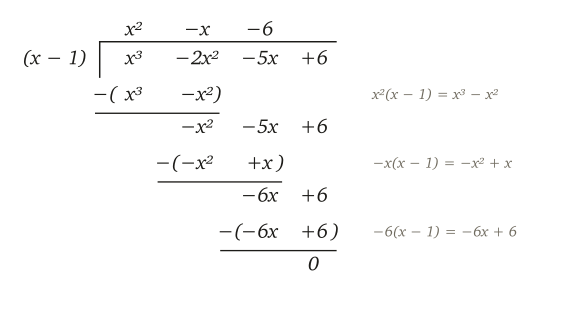
So (subtract ), then (subtract ), then (subtract ) — nothing left. The quotient sits along the top and the remainder is :
Common mistake
Keep a slot for every power, even missing ones. Dividing , write it as — the invisible keeps your columns lined up. Skipping it is the most common division error.
Method 2 — the grid method
Here you fill a multiplication grid. The divisor goes down the left, the quotient sits along the top (the part you’re finding), and you fill each cell so that the columns add up to the polynomial you started with.
Worked example 6.2 · The grid method
Divide by using a grid.
-
Set up the grid with down the left and the quotient (to be found) along the top. Fill it so each column matches a term of the dividend, working left to right:
-
Read the columns against :
- column: ✓ — so the first quotient term is .
- column: ✓ — the next term is .
- column: ✓ — the last term is .
- constant: ✓.
The quotient is the top row: — exactly what long division gave.
Why it works
The grid is just the expansion of laid out in a table: every cell is one product, and adding the cells down each column collects the like terms. Matching those column totals to the original polynomial is the same as saying the factors multiply back to it.
The grid copes just as happily with a non-monic divisor like — put and down the left and fill in the same way.
2. The factor and remainder theorems
Division is the workhorse, but there’s a shortcut for the question “is a factor?” — you don’t need to divide at all.
The remainder and factor theorems
When is divided by , the remainder is exactly .
So if , the remainder is zero and is a factor. This is the factor theorem, and it runs both ways:
Why it works
Write the division as , where is the (constant) remainder. Substituting kills the first term — — leaving . So the remainder is , and it vanishes exactly when divides cleanly.
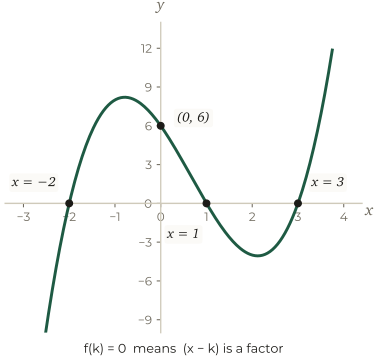
Try a value of k. The probe lands on the curve at (k, f(k)) — and the moment f(k) hits zero, the curve crosses the axis and (x − k) is a factor.
testing f(x) = x³ − 2x² − 5x + 6 · roots at −2, 1 and 3
Worked example 6.3 · Testing for factors
Show that is a factor of , but is not.
-
Evaluate :
Since , is a factor.
-
Evaluate :
Since , is not a factor (dividing by it would leave remainder ).
3. Factorising a cubic fully
Now combine the two tools. The factor theorem finds you a way in; division does the rest.
The method
- Find one root by trying small values (, and factors of the constant term) until .
- Divide by — long division or grid — to get a quadratic.
- Factorise the quadratic the usual way.
Worked example 6.4 · Factorising a cubic
Factorise completely.
-
Try small values. , so is a factor.
-
Divide by — by either method above:
-
Factorise the quadratic: .
So the full factorisation is
Common mistake
When hunting for the first root, only whole-number factors of the constant term can be integer roots. For , the constant is , so try — not, say, . It saves a lot of blind guessing.
4. Sketching the factorised cubic
Once factorised, the cubic sketches itself — the same crossing/touching rule from Using Graphs, now powered by the factor theorem.
Key result
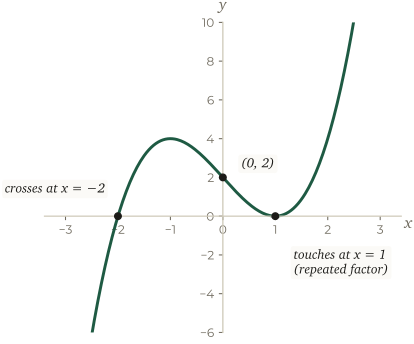
- A single factor like gives a clean crossing at .
- A repeated factor like gives a touch — the curve meets the axis and turns back, as at a vertex.
- The -intercept is ; the highest power decides the far-left and far-right behaviour.
Worked example 6.5 · Sketching from factors
Sketch , marking where it meets the axes.
-
Roots from the factors: (single — a crossing) and (repeated — a touch).
-
-intercept at :
-
Expanding would begin with , so the curve rises from the bottom-left and climbs to the top-right.
-
Join them up: up through , over a hump past , down to just touch the axis at , then away to the top right.
Practice
Twelve questions in three tiers. Try each one properly before opening the solution — the solutions show full method, not just answers.
Warm-up
Given , evaluate:
State which, if either, of and is a factor.
Show solution
(a) .
(b) .
Both are zero, so by the factor theorem both and are factors.
Divide by .
Show solution
-
. Multiply: . Subtract: .
-
Bring down . . Multiply: . Subtract: .
The quotient is , remainder : .
The polynomial is divided by . Use the remainder theorem to find the remainder.
Show solution
The remainder is :
A cubic is fully factorised as . Write down its three roots and its -intercept.
Show solution
Roots where each factor is zero: , , .
-intercept at : , so .
Standard
Divide by .
Show solution
-
. Multiply: . Subtract: .
-
Bring down . . Multiply: . Subtract: .
-
Bring down . . Multiply: . Subtract: .
Quotient , remainder :
Factorise completely.
Show solution
-
Try factors of . , so is a factor.
-
Divide: .
-
Factorise the quadratic: .
Factorise completely.
Show solution
-
From Question 5, is a factor and .
-
Factorise the quadratic: .
(Roots .)
Sketch the curve , marking the points where it meets the axes.
Show solution
-
Roots: is repeated (a touch), is single (a crossing).
-
-intercept at : , so .
-
Positive leading term: rises from bottom-left to top-right.
-
The curve comes up through , over to , down to touch the axis at , then back up.
The polynomial has as a factor. Find the value of .
Show solution
By the factor theorem, :
Exam style
- Show that is a factor of . [2]
- Hence factorise completely. [4]
Show solution
(a) , so by the factor theorem is a factor. ✓
(b) Divide by :
Factorise the quadratic: .
The polynomial has factors and . Find the values of and .
Show solution
Both factors mean and .
-
.
-
.
-
Subtract the first from the second: , then .
So , .
- Factorise completely. [3]
- Hence solve . [1]
- Write down the coordinates of the point where crosses the -axis. [1]
Show solution
(a) Try factors of . , so is a factor. Dividing: .
(b) at .
(c) , so the curve crosses the -axis at .