Year 1 Mechanics · Chapter 3
Forces and Motion
Specification: Edexcel Paper 3 §8.1–8.4 — Forces and Newton's laws · AQA section R
In this chapter
Key facts — this chapter
- Newton’s first law: a body stays at rest or moves with constant velocity unless a resultant force acts on it. Forces in equilibrium have resultant zero.
- Newton’s second law: resultant force mass acceleration, , with in N, in kg and in . The acceleration is in the direction of the resultant force.
- Newton’s third law: if pushes or pulls , then pushes or pulls with a force equal in size and opposite in direction.
- Forces given as vectors add component by component, and works with vectors too.
- Connected particles: use the whole system to find , then one body on its own to find the tension (or thrust).
- A light, inextensible string over a smooth pulley has the same tension on both sides, and the particles it joins move with the same speed and the same size of acceleration.
Chapter 2 described motion without asking what causes it. This chapter adds the cause: forces. Newton’s three laws connect the forces on a body to the way it accelerates. With them, and the suvat equations, you can predict the motion of anything from a sledge to a lift to two masses over a pulley.
1. Force diagrams and Newton’s first law
Every problem starts with a force diagram: one body, every force acting on it, each drawn as an arrow in the right direction and labelled. Chapter 1 met the types: weight, normal reaction, tension, thrust and resistances. Draw the acceleration separately, with a different kind of arrow, so it is never mistaken for a force.
Newton's first law
A body remains at rest, or moves with constant velocity, unless a resultant force acts on it.
So if a body is at rest or moving at constant velocity, the forces on it are in equilibrium: they balance in every direction.
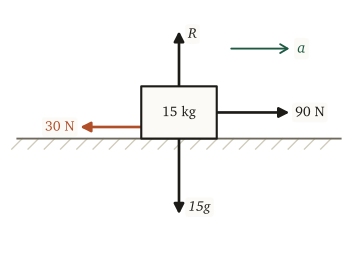
The box in the diagram does not move up or down, so the vertical forces balance: . Horizontally they don’t balance, and that is what the second law is for.
2. Newton’s second law
Newton's second law
where is the resultant force (in N) in the direction of the acceleration, is the mass (in kg) and is the acceleration (in ). This is where the unit comes from: is the force that gives an acceleration of .
The routine is always the same. Draw the force diagram. Choose the direction of the acceleration as positive. Then write
Worked example 3.1 · A box pulled along a floor
The 15 kg box in the diagram is pulled by a horizontal rope with tension 90 N against a constant resistance of 30 N. It starts from rest. Find its acceleration, and its speed after 3 s.
Resolving horizontally, with the direction of motion positive:
The acceleration is constant, so suvat applies: .
In context
The box accelerates at and is moving at after 3 s.
Lifts
A person standing in a lift feels the floor push up on them with the normal reaction . When the lift accelerates, is no longer equal to their weight, which is why your stomach lurches.
Worked example 3.2 · Standing in a lift
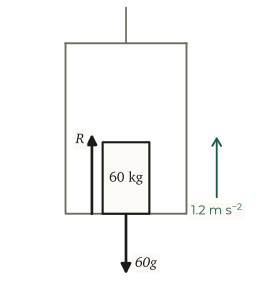
A woman of mass 60 kg stands in a lift. Find the normal reaction from the floor when the lift (a) accelerates upwards at , (b) accelerates downwards at , and (c) moves at constant speed.
(a) Up is positive: , so .
(b) Down is positive: , so .
(c) No acceleration, so the forces balance: .
In context
She presses harder on the floor (660 N) when the lift speeds up going up, and less (516 N) when it speeds up going down. That’s why you feel heavier and lighter.
Common mistake
The "" side is not a force, so never draw on a force diagram. And in is the resultant force, not any single force: subtract the ones acting against the acceleration.
3. Forces as vectors
When forces are given in , form, add them component by component to get the resultant, exactly as in Chapter 15 of Pure. Newton’s second law then holds as a vector equation:
Key result
The acceleration points the same way as the resultant force, and its size is . Forces are in equilibrium when their vector sum is .
Worked example 3.3 · A resultant as a vector
A particle of mass 2 kg is acted on by the forces and . Find its acceleration as a vector, the size of the acceleration, and the angle it makes with .
Resultant: .
It points 3 right and 4 down, at below .
A particle that starts from rest under a constant force moves in a straight line in the direction of that force. Its velocity after time is : suvat, in vector form.
4. Newton’s third law and connected particles
Newton's third law
When body exerts a force on body , body exerts a force on that is equal in size and opposite in direction.
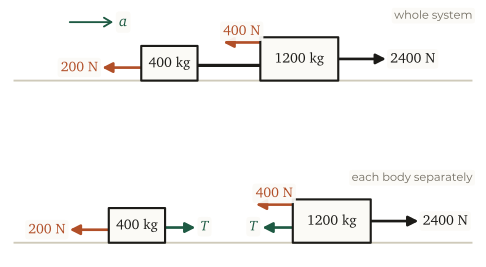
A car towing a trailer is the standard example. The tow bar pulls the trailer forwards with a tension , and by the third law it pulls the car backwards with the same . Treat the car and trailer as one system and those two tensions cancel: they are internal forces. Pull the bodies apart to see them.
The connected-particles routine
- Whole system: use the external forces and the total mass to find .
- One body: write for the simpler body. The internal force (tension or thrust) appears, and you can solve for it.
- Check with the other body.
Worked example 3.4 · Car and trailer
A car of mass 1200 kg tows a trailer of mass 400 kg along a straight horizontal road. The engine produces a driving force of 2400 N. The resistances to motion are 400 N on the car and 200 N on the trailer. The tow bar is light and horizontal. Find the acceleration and the tension in the tow bar.
Whole system (1600 kg):
Trailer only: the tension pulls it forward, the resistance holds it back:
Check with the car: ✓
In context
The car and trailer accelerate at , and the tension in the tow bar is 650 N.
A car tows a trailer. Set the engine force (negative means braking) and the two masses. The whole system gives the acceleration, and the trailer on its own gives the force in the tow bar. Brake hard and watch the tension turn into a thrust.
Tension or thrust?
When the car brakes, the trailer tends to run into it, so the tow bar is squashed and pushes: it is in thrust (compression). The equations don’t change. Solve for as usual, and a negative answer means the force acts the other way: a thrust of that size. A rope can only pull, so it can never be in thrust. That is one reason tow bars exist.
5. Pulleys
Particles joined by a string over a pulley are connected particles too. The string changes direction at the pulley, so write a separate equation for each particle, each in its own direction of motion.
Modelling assumption
The string is light and inextensible: the tension is the same all along it, and both particles have the same speed and the same size of acceleration. The pulley is smooth, so the tension is the same on both sides of it.
Worked example 3.5 · Two particles over a pulley
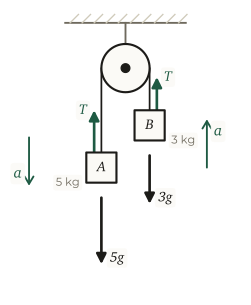
Particles (5 kg) and (3 kg) are joined by a light inextensible string passing over a smooth fixed pulley and released from rest with the string taut. Find the acceleration, the tension in the string and the force the string exerts on the pulley.
is heavier, so it moves down and moves up, each with acceleration .
Adding eliminates : , so . Then , so (3 s.f.).
The string pulls down on the pulley on both sides, with a total force of .
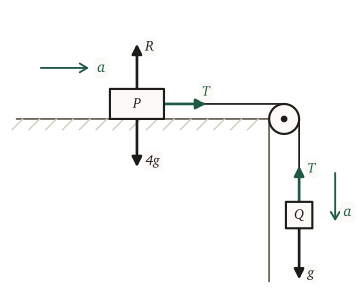
Worked example 3.6 · One on the table, one hanging
In the diagram, has mass 4 kg and rests on a smooth horizontal table. has mass 1 kg. The system is released from rest. Find the acceleration and the tension.
Adding: , so , and .
The hanging weight has to accelerate both masses, in all, which is why is only a fifth of .
Common mistake
Don’t use “whole system” reasoning on a pulley by adding weights that act in different directions. Here the whole-system version only works if you think of the string as straightened out: the driving force is and the total mass is 5 kg. The safe method is always one equation per particle, each in its own direction of motion.
Practice
Twelve questions in three tiers. Try each one properly before opening the solution. The solutions show the full method, not just answers. Take throughout. Strings are light and inextensible and pulleys are smooth unless a question says otherwise.
Warm-up
- A particle of mass 4 kg is acted on by a force of 20 N due east and a force of 8 N due west. Find its acceleration.
- A resultant force of 15 N gives a body an acceleration of . Find its mass.
Show solution
(a) Resultant N east, so due east.
(b) kg.
A crate of mass 12 kg rests on a horizontal floor. Draw a force diagram, find the normal reaction, and explain which of Newton’s laws you used.
Show solution
Two forces act: the weight vertically down and the normal reaction vertically up.
The crate is at rest, so by Newton’s first law the forces are in equilibrium: N, or 118 N (3 s.f.).
Forces and act on a particle of mass 2 kg. Find the resultant force, its magnitude, and the acceleration of the particle as a vector.
Show solution
, with N.
, which has magnitude .
A man of mass 80 kg stands in a lift that is accelerating upwards at . Find the normal reaction between the man and the floor.
Show solution
Up is positive: , so N.
Standard
A box of mass 25 kg is pulled from rest across a horizontal floor by a horizontal rope. The tension in the rope is 120 N and there is a constant resistance of 45 N.
- Find the acceleration of the box.
- Find its speed after 4 s, and the distance it has moved by then.
Show solution
(a) , so .
(b) and m.
A particle is in equilibrium under three forces: , and . Find , its magnitude, and the angle it makes with .
Show solution
In equilibrium the forces sum to :
N (3 s.f.). It points 5 right and 6 down, at below .
A car of mass 1000 kg tows a trailer of mass 500 kg along a straight horizontal road using a light horizontal tow bar. The driving force is 2250 N, and the resistances are 300 N on the car and 150 N on the trailer.
- Find the acceleration.
- Find the tension in the tow bar.
Show solution
(a) Whole system: , so .
(b) Trailer: , so N.
Check with the car: ✓
A particle of mass 3 kg is at rest at the origin when a constant force starts to act on it.
- Find its acceleration.
- Find its velocity and speed after 4 s.
- Find its position vector after 4 s.
Show solution
(a) .
(b) . Its speed is (3 s.f.).
(c) m.
Exam style
Particles (6 kg) and (4 kg) are attached to the ends of a string that passes over a fixed pulley. They hang with the string taut, 2 m above the ground and on the ground, and are released from rest.
- Find the acceleration of the particles and the tension in the string.
- Find the force exerted on the pulley by the string.
- Find the speed of just before it hits the ground.
- When hits the ground it does not rebound, and does not reach the pulley. Find the greatest height of above the ground.
Show solution
(a) (down): . (up): . Adding: , so .
Then , so N (3 s.f.).
(b) N (3 s.f.), vertically downwards.
(c) falls 2 m from rest: , so .
(d) At that moment is 2 m up and rising at . The string goes slack, so now moves freely under gravity. It rises a further where , so m.
In context
reaches a greatest height of m above the ground.
A block of mass 4 kg lies on a rough horizontal table. It is attached by a string, passing over a pulley at the edge of the table, to a particle of mass 3 kg, which hangs freely. The resistance to the motion of is a constant 9.8 N. The system is released from rest.
- Write down an equation of motion for each particle.
- Find the acceleration and the tension.
- State where in your working you used the fact that the string is inextensible.
Show solution
(a) (towards the pulley): . (down): .
(b) Adding: , so . Then N.
(c) In using the same acceleration for both particles.
A lift of mass 500 kg carries a woman of mass 60 kg. The lift is raised by a vertical cable.
- The tension in the cable is 6000 N. Find the acceleration of the lift.
- Find the normal reaction between the woman and the floor during this motion.
- Later, the lift is moving upwards and slowing down at . Find the tension in the cable and the normal reaction on the woman.
Show solution
(a) Lift and woman together (560 kg), up positive: , so (3 s.f.), upwards.
(b) Woman: , so N (3 s.f.).
(c) Now (up positive). Whole: , so N. Woman: N.
In context
While the lift slows on the way up, the cable tension drops to 4650 N (3 s.f.) and the woman feels lighter: the floor pushes up with only 498 N instead of her weight of 588 N.
A car of mass 1200 kg tows a trailer of mass 600 kg using a light rigid tow bar. They are travelling at along a straight horizontal road when the car’s brakes are applied. The braking force on the car is 3000 N, and there are also constant resistances of 400 N on the car and 200 N on the trailer.
- Find the deceleration.
- Find the force in the tow bar, and state whether it is a tension or a thrust.
- Find the distance travelled before the car and trailer stop.
Show solution
(a) Whole system, forwards positive: , so : a deceleration of .
(b) Suppose the tow bar pulls the trailer forwards with tension . Trailer: , so .
The negative sign means the force acts the other way: the bar pushes the trailer backwards with 1000 N. It is a thrust of 1000 N.
(Check with the car: ✓)
(c) , so m.