Year 2 Pure · Chapter 17
Vectors in Three Dimensions
Specification: Edexcel Pure 10.1–10.5 — Vectors · AQA section J1–J5
In this chapter
Key facts — this chapter
- In 3D, , and are unit vectors along the -, - and -axes: .
- The magnitude is , and a unit vector in the same direction is .
- The distance between two points is the magnitude of the vector between them: .
- The angle that makes with the -axis has , and similarly for the other axes.
- Adding, subtracting and scaling work component by component, exactly as in 2D.
Everything from the Year 1 vectors chapter works in three dimensions: a third component joins the other two, and every rule gains a third term. A 3D vector describes a position or a movement in space, such as a drone’s flight path or the corner of a room.
1. Coordinates and vectors in 3D
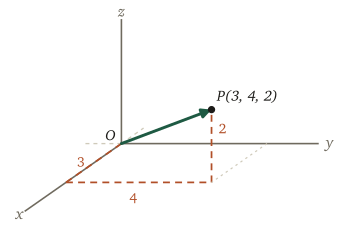
Three axes at right angles meet at the origin . They are arranged so that if the -axis points towards you and the -axis to the right, the -axis points up.
Key result
A point has coordinates . Its position vector is
where , and are unit vectors in the directions of the -, - and -axes.
2. Magnitude and distance
Key result
The distance between and is , where .
Pythagoras twice
In the figure above, the point is from across the flat -plane. is then straight up from it, at right angles to that line, so . The same two steps work for any point.
Worked example 17.1 · Magnitude and unit vector
For , find and a unit vector in the direction of .
Dividing by gives the unit vector .
Worked example 17.2 · Distance between two points
Find the distance between and .
3. The angle with each axis
The component along an axis is the magnitude times the cosine of the angle the vector makes with that axis, just as in 2D.
Key result
If makes angles , and with the positive -, - and -axes, then
Worked example 17.3 · Angles with the axes
Find the angles that makes with the positive -, - and -axes.
From Example 17.1, , so
(all to 1 d.p.). The negative -component gives an obtuse angle with the -axis: the vector points away from it.
Set the components, then drag the picture (or use the turn buttons) to look at the vector from different sides. The dashed path goes x along, y across and z up; the arrow is the position vector, and its length never changes as you turn.
4. Vector arithmetic in 3D
Key result
Add, subtract and multiply by a scalar one component at a time:
Two vectors are parallel when one is a scalar multiple of the other.
Worked example 17.4 · Combining vectors
Given and , find and its magnitude.
Note that has no component: it is .
5. Position vectors and geometric problems
The methods from Year 1 carry straight over: write each side as a vector, then use equal vectors for parallelograms, scalar multiples for parallel lines and collinear points, and magnitudes for lengths.
Worked example 17.5 · Completing a parallelogram
, and are three corners of the parallelogram . Find the coordinates of .
-
In , , so .
-
, so
and is .
Worked example 17.6 · Collinear points
Show that , and lie on a straight line, and find the ratio .
-
and .
-
So and are parallel, and they share the point , so , and are collinear.
-
is twice as long as , so .
Common mistake
Parallel is not enough to prove collinear: two parallel vectors could lie on parallel lines that never meet. Always say that they share a point.
Worked example 17.7 · An unknown component
The vector has magnitude . Find the possible values of .
Practice
Twelve questions in three tiers. Try each one properly before opening the solution — the solutions show full method, not just answers.
Warm-up
Find .
Show solution
.
Find a unit vector in the direction of .
Show solution
The magnitude is , so the unit vector is .
Find the distance between the points and .
Show solution
The vector between them is , so the distance is .
Given and , find .
Show solution
Standard
Find the angles that makes with each of the positive coordinate axes.
Show solution
The magnitude is , so
(all to 1 d.p.).
is and is . Find , the distance and the midpoint of .
Show solution
, so . The midpoint is .
The vector has magnitude . Find the possible values of .
Show solution
So and .
is , is and is . Show that triangle is right-angled and isosceles.
Show solution
, so the triangle is isosceles. , so by the converse of Pythagoras the angle at is a right angle.
Show that , and are collinear, and find the ratio .
Show solution
and . They are parallel and share the point , so , and are collinear, and .
Exam style
, and are three corners of the parallelogram .
- Find the coordinates of . [3]
- Find the exact perimeter of the parallelogram. [3]
Show solution
(a) , and , so . is .
(b) and , so . Opposite sides are equal, so the perimeter is .
is and is . The point lies on with .
- Find the length of . [2]
- Find the coordinates of . [3]
- Find the distance of from the origin. [1]
Show solution
(a) , so .
(b) is a quarter of the way from to :
so is .
(c) .
A drone takes off from a point on flat ground and flies in a straight line to the point , with metres. Here points vertically up.
- Find the distance , to the nearest metre. [2]
- Find the angle between and the vertical, and hence the angle at which the drone climbs above the horizontal. [3]
- The drone then flies at a constant height to , where . Find the distance . [2]
Show solution
(a) m.
(b) , so (1 d.p.) from the vertical, and the drone climbs at above the horizontal.
(c) , so m.