Year 2 Pure · Chapter 9
Reciprocal and Inverse Trigonometric Functions
Specification: Edexcel Pure 5.4, 5.5 — Trigonometry · AQA section E4, E5
In this chapter
Key facts — this chapter
- , and . The third letter tells you which function is underneath.
- Each reciprocal has an asymptote wherever the function underneath is , and is wherever it is .
- and . Both come from dividing .
- , and undo , and on a restricted domain, so each gives one answer.
- Ranges: and lie between and ; lies between and .
Three new functions, and three old ones run backwards. The reciprocal functions tidy up expressions and give two more identities for solving equations. The inverse functions are the buttons on your calculator, and this chapter explains why each gives the answer it does.
1. sec, cosec and cot
Key result
Each is undefined where the function underneath is . Since , you can also write , which works even where is undefined.
To remember which is which, look at the third letter: sec goes with , cosec with , and cot with .
Worked example 9.1 · Exact values
Find the exact values of , and .
Find the function underneath first, then turn it upside down:
2. Their graphs
Turning each height upside down gives the shape of the reciprocal graph. Where , too. As shrinks towards , grows without limit, and where there is an asymptote. A reciprocal always has the same sign as the function underneath.
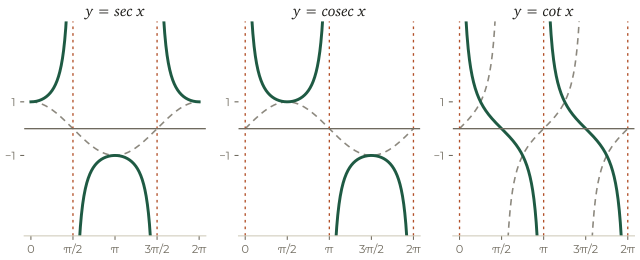
The shapes
- has period and asymptotes at Its values are or .
- has period and asymptotes at Its values are or .
- has period , asymptotes at and crosses the -axis at
The dashed curve is the function underneath; the solid one is its reciprocal. Step x along and watch each height turn upside down: small heights become large ones, and a height of 0 becomes an asymptote.
To solve an equation in , or , turn it into one in , or .
Worked example 9.2 · An equation in cosec
Solve for .
-
means .
-
The related acute angle is . Sine is negative in the third and fourth quadrants, so the solutions are
Worked example 9.3 · A multiple angle
Solve for , giving your answers to 3 significant figures.
-
, and as runs from to , runs from to .
-
The principal value is , and the other value in range is
-
Halve each one: or (3 s.f.).
3. Two more identities
Divide every term of by , or by :
Key result
Worked example 9.4 · Finding one ratio from another
Given that and , find the exact value of .
-
, so .
-
is in the third quadrant, where is negative, and has the same sign. So .
Worked example 9.5 · A quadratic in sec
Solve for , giving your answers to 3 significant figures where they aren’t exact.
-
Replace with , so that only is left:
-
means , so .
-
means . The principal value is , and the other is So , or (3 s.f.).
Worked example 9.6 · Proving an identity
Prove that .
Start from the left-hand side and write everything in and :
Common mistake
is not . The in means the inverse function, which is , not the reciprocal. So , but .
4. The inverse functions
has infinitely many solutions, so can’t be undone as it stands: an inverse function needs a one-to-one function (Chapter 3). The fix is to restrict the domain to one piece of the graph that takes every value once. The inverse of that piece is , written on your calculator.
Key result
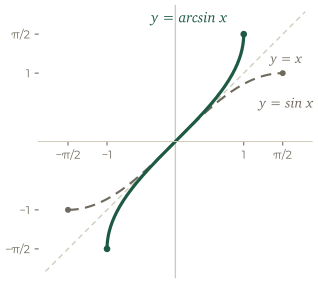
As with any inverse function, each graph is the reflection of the restricted function in the line . uses the piece of from to , and the piece of between its asymptotes at , which become horizontal asymptotes of .
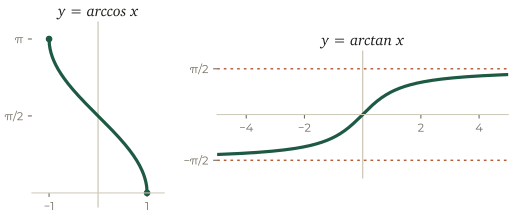
Worked example 9.7 · Exact inverse values
Find the exact values of , and .
Each answer must lie in the function’s range:
gives a negative angle for a negative input. can’t, because its range is to , so the answer is in the second quadrant instead.
Worked example 9.8 · A function of an inverse
Given that , show that .
-
means , with .
-
, so .
-
Cosine is never negative for , so take the positive root: .
Common mistake
is only when is in the range of . For example, , not .
Practice
Twelve questions in three tiers. Try each one properly before opening the solution — the solutions show full method, not just answers.
Warm-up
Find the exact values of , and .
Show solution
Find the exact values of , and .
Show solution
Each answer must lie in the function’s range:
For , write down the equations of the asymptotes of , and the set of values it takes.
Show solution
The asymptotes are where : , and .
takes values from to , so takes the values or .
Show that .
Show solution
Standard
Solve for .
Show solution
. The related acute angle is , and cosine is negative in the second and third quadrants:
Given that and , find the exact values of and .
Show solution
, and is negative in the third quadrant, so . Then
Prove that .
Show solution
and , so
Solve for , giving exact answers.
Show solution
Use , so that only is left:
means , so . means , so or . So .
Find the exact values of
- [2]
- [2]
Show solution
(a) Let , so with , where cosine is not negative. So .
(b) Let , so with , where sine is not negative. So and
Exam style
Solve for . Give exact answers where you can, and the others to 3 significant figures.
Show solution
Use :
- gives or .
- gives or
So .
- Describe the graph of , giving its domain, its range and the coordinates of its end points. [3]
- Solve . [1]
- Prove that for . [3]
Show solution
(a) The domain is and the range is . The graph falls from through to .
(b) .
(c) Let , so with . Then , and , which is the range of . So
which rearranges to .
- Prove that . [2]
- Given that , find the exact values of , and . [4]
- Hence find for , to 3 significant figures. [2]
Show solution
(a) Multiplying out gives the difference of two squares: , using .
(b) From (a), . Adding and subtracting the two equations:
So , which gives , and .
(c) and are both positive, so is in the first quadrant only: (3 s.f.).