Year 2 Pure · Chapter 8
Radians
Specification: Edexcel Pure 5.1–5.3 — Trigonometry · AQA section E1, E2, E3
In this chapter
Key facts — this chapter
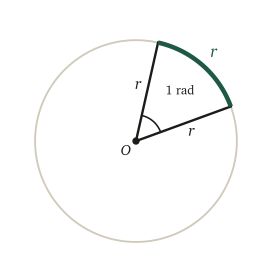
- One radian is the angle at the centre of a circle when the arc is as long as the radius. radians .
- To convert, multiply degrees by , or radians by .
- In radians, and have period , and has period . Set your calculator to radians.
- For a sector of radius and angle radians: arc length and area .
- A segment has area : the sector minus the triangle.
- For small in radians: , and .
There is nothing special about degrees in a full turn: it’s a choice made thousands of years ago. Radians measure an angle by the circle itself, so the formulas for arcs and sectors lose their stray factors. From this chapter on, angles are in radians unless a question gives them in degrees.
1. Measuring angles in radians
Key result
An angle of one radian is the angle at the centre of a circle when the arc it cuts off is exactly one radius long.
A full circle has circumference , which is radii, so a full turn is radians and half a turn is radians:
One radian is .
To change degrees into radians, multiply by . To change radians into degrees, multiply by . The common angles are simple fractions of , so learn them both ways.
Angles to know
The rest follow from these and : , , , and .
Worked example 8.1 · Converting
Convert to radians, and and radians to degrees.
An angle in radians is often written with no unit at all: an angle of means radians. Some books write or rad.
Common mistake
Check your calculator’s angle mode before every trig calculation. In radian mode, , because the calculator reads as radians, which is nearly five full turns.
2. Exact values, graphs and equations in radians
Everything from Year 1 carries over; only the labels change. The exact values are the same numbers at the same angles:
Exact values in radians
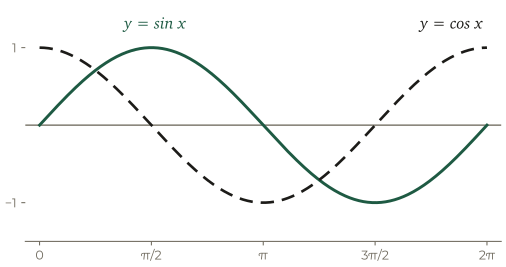
The graphs have the same shapes, with the axis now marked in multiples of . and repeat every . repeats every , with asymptotes at The symmetries you used in degrees become
Worked example 8.2 · Exact values past a right angle
Find the exact values of and .
-
is in the third quadrant, where sine is negative:
-
is in the fourth quadrant, where cosine is positive:
Worked example 8.3 · A multiple angle in radians
Solve for .
-
As runs from to , runs from to . Solve in this wider interval.
-
The principal value is , and sine is also positive at . Adding to each gives the rest:
-
Halve each one:
This is Year 1’s Example 9.3 in radians: the answers are , , and again.
Worked example 8.4 · An answer that isn't exact
Solve for , giving your answers to 3 significant figures.
-
, so the principal value is
-
repeats every , so the other solution in range is So or (3 s.f.).
3. Arcs, sectors and segments
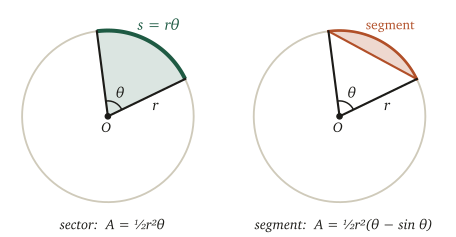
A sector with angle is the fraction of the whole circle. So its arc is that fraction of the circumference, and its area is that fraction of the circle’s area.
Key result
For a sector of radius and angle in radians,
Worked example 8.5 · A sector
A sector has radius cm and angle radians. Find its arc length, area and perimeter.
The perimeter is the arc plus two radii: cm.
Worked example 8.6 · Working backwards
A sector has area cm² and perimeter cm. Find the possible values of its radius and angle .
-
The two facts give two equations:
-
From the second, . Substitute into the first, written as :
-
If , then and . If , then and . Both angles are less than , so both sectors exist.
Change the angle and the radius and watch the arc and the area. In radians the angle is simply how many radii long the arc is. Switch to small angles to see sin θ, θ and tan θ close up.
A chord cuts a circle into two segments. The minor segment is what’s left of the sector when you take away the triangle made by the two radii and the chord. The triangle has area .
Key result
The segment cut off by a chord that makes angle at the centre has area
Worked example 8.7 · A segment
A chord of a circle of radius cm makes an angle of at the centre. Find the exact area of the minor segment, and give it to 3 significant figures.
Common mistake
The formulas and only work with in radians. If a question gives the angle in degrees, convert it first.
4. Small-angle approximations
When is small and in radians, , and itself are almost equal, and is almost .
Key result
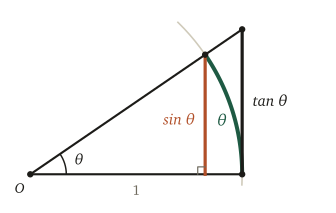
For small , measured in radians,
Where the approximations come from
On a circle of radius , the arc has length . The height of its end above the first radius is , which is a little shorter. The tangent at the start, cut off by the second radius, has length , which is a little longer. So , and as shrinks the three lengths close up.
For cosine, use . Then the binomial series from Chapter 7 gives .
Worked example 8.8 · Simplifying an expression
Show that, when is small, .
-
Replace each function, keeping the whole angle together: , and .
-
Substitute and simplify:
Common mistake
Square the whole angle in the cosine approximation: , not .
Worked example 8.9 · How good are they?
Compare each approximation with the true value when , and find the percentage errors.
| Value | Estimate | Error | |
|---|---|---|---|
Each error is the difference as a percentage of the true value, for example . All three are good, and the cosine one is far better, because its first missing term is a term.
Practice
Twelve questions in three tiers. Try each one properly before opening the solution — the solutions show full method, not just answers.
Warm-up
- Convert to radians, as an exact multiple of . [1]
- Convert radians to degrees. [1]
- Convert radians to degrees, to 1 decimal place. [1]
Show solution
(a) .
(b) .
(c) (1 d.p.).
- Find the exact values of , and . [3]
- State the period of , in radians. [1]
Show solution
(a) Each is the related acute angle’s value, with the sign of its quadrant:
(b) has period , so has period .
A sector has radius cm and angle radians. Find its arc length, its area and its perimeter.
Show solution
The perimeter is cm.
Find the approximate value of when is small.
Show solution
and , so
Standard
Solve for , giving your answers to 3 significant figures.
Show solution
The principal value is The other solution comes from the symmetry :
So or (3 s.f.).
Solve for , giving exact answers.
Show solution
Don’t divide by : that would lose the solutions where . Factorise instead:
- gives .
- gives .
So .
A sector of a circle of radius cm has area cm². Find the angle of the sector and its perimeter.
Show solution
, so and radians.
The arc is cm, so the perimeter is cm.
A sector of a circle has radius cm and perimeter cm.
- Show that the area of the sector is . [3]
- Find the largest possible area, and the angle of the sector when the area is largest. [2]
Show solution
(a) The perimeter is , so . Then
(b) Complete the square: . So the largest area is cm², when . Then , so radians.
- Show that, when is small, . [3]
- Find the value of the expression when , to 4 decimal places, and the percentage error in the approximation. [2]
Show solution
(a) and , so
(b) In radian mode, the expression is (4 d.p.) when . The percentage error is
to 1 significant figure.
Exam style
From a point on level ground m from the foot of a tall building, the angle of elevation of the top of the building is radians.
- Use a small-angle approximation to estimate the height of the building. [2]
- Find the height to 5 significant figures, and the percentage error in your estimate. [3]
- A second building, also m away, has an angle of elevation of radians. Explain why the same method would be much less reliable for it. [2]
Show solution
(a) The height is . For small angles , so m.
(b) m (5 s.f.). The percentage error is
to 1 significant figure.
(c) The approximation only works when is small. At radians, , so the estimate m is about below the true height of m.
Solve for , giving exact answers.
Show solution
Use to get an equation in only:
gives and , and gives . So .
A sector of a circle with centre has area cm² and arc length cm.
- Find the radius of the circle and the angle . [3]
- Find the area of the segment between the chord and the arc, to 3 significant figures. [3]
- Find the perimeter of the segment, to 3 significant figures. [3]
Show solution
(a) and . Writing the area as gives , so cm and radians.
(b)
(c) Find the chord with the cosine rule:
The perimeter is the arc plus the chord: cm (3 s.f.).