Year 2 Pure · Chapter 2

Algebraic Fractions and Partial Fractions

Specification: Edexcel Pure 2.6, 2.10 — Algebra and functions  ·  AQA section B6, B10

In this chapter
  1. 1. Simplifying, multiplying and dividing
  2. 2. Adding and subtracting
  3. 3. Partial fractions
  4. 4. Repeated factors
  5. 5. Improper fractions
  6. Practice

Key facts — this chapter

  • Simplify an algebraic fraction by factorising the top and bottom fully, then cancelling common factors, never terms.
  • Multiply by multiplying tops and bottoms (cancel first). Divide by multiplying by the reciprocal.
  • Add or subtract over a common denominator, ideally the lowest common multiple of the denominators.
  • Partial fractions reverse the adding: px+q(x−a)(x−b)≡Ax−a+Bx−b\frac{px + q}{(x - a)(x - b)} \equiv \frac{A}{x - a} + \frac{B}{x - b}.
  • A repeated factor needs a term for each power: Ax−a+B(x−a)2+Cx−b\frac{A}{x - a} + \frac{B}{(x - a)^2} + \frac{C}{x - b}.
  • Find the constants by substituting the roots of the denominator, then comparing coefficients for any left over.
  • If the top’s degree is at least the bottom’s, the fraction is improper: divide first.

Algebraic fractions follow the same rules as number fractions: you cancel common factors, find common denominators, and flip to divide. The new idea in this chapter runs the other way. Partial fractions take one complicated fraction apart into simple ones, and those simple pieces are what the binomial series (Chapter 7) and integration (Chapter 15) can handle.

1. Simplifying, multiplying and dividing

Key result

  1. Factorise the numerator and denominator completely.
  2. Cancel any factor that appears in both.
  3. To multiply, multiply the numerators and the denominators, cancelling first. To divide, multiply by the reciprocal of the second fraction.

Worked example 2.1 · Cancelling a common factor

Simplify x2−9x2+x−6\dfrac{x^2 - 9}{x^2 + x - 6}.


  1. Factorise the top (a difference of two squares) and the bottom:

    x2−9x2+x−6=(x−3)(x+3)(x+3)(x−2)\frac{x^2 - 9}{x^2 + x - 6} = \frac{(x - 3)(x + 3)}{(x + 3)(x - 2)}
  2. Cancel the common factor (x+3)(x + 3):

    =x−3x−2= \frac{x - 3}{x - 2}

Common mistake

Cancel factors, not terms. In x+3x+5\dfrac{x + 3}{x + 5} nothing cancels: the xxs are terms of a sum, not factors of the whole top and bottom. Try x=1x = 1: the fraction is 46\tfrac{4}{6}, not 35\tfrac{3}{5}.

Worked example 2.2 · Dividing fractions

Simplify x2−43x+6÷x−26x\dfrac{x^2 - 4}{3x + 6} \div \dfrac{x - 2}{6x}.


  1. Factorise, and multiply by the reciprocal of the second fraction:

    (x−2)(x+2)3(x+2)×6xx−2\frac{(x - 2)(x + 2)}{3(x + 2)} \times \frac{6x}{x - 2}
  2. Cancel (x−2)(x - 2), (x+2)(x + 2) and the 33 into the 66:

    =2x= 2x

2. Adding and subtracting

Key result

Rewrite each fraction over a common denominator, then combine the numerators:

ab±cd=ad±bcbd\frac{a}{b} \pm \frac{c}{d} = \frac{ad \pm bc}{bd}

If the denominators already share a factor, use their lowest common multiple instead of the product: the working is shorter and the answer needs less cancelling.

Worked example 2.3 · Subtracting two fractions

Write 3x+2−1x−1\dfrac{3}{x + 2} - \dfrac{1}{x - 1} as a single fraction.


  1. The common denominator is (x+2)(x−1)(x + 2)(x - 1):

    3(x−1)(x+2)(x−1)−x+2(x+2)(x−1)\frac{3(x - 1)}{(x + 2)(x - 1)} - \frac{x + 2}{(x + 2)(x - 1)}
  2. Combine the numerators, keeping the bracket on the second one:

    =3x−3−x−2(x+2)(x−1)=2x−5(x+2)(x−1)\begin{aligned} &= \frac{3x - 3 - x - 2}{(x + 2)(x - 1)} \\ &= \frac{2x - 5}{(x + 2)(x - 1)} \end{aligned}

Common mistake

The minus sign applies to the whole second numerator. Writing 3x−3−x+23x - 3 - x + 2 instead of 3x−3−x−23x - 3 - x - 2 is the most common slip in these questions. Put the numerator in a bracket before you expand.

3. Partial fractions

Adding 2x−1+3x+2\dfrac{2}{x - 1} + \dfrac{3}{x + 2} gives 5x+1(x−1)(x+2)\dfrac{5x + 1}{(x - 1)(x + 2)}. Partial fractions run that backwards: given the single fraction, find the simple ones that add up to it.

Partial fractions: distinct linear factors

A proper fraction whose denominator is a product of different linear factors splits into one term for each factor:

px+q(x−a)(x−b)≡Ax−a+Bx−b\frac{px + q}{(x - a)(x - b)} \equiv \frac{A}{x - a} + \frac{B}{x - b}

With three factors there are three terms, Ax−a+Bx−b+Cx−c\dfrac{A}{x - a} + \dfrac{B}{x - b} + \dfrac{C}{x - c}. To find AA and BB, multiply through by the denominator and substitute x=ax = a and x=bx = b in turn: each value makes all but one term vanish.

Worked example 2.4 · Two linear factors

Express 5x+1(x−1)(x+2)\dfrac{5x + 1}{(x - 1)(x + 2)} in partial fractions.


  1. Write down the form:

    5x+1(x−1)(x+2)≡Ax−1+Bx+2\frac{5x + 1}{(x - 1)(x + 2)} \equiv \frac{A}{x - 1} + \frac{B}{x + 2}
  2. Multiply through by (x−1)(x+2)(x - 1)(x + 2):

    5x+1≡A(x+2)+B(x−1)5x + 1 \equiv A(x + 2) + B(x - 1)
  3. Substitute x=1x = 1: 6=3A6 = 3A, so A=2A = 2. Substitute x=−2x = -2: −9=−3B-9 = -3B, so B=3B = 3.

  4. So

    5x+1(x−1)(x+2)≡2x−1+3x+2\frac{5x + 1}{(x - 1)(x + 2)} \equiv \frac{2}{x - 1} + \frac{3}{x + 2}
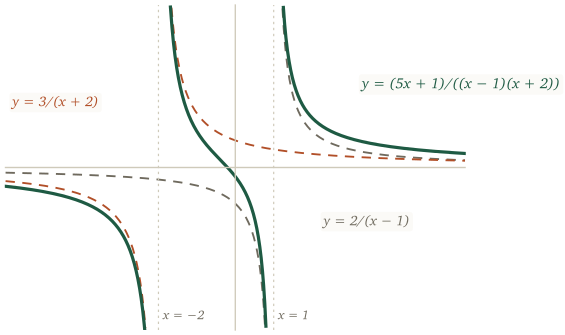
The graph of y = (5x + 1) over (x − 1)(x + 2) drawn solid, with the curves y = 2 over (x − 1) and y = 3 over (x + 2) dashed: near x = 1 the solid curve follows the first, near x = −2 it follows the second
Near x = 1 the curve follows 2/(x − 1); near x = −2 it follows 3/(x + 2).

Why substituting works

The line 5x+1≡A(x+2)+B(x−1)5x + 1 \equiv A(x + 2) + B(x - 1) is an identity: true for every value of xx, so you may choose any value you like. Choosing x=1x = 1 wipes out the BB term, leaving AA on its own. In effect you are covering up the factor (x−1)(x - 1) in the original fraction and putting x=1x = 1 into what is left: A=5(1)+11+2=2A = \dfrac{5(1) + 1}{1 + 2} = 2.

The solid curve is the fraction; the dashed curves are its partial fractions. Step x along: the two dashed heights stack up to exactly the solid one, and near each asymptote one part takes over.

Fraction

4. Repeated factors

A squared factor such as (x−1)2(x - 1)^2 needs two terms, one over (x−1)(x - 1) and one over (x−1)2(x - 1)^2. Leaving out either one makes the split impossible.

Partial fractions: a repeated factor

px2+qx+r(x−a)2(x−b)≡Ax−a+B(x−a)2+Cx−b\begin{aligned} &\frac{px^2 + qx + r}{(x - a)^2(x - b)} \\ &\quad \equiv \frac{A}{x - a} + \frac{B}{(x - a)^2} + \frac{C}{x - b} \end{aligned}

Substituting x=ax = a and x=bx = b finds BB and CC. For AA, compare coefficients, usually of x2x^2.

Worked example 2.5 · A repeated factor

Express 4x2−3x+5(x−1)2(x+2)\dfrac{4x^2 - 3x + 5}{(x - 1)^2(x + 2)} in partial fractions.


  1. Write down the form:

    4x2−3x+5(x−1)2(x+2)≡Ax−1+B(x−1)2+Cx+2\begin{aligned} &\frac{4x^2 - 3x + 5}{(x - 1)^2(x + 2)} \\ &\quad \equiv \frac{A}{x - 1} + \frac{B}{(x - 1)^2} + \frac{C}{x + 2} \end{aligned}

    and multiply through:

    4x2−3x+5≡A(x−1)(x+2)+B(x+2)+C(x−1)2\begin{aligned} &4x^2 - 3x + 5 \\ &\quad \equiv A(x - 1)(x + 2) + B(x + 2) \\ &\qquad + C(x - 1)^2 \end{aligned}
  2. Substitute x=1x = 1: 6=3B6 = 3B, so B=2B = 2. Substitute x=−2x = -2: 27=9C27 = 9C, so C=3C = 3.

  3. Compare the coefficients of x2x^2: 4=A+C4 = A + C, so A=1A = 1.

  4. So

    4x2−3x+5(x−1)2(x+2)≡1x−1+2(x−1)2+3x+2\begin{aligned} &\frac{4x^2 - 3x + 5}{(x - 1)^2(x + 2)} \\ &\quad \equiv \frac{1}{x - 1} + \frac{2}{(x - 1)^2} + \frac{3}{x + 2} \end{aligned}

Common mistake

The x2x^2 coefficient on the right comes from both A(x−1)(x+2)A(x - 1)(x + 2) and C(x−1)2C(x - 1)^2. Forgetting the CC term gives A=4A = 4, which is wrong. Check your answer by putting in a value such as x=0x = 0: both sides here give 52\tfrac{5}{2}.

5. Improper fractions

A fraction is improper when the degree of the numerator is at least the degree of the denominator, like x2+3x+5x+1\dfrac{x^2 + 3x + 5}{x + 1}. Just as 175=3+25\tfrac{17}{5} = 3 + \tfrac{2}{5}, an improper algebraic fraction is a polynomial plus a proper fraction.

Key result

If the degree of f(x)f(x) is at least the degree of g(x)g(x), divide first:

f(x)g(x)=q(x)+r(x)g(x)\frac{f(x)}{g(x)} = q(x) + \frac{r(x)}{g(x)}

where q(x)q(x) is the quotient and r(x)r(x) is the remainder, whose degree is lower than that of g(x)g(x). Then split the proper fraction that is left into partial fractions.

Worked example 2.6 · Dividing first

Express x2+3x+5x+1\dfrac{x^2 + 3x + 5}{x + 1} in the form Ax+B+Cx+1Ax + B + \dfrac{C}{x + 1}.


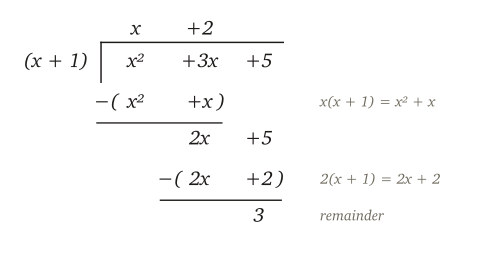
Divide x2+3x+5x^2 + 3x + 5 by (x+1)(x + 1):

Long division of x squared plus 3x plus 5 by (x plus 1): quotient x plus 2 on top; subtracting x(x plus 1) leaves 2x plus 5, then subtracting 2(x plus 1) leaves remainder 3
The quotient x + 2 builds along the top; the remainder is 3.

The quotient is x+2x + 2 and the remainder is 33, so

x2+3x+5x+1=x+2+3x+1\frac{x^2 + 3x + 5}{x + 1} = x + 2 + \frac{3}{x + 1}

Worked example 2.7 · Improper, then partial fractions

Express 3x2−5x+4(x−1)(x−2)\dfrac{3x^2 - 5x + 4}{(x - 1)(x - 2)} in partial fractions.


  1. Both top and bottom have degree 22, so divide first. The denominator is x2−3x+2x^2 - 3x + 2, and taking 33 lots of it from the numerator leaves a linear remainder:

    3x2−5x+4=3(x2−3x+2)+(4x−2)\begin{aligned} 3x^2 - 5x + 4 &= 3(x^2 - 3x + 2) \\ &\quad + (4x - 2) \end{aligned}

    So the fraction is 3+4x−2(x−1)(x−2)3 + \dfrac{4x - 2}{(x - 1)(x - 2)}.

  2. Split the proper part: 4x−2≡A(x−2)+B(x−1)4x - 2 \equiv A(x - 2) + B(x - 1). Put x=2x = 2: B=6B = 6. Put x=1x = 1: 2=−A2 = -A, so A=−2A = -2.

  3. So

    3x2−5x+4(x−1)(x−2)≡3−2x−1+6x−2\begin{aligned} &\frac{3x^2 - 5x + 4}{(x - 1)(x - 2)} \\ &\quad \equiv 3 - \frac{2}{x - 1} + \frac{6}{x - 2} \end{aligned}

Practice

Twelve questions in three tiers. Try each one properly before opening the solution — the solutions show full method, not just answers.

Warm-up

1 [3 marks]

Simplify fully:

  1. x2−16x2+4x\dfrac{x^2 - 16}{x^2 + 4x}
  2. 2x2+5x−34x2−1\dfrac{2x^2 + 5x - 3}{4x^2 - 1}
Show solution

(a)

x2−16x2+4x=(x−4)(x+4)x(x+4)=x−4x\begin{aligned} \frac{x^2 - 16}{x^2 + 4x} &= \frac{(x - 4)(x + 4)}{x(x + 4)} \\ &= \frac{x - 4}{x} \end{aligned}

(b)

2x2+5x−34x2−1=(2x−1)(x+3)(2x−1)(2x+1)=x+32x+1\begin{aligned} \frac{2x^2 + 5x - 3}{4x^2 - 1} &= \frac{(2x - 1)(x + 3)}{(2x - 1)(2x + 1)} \\ &= \frac{x + 3}{2x + 1} \end{aligned}
2 [3 marks]

Write 2x+3+5x−1\dfrac{2}{x + 3} + \dfrac{5}{x - 1} as a single fraction.

Show solution

Over the common denominator (x+3)(x−1)(x + 3)(x - 1):

2(x−1)+5(x+3)(x+3)(x−1)=7x+13(x+3)(x−1)\begin{aligned} &\frac{2(x - 1) + 5(x + 3)}{(x + 3)(x - 1)} \\ &= \frac{7x + 13}{(x + 3)(x - 1)} \end{aligned}
3 [3 marks]

Simplify x2+2xx2−1÷xx+1\dfrac{x^2 + 2x}{x^2 - 1} \div \dfrac{x}{x + 1}.

Show solution

Multiply by the reciprocal and factorise:

x(x+2)(x−1)(x+1)×x+1x\frac{x(x + 2)}{(x - 1)(x + 1)} \times \frac{x + 1}{x}

Cancelling xx and (x+1)(x + 1) leaves x+2x−1\dfrac{x + 2}{x - 1}.

4 [3 marks]

Express 3x+7(x+1)(x+3)\dfrac{3x + 7}{(x + 1)(x + 3)} in partial fractions.

Show solution

3x+7≡A(x+3)+B(x+1)3x + 7 \equiv A(x + 3) + B(x + 1).

Put x=−1x = -1: 4=2A4 = 2A, so A=2A = 2. Put x=−3x = -3: −2=−2B-2 = -2B, so B=1B = 1.

3x+7(x+1)(x+3)≡2x+1+1x+3\frac{3x + 7}{(x + 1)(x + 3)} \equiv \frac{2}{x + 1} + \frac{1}{x + 3}

Standard

5 [4 marks]

Express x−17(2x+1)(x−3)\dfrac{x - 17}{(2x + 1)(x - 3)} in partial fractions.

Show solution

x−17≡A(x−3)+B(2x+1)x - 17 \equiv A(x - 3) + B(2x + 1).

Put x=3x = 3: −14=7B-14 = 7B, so B=−2B = -2.

Put x=−12x = -\tfrac{1}{2}: −352=−72A-\tfrac{35}{2} = -\tfrac{7}{2}A, so A=5A = 5.

x−17(2x+1)(x−3)≡52x+1−2x−3\frac{x - 17}{(2x + 1)(x - 3)} \equiv \frac{5}{2x + 1} - \frac{2}{x - 3}
6 [4 marks]

Express 2x2+5x−4x(x−1)(x+2)\dfrac{2x^2 + 5x - 4}{x(x - 1)(x + 2)} in partial fractions.

Show solution
2x2+5x−4≡A(x−1)(x+2)+Bx(x+2)+Cx(x−1)\begin{aligned} &2x^2 + 5x - 4 \\ &\quad \equiv A(x - 1)(x + 2) + Bx(x + 2) \\ &\qquad + Cx(x - 1) \end{aligned}

Put x=0x = 0: −4=−2A-4 = -2A, so A=2A = 2.

Put x=1x = 1: 3=3B3 = 3B, so B=1B = 1.

Put x=−2x = -2: −6=6C-6 = 6C, so C=−1C = -1.

2x2+5x−4x(x−1)(x+2)≡2x+1x−1−1x+2\begin{aligned} &\frac{2x^2 + 5x - 4}{x(x - 1)(x + 2)} \\ &\quad \equiv \frac{2}{x} + \frac{1}{x - 1} - \frac{1}{x + 2} \end{aligned}
7 [4 marks]

Express 3x2+2x+2(x+1)2(x−2)\dfrac{3x^2 + 2x + 2}{(x + 1)^2(x - 2)} in partial fractions.

Show solution
3x2+2x+2≡A(x+1)(x−2)+B(x−2)+C(x+1)2\begin{aligned} &3x^2 + 2x + 2 \\ &\quad \equiv A(x + 1)(x - 2) + B(x - 2) \\ &\qquad + C(x + 1)^2 \end{aligned}

Put x=−1x = -1: 3=−3B3 = -3B, so B=−1B = -1.

Put x=2x = 2: 18=9C18 = 9C, so C=2C = 2.

Compare the coefficients of x2x^2: 3=A+C3 = A + C, so A=1A = 1.

3x2+2x+2(x+1)2(x−2)≡1x+1−1(x+1)2+2x−2\begin{aligned} &\frac{3x^2 + 2x + 2}{(x + 1)^2(x - 2)} \\ &\quad \equiv \frac{1}{x + 1} - \frac{1}{(x + 1)^2} + \frac{2}{x - 2} \end{aligned}
8 [4 marks]

Express 2x2+3x−1x+2\dfrac{2x^2 + 3x - 1}{x + 2} in the form Ax+B+Cx+2Ax + B + \dfrac{C}{x + 2}.

Show solution

Instead of dividing, you can write the identity the answer must satisfy and compare coefficients:

2x2+3x−1≡(Ax+B)(x+2)+C\begin{aligned} 2x^2 + 3x - 1 &\equiv (Ax + B)(x + 2) \\ &\quad + C \end{aligned}

Put x=−2x = -2: 8−6−1=C8 - 6 - 1 = C, so C=1C = 1.

Compare the coefficients of x2x^2: A=2A = 2.

Compare the constants: −1=2B+C-1 = 2B + C, so B=−1B = -1.

2x2+3x−1x+2=2x−1+1x+2\frac{2x^2 + 3x - 1}{x + 2} = 2x - 1 + \frac{1}{x + 2}
9 [3 marks]

Show that xx2−4−1x+2\dfrac{x}{x^2 - 4} - \dfrac{1}{x + 2} can be written as kx2−4\dfrac{k}{x^2 - 4}, and find the value of kk.

Show solution

x2−4=(x−2)(x+2)x^2 - 4 = (x - 2)(x + 2) already contains (x+2)(x + 2), so it is the common denominator:

x(x−2)(x+2)−x−2(x−2)(x+2)=x−(x−2)x2−4=2x2−4\begin{aligned} &\frac{x}{(x - 2)(x + 2)} - \frac{x - 2}{(x - 2)(x + 2)} \\ &= \frac{x - (x - 2)}{x^2 - 4} = \frac{2}{x^2 - 4} \end{aligned}

So k=2k = 2.

Exam style

10 [6 marks]
f(x)=2x2+2x−3(x+1)(x−2),x>2f(x) = \frac{2x^2 + 2x - 3}{(x + 1)(x - 2)}, \qquad x > 2
  1. Express f(x)f(x) in the form C+Ax+1+Bx−2C + \dfrac{A}{x + 1} + \dfrac{B}{x - 2}, where AA, BB and CC are constants. [4]
  2. Hence explain why f(x)>2f(x) > 2 for all x>2x > 2. [2]
Show solution

(a) The fraction is improper, so divide first. The denominator is x2−x−2x^2 - x - 2, and

2x2+2x−3=2(x2−x−2)+(4x+1)\begin{aligned} 2x^2 + 2x - 3 &= 2(x^2 - x - 2) \\ &\quad + (4x + 1) \end{aligned}

so C=2C = 2. Then 4x+1≡A(x−2)+B(x+1)4x + 1 \equiv A(x - 2) + B(x + 1).

Put x=2x = 2: 9=3B9 = 3B, so B=3B = 3. Put x=−1x = -1: −3=−3A-3 = -3A, so A=1A = 1.

f(x)=2+1x+1+3x−2f(x) = 2 + \frac{1}{x + 1} + \frac{3}{x - 2}

(b) For x>2x > 2, both x+1x + 1 and x−2x - 2 are positive, so 1x+1>0\dfrac{1}{x + 1} > 0 and 3x−2>0\dfrac{3}{x - 2} > 0. Adding two positive terms to 22 gives more than 22.

11 [5 marks]
  1. Express (x−1)2x2(2x+1)\dfrac{(x - 1)^2}{x^2(2x + 1)} in partial fractions. [4]
  2. Check your answer by substituting x=1x = 1 into both sides. [1]
Show solution

(a) The factor x2x^2 is repeated, so

(x−1)2x2(2x+1)≡Ax+Bx2+C2x+1\frac{(x - 1)^2}{x^2(2x + 1)} \equiv \frac{A}{x} + \frac{B}{x^2} + \frac{C}{2x + 1}(x−1)2≡Ax(2x+1)+B(2x+1)+Cx2\begin{aligned} (x - 1)^2 &\equiv Ax(2x + 1) + B(2x + 1) \\ &\quad + Cx^2 \end{aligned}

Put x=0x = 0: 1=B1 = B.

Put x=−12x = -\tfrac{1}{2}: 94=14C\tfrac{9}{4} = \tfrac{1}{4}C, so C=9C = 9.

Compare the coefficients of x2x^2: 1=2A+C1 = 2A + C, so A=−4A = -4.

(x−1)2x2(2x+1)≡−4x+1x2+92x+1\frac{(x - 1)^2}{x^2(2x + 1)} \equiv -\frac{4}{x} + \frac{1}{x^2} + \frac{9}{2x + 1}

(b) At x=1x = 1 the left side is 00, and the right side is −4+1+3=0-4 + 1 + 3 = 0. ✓

12 [7 marks]
  1. Use the factor theorem to show that (x−1)(x - 1) is a factor of x3−7x+6x^3 - 7x + 6, and hence factorise x3−7x+6x^3 - 7x + 6 fully. [3]
  2. Hence express 2x2+11x−25x3−7x+6\dfrac{2x^2 + 11x - 25}{x^3 - 7x + 6} in partial fractions. [4]
Show solution

(a) 13−7(1)+6=01^3 - 7(1) + 6 = 0, so (x−1)(x - 1) is a factor. Write x3−7x+6=(x−1)(x2+bx+c)x^3 - 7x + 6 = (x - 1)(x^2 + bx + c) and compare coefficients: the x2x^2 terms give b−1=0b - 1 = 0, so b=1b = 1, and the constants give −c=6-c = 6, so c=−6c = -6. Then

x3−7x+6=(x−1)(x2+x−6)=(x−1)(x−2)(x+3)\begin{aligned} x^3 - 7x + 6 &= (x - 1)(x^2 + x - 6) \\ &= (x - 1)(x - 2)(x + 3) \end{aligned}

(b)

2x2+11x−25≡A(x−2)(x+3)+B(x−1)(x+3)+C(x−1)(x−2)\begin{aligned} &2x^2 + 11x - 25 \\ &\quad \equiv A(x - 2)(x + 3) \\ &\qquad + B(x - 1)(x + 3) \\ &\qquad + C(x - 1)(x - 2) \end{aligned}

Put x=1x = 1: −12=−4A-12 = -4A, so A=3A = 3.

Put x=2x = 2: 5=5B5 = 5B, so B=1B = 1.

Put x=−3x = -3: −40=20C-40 = 20C, so C=−2C = -2.

2x2+11x−25x3−7x+6≡3x−1+1x−2−2x+3\begin{aligned} &\frac{2x^2 + 11x - 25}{x^3 - 7x + 6} \\ &\quad \equiv \frac{3}{x - 1} + \frac{1}{x - 2} - \frac{2}{x + 3} \end{aligned}