Year 2 Pure · Chapter 11

Parametric Equations

Specification: Edexcel Pure 3.3, 3.4 — Coordinate geometry  ·  AQA section C3, C4

In this chapter
  1. 1. Curves traced by a parameter
  2. 2. Finding the Cartesian equation
  3. 3. Intersections
  4. 4. Modelling with parametric equations
  5. Practice

Key facts — this chapter

  • A parametric curve gives xx and yy separately in terms of a third variable, the parameter, often tt or θ\theta.
  • Each value of the parameter gives one point (x,y)(x, y). As the parameter changes, the point traces the curve.
  • To find the Cartesian equation, eliminate the parameter: make it the subject of one equation and substitute, or use an identity such as sin⁡2t+cos⁡2t≡1\sin^2 t + \cos^2 t \equiv 1.
  • The values xx can take are the range of x(t)x(t), which may restrict the Cartesian curve to only part of its graph.
  • To find where a curve meets a line, substitute x(t)x(t) and y(t)y(t) into the line’s equation and solve for tt.

A ball in flight has a horizontal position and a height, and both change with time. Writing each in terms of time tt describes its path, and says where the ball is at every moment, which an equation linking xx and yy alone can’t do.

1. Curves traced by a parameter

Key result

A parametric curve is given by two equations

x=f(t),y=g(t)x = f(t), \qquad y = g(t)

with the parameter tt taking values in some interval. Each value of tt gives one point on the curve.

Worked example 11.1 · Plotting from a table

Sketch the curve x=t2x = t^2, y=2ty = 2t for −2≤t≤2-2 \le t \le 2.


Work out a point for each of a few values of tt:

tt−2-2−1-1001122
x=t2x = t^24411001144
y=2ty = 2t−4-4−2-2002244

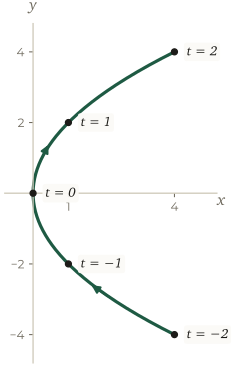
Plot the points in order of tt and join them with a smooth curve. It is a parabola on its side, traced from (4,−4)(4, -4) up to (4,4)(4, 4).

The parabola x = t squared, y = 2t, opening to the right, with the points for t = minus 2, minus 1, 0, 1 and 2 marked and labelled, and arrows showing the direction of increasing t from bottom to top
x = t², y = 2t, traced as t increases from −2 to 2.

Step the parameter t and watch the point (x, y) move. The solid part is the path traced so far; the faint dashed part is still to come.

2. Finding the Cartesian equation

To find an equation linking xx and yy alone, eliminate the parameter.

Worked example 11.2 · Eliminating the parameter

Find the Cartesian equation of the curve x=t+1x = t + 1, y=t2−3y = t^2 - 3, for −2≤t≤2-2 \le t \le 2, and state its domain.


  1. Make tt the subject of the simpler equation: t=x−1t = x - 1.

  2. Substitute into the other:

    y=(x−1)2−3y = (x - 1)^2 - 3
  3. As tt runs from −2-2 to 22, x=t+1x = t + 1 runs from −1-1 to 33. So the curve is only the part of this parabola with −1≤x≤3-1 \le x \le 3.

Worked example 11.3 · A circle

Show that the curve x=2+3cos⁡tx = 2 + 3\cos t, y=−1+3sin⁡ty = -1 + 3\sin t, 0≤t<2π0 \le t < 2\pi, is a circle, and give its centre and radius.


  1. Isolate the trig functions: cos⁡t=x−23\cos t = \tfrac{x - 2}{3} and sin⁡t=y+13\sin t = \tfrac{y + 1}{3}.

  2. Use cos⁡2t+sin⁡2t≡1\cos^2 t + \sin^2 t \equiv 1:

    (x−2)29+(y+1)29=1(x−2)2+(y+1)2=9\begin{aligned} \frac{(x - 2)^2}{9} + \frac{(y + 1)^2}{9} &= 1 \\ (x - 2)^2 + (y + 1)^2 &= 9 \end{aligned}

So it is the circle with centre (2,−1)(2, -1) and radius 33.

Worked example 11.4 · A restricted curve

Find the Cartesian equation of the curve x=sin⁡tx = \sin t, y=cos⁡2ty = \cos 2t, and state the values of xx for which it is defined.


  1. Use the double-angle formula that contains only sin⁡t\sin t:

    y=cos⁡2t=1−2sin⁡2t=1−2x2\begin{aligned} y = \cos 2t &= 1 - 2\sin^2 t \\ &= 1 - 2x^2 \end{aligned}
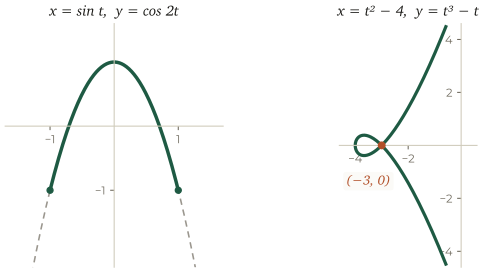
  2. x=sin⁡tx = \sin t can only take values from −1-1 to 11. So the curve is the part of the parabola y=1−2x2y = 1 - 2x^2 with −1≤x≤1-1 \le x \le 1. It is traced backwards and forwards along this arc as tt increases.

Left: the parabola y = 1 minus 2 x squared drawn faintly, with only the arc from x = minus 1 to x = 1 drawn solid, which is the curve x = sin t, y = cos 2t. Right: the curve x = t squared minus 4, y = t cubed minus t, a loop that crosses itself at the point (minus 3, 0)
Left: x = sin t, y = cos 2t is only the arc of y = 1 − 2x² with −1 ≤ x ≤ 1. Right: x = t² − 4, y = t³ − t crosses itself at (−3, 0).

Common mistake

The Cartesian equation can describe more than the curve does. Always check which values xx and yy can take: in Example 11.4, y=1−2x2y = 1 - 2x^2 goes on for ever, but the parametric curve stops at x=±1x = \pm 1.

3. Intersections

To find where a parametric curve meets a line or another curve, substitute x(t)x(t) and y(t)y(t) into the other equation. That gives an equation in tt alone. Solve it, then turn each value of tt back into a point.

Worked example 11.5 · Meeting a line

Find the points where the curve x=t2x = t^2, y=2ty = 2t meets the line y=x−3y = x - 3.


  1. Substitute into the line:

    2t=t2−3t2−2t−3=0(t−3)(t+1)=0\begin{aligned} 2t &= t^2 - 3 \\ t^2 - 2t - 3 &= 0 \\ (t - 3)(t + 1) &= 0 \end{aligned}
  2. t=3t = 3 gives the point (9,6)(9, 6), and t=−1t = -1 gives (1,−2)(1, -2).

Worked example 11.6 · Meeting the axes

The curve CC is x=t2−4x = t^2 - 4, y=t3−ty = t^3 - t. Find where CC meets the coordinate axes.


  1. On the yy-axis, x=0x = 0, so t2=4t^2 = 4 and t=±2t = \pm 2. Then y=8−2=6y = 8 - 2 = 6 or y=−8+2=−6y = -8 + 2 = -6: the points (0,6)(0, 6) and (0,−6)(0, -6).

  2. On the xx-axis, y=0y = 0, so t(t2−1)=0t(t^2 - 1) = 0 and t=0t = 0 or ±1\pm 1. Then t=0t = 0 gives (−4,0)(-4, 0), and both t=1t = 1 and t=−1t = -1 give (−3,0)(-3, 0).

Two values of tt give the same point, so the curve passes through (−3,0)(-3, 0) twice: it crosses itself there, as the figure above shows.

4. Modelling with parametric equations

Worked example 11.7 · A projectile

A ball is kicked from the ground. After tt seconds it is x=20tx = 20t metres along the ground and y=15t−4.9t2y = 15t - 4.9t^2 metres high. Find how far it travels before it lands, its greatest height, and the Cartesian equation of its path.


  1. It lands when y=0y = 0: t(15−4.9t)=0t(15 - 4.9t) = 0, so t=154.9=3.061…t = \tfrac{15}{4.9} = 3.061\ldots It is then x=20×3.061…=61.2x = 20 \times 3.061\ldots = 61.2 m away (3 s.f.).

  2. yy is a quadratic in tt, greatest halfway between its roots, at t=159.8=1.530…t = \tfrac{15}{9.8} = 1.530\ldots:

    y=15×1.530…−4.9×1.530…2=11.5 m (3 s.f.)\begin{aligned} y &= 15 \times 1.530\ldots \\ &\quad - 4.9 \times 1.530\ldots^2 \\ &= 11.5 \text{ m (3 s.f.)} \end{aligned}
  3. t=x20t = \tfrac{x}{20}, so

    y=15×x20−4.9×x2400=0.75x−0.01225x2\begin{aligned} y &= 15 \times \tfrac{x}{20} - 4.9 \times \tfrac{x^2}{400} \\ &= 0.75x - 0.01225x^2 \end{aligned}

    for 0≤x≤61.20 \le x \le 61.2.

Practice

Twelve questions in three tiers. Try each one properly before opening the solution — the solutions show full method, not just answers.

Warm-up

1 [2 marks]

Find the Cartesian equation of the curve x=2t−1x = 2t - 1, y=t2+1y = t^2 + 1.

Show solution

t=x+12t = \tfrac{x + 1}{2}, so

y=(x+12)2+1=(x+1)24+1y = \left(\frac{x + 1}{2}\right)^2 + 1 = \frac{(x + 1)^2}{4} + 1
2 [2 marks]

Describe the curve x=4cos⁡θx = 4\cos\theta, y=4sin⁡θy = 4\sin\theta, 0≤θ<2π0 \le \theta < 2\pi.

Show solution

x2+y2=16cos⁡2θ+16sin⁡2θ=16x^2 + y^2 = 16\cos^2\theta + 16\sin^2\theta = 16, so the curve is the circle with centre (0,0)(0, 0) and radius 44.

3 [2 marks]

A curve is given by x=t3x = t^3, y=t2−1y = t^2 - 1.

  1. Find the point where t=2t = 2. [1]
  2. Find the value of tt at the point (−1,0)(-1, 0). [1]
Show solution

(a) x=8x = 8 and y=3y = 3, so the point is (8,3)(8, 3).

(b) t3=−1t^3 = -1 gives t=−1t = -1, and then y=1−1=0y = 1 - 1 = 0 as required.

4 [2 marks]

Find the Cartesian equation of the curve x=1tx = \tfrac{1}{t}, y=t+1y = t + 1, where t≠0t \ne 0.

Show solution

t=1xt = \tfrac{1}{x}, so y=1x+1y = \tfrac{1}{x} + 1.

Standard

5 [3 marks]

A curve is given by x=3+2cos⁡tx = 3 + 2\cos t, y=−1+2sin⁡ty = -1 + 2\sin t, 0≤t<2π0 \le t < 2\pi. Find its Cartesian equation, and describe the curve.

Show solution

cos⁡t=x−32\cos t = \tfrac{x - 3}{2} and sin⁡t=y+12\sin t = \tfrac{y + 1}{2}. Using cos⁡2t+sin⁡2t≡1\cos^2 t + \sin^2 t \equiv 1:

(x−3)2+(y+1)2=4(x - 3)^2 + (y + 1)^2 = 4

It is the circle with centre (3,−1)(3, -1) and radius 22.

6 [4 marks]

A curve is given by x=cos⁡tx = \cos t, y=sin⁡2ty = \sin 2t. Show that its Cartesian equation is y2=4x2(1−x2)y^2 = 4x^2(1 - x^2).

Show solution

y=sin⁡2t=2sin⁡tcos⁡ty = \sin 2t = 2\sin t\cos t. Squaring removes the sign of sin⁡t\sin t:

y2=4sin⁡2tcos⁡2t=4(1−cos⁡2t)cos⁡2t=4(1−x2)x2\begin{aligned} y^2 &= 4\sin^2 t\cos^2 t \\ &= 4(1 - \cos^2 t)\cos^2 t \\ &= 4(1 - x^2)x^2 \end{aligned}
7 [4 marks]

A curve is given by x=2sin⁡tx = 2\sin t, y=cos⁡2ty = \cos 2t.

  1. Find its Cartesian equation. [2]
  2. State the values that xx and yy can take. [2]
Show solution

(a) cos⁡2t=1−2sin⁡2t\cos 2t = 1 - 2\sin^2 t and sin⁡t=x2\sin t = \tfrac{x}{2}, so

y=1−2×x24=1−x22y = 1 - 2 \times \frac{x^2}{4} = 1 - \frac{x^2}{2}

(b) x=2sin⁡tx = 2\sin t takes values −2≤x≤2-2 \le x \le 2, and y=cos⁡2ty = \cos 2t takes values −1≤y≤1-1 \le y \le 1.

8 [4 marks]

Find the points where the curve x=t2x = t^2, y=t3y = t^3 meets the line y=2xy = 2x.

Show solution

Substitute into the line:

t3=2t2t2(t−2)=0\begin{aligned} t^3 &= 2t^2 \\ t^2(t - 2) &= 0 \end{aligned}

t=0t = 0 gives (0,0)(0, 0), and t=2t = 2 gives (4,8)(4, 8).

9 [4 marks]

Find the coordinates of the points where the curve x=t2−1x = t^2 - 1, y=t(t−2)y = t(t - 2) meets the coordinate axes.

Show solution

On the yy-axis, x=0x = 0, so t=±1t = \pm 1. Then t=1t = 1 gives y=−1y = -1 and t=−1t = -1 gives y=3y = 3: the points (0,−1)(0, -1) and (0,3)(0, 3).

On the xx-axis, y=0y = 0, so t=0t = 0 or t=2t = 2. These give (−1,0)(-1, 0) and (3,0)(3, 0).

Exam style

10 [8 marks]

A ball is thrown from a window. Its position tt seconds later is modelled by x=12tx = 12t and y=1.5+9t−4.9t2y = 1.5 + 9t - 4.9t^2, where xx and yy are in metres, measured along the ground and up from the ground.

  1. State the height from which the ball is thrown. [1]
  2. Find the time at which the ball hits the ground, and how far it has then travelled horizontally, to 3 significant figures. [4]
  3. Find the Cartesian equation of its path. [2]
  4. Give one way in which the model could be improved. [1]
Show solution

(a) When t=0t = 0, y=1.5y = 1.5 m.

(b) It hits the ground when 4.9t2−9t−1.5=04.9t^2 - 9t - 1.5 = 0. By the quadratic formula, taking the positive root:

t=9+81+29.49.8=1.99 s (3 s.f.)\begin{aligned} t &= \frac{9 + \sqrt{81 + 29.4}}{9.8} \\ &= 1.99 \text{ s (3 s.f.)} \end{aligned}

It has then travelled x=12×1.990…=23.9x = 12 \times 1.990\ldots = 23.9 m (3 s.f.).

(c) t=x12t = \tfrac{x}{12}, so

y=1.5+9×x12−4.9×x2144=1.5+0.75x−49x21440\begin{aligned} y &= 1.5 + 9 \times \frac{x}{12} - 4.9 \times \frac{x^2}{144} \\ &= 1.5 + 0.75x - \frac{49x^2}{1440} \end{aligned}

(d) For example, include air resistance, which the model ignores.

11 [6 marks]

A curve is given by x=tan⁡tx = \tan t, y=sec⁡ty = \sec t, for −π2<t<π2-\tfrac{\pi}{2} < t < \tfrac{\pi}{2}.

  1. Show that the Cartesian equation is y=1+x2y = \sqrt{1 + x^2}. [3]
  2. Find the points where the curve meets the line y=2y = 2. [3]
Show solution

(a) sec⁡2t=1+tan⁡2t\sec^2 t = 1 + \tan^2 t, so y2=1+x2y^2 = 1 + x^2. For −π2<t<π2-\tfrac{\pi}{2} < t < \tfrac{\pi}{2}, cos⁡t>0\cos t > 0, so y=sec⁡t>0y = \sec t > 0 and y=1+x2y = \sqrt{1 + x^2}.

(b) sec⁡t=2\sec t = 2 means cos⁡t=12\cos t = \tfrac{1}{2}, so t=±π3t = \pm\tfrac{\pi}{3}. Then x=tan⁡(±π3)=±3x = \tan\left(\pm\tfrac{\pi}{3}\right) = \pm\sqrt3: the points are (3,2)\left(\sqrt3, 2\right) and (−3,2)\left(-\sqrt3, 2\right).

12 [7 marks]

The curve CC is given by x=1+2cos⁡tx = 1 + 2\cos t, y=2+2sin⁡ty = 2 + 2\sin t, 0≤t<2π0 \le t < 2\pi. The line y=x+1y = x + 1 meets CC at AA and BB.

  1. Show that at AA and BB, tan⁡t=1\tan t = 1. [2]
  2. Find the exact coordinates of AA and BB. [3]
  3. Show that ABAB is a diameter of CC, and state its length. [2]
Show solution

(a) Substitute into the line: 2+2sin⁡t=1+2cos⁡t+12 + 2\sin t = 1 + 2\cos t + 1, so sin⁡t=cos⁡t\sin t = \cos t, and dividing by cos⁡t\cos t gives tan⁡t=1\tan t = 1.

(b) t=π4t = \tfrac{\pi}{4} or 5π4\tfrac{5\pi}{4}. With cos⁡π4=sin⁡π4=22\cos\tfrac{\pi}{4} = \sin\tfrac{\pi}{4} = \tfrac{\sqrt2}{2}, the points are (1+2, 2+2)\left(1 + \sqrt2,\ 2 + \sqrt2\right) and (1−2, 2−2)\left(1 - \sqrt2,\ 2 - \sqrt2\right).

(c) CC is the circle with centre (1,2)(1, 2) and radius 22. The midpoint of ABAB is (1,2)(1, 2), the centre, so ABAB is a diameter, of length 44.