Year 2 Pure · Chapter 14
Numerical Methods
Specification: Edexcel Pure 9.1–9.5 — Numerical methods · AQA section I1–I4
In this chapter
Key facts — this chapter
- If is continuous on and and have opposite signs, then has a root between and .
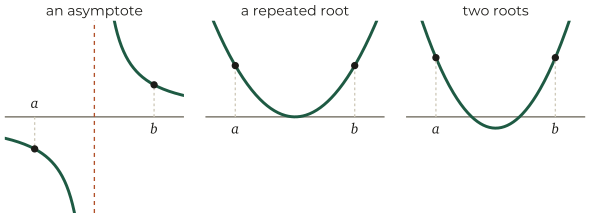
- A change of sign can mislead: an asymptote gives a sign change with no root, and a repeated root or two close roots can give none.
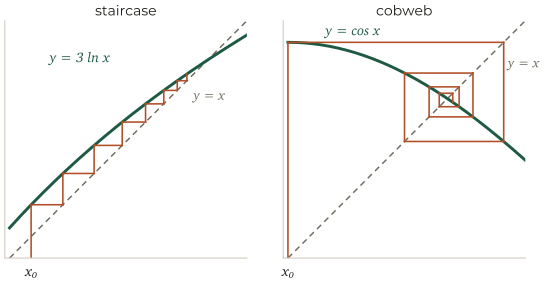
- Iteration: rearrange as and use . The steps make a staircase or a cobweb, and some rearrangements diverge.
- Newton–Raphson: . It is fast, but fails if and can jump to another root if is small.
- Trapezium rule: , with .
- It overestimates where the curve is convex and underestimates where it is concave.
Most equations can’t be solved exactly. has one real root, and no rearranging will produce a neat formula for it. Numerical methods find such roots, and the areas under curves you can’t integrate, to any accuracy you need: each step gets closer, and you stop when the answer is good enough.
1. Locating roots by a change of sign
Key result
If is continuous on the interval , and and have opposite signs, then there is at least one root of between and .
The graph of a continuous function has no gaps, so to get from below the axis to above it, it has to cross the axis somewhere in between.
Worked example 14.1 · Locating and refining a root
Show that has a root between and , and show that it is to 2 decimal places.
-
Let . Then and . is a polynomial, so it is continuous, and the change of sign shows there is a root between and .
-
To show the root is to 2 d.p., test either side of the interval that rounds to :
-
There is a change of sign, so the root lies between and , and is to 2 decimal places.
Common mistake
Check that the function is continuous on the interval. changes sign between and , but has no root there: the sign change comes from the asymptote at .
2. Iteration
To solve by iteration, rearrange it into the form , pick a starting value , and use the rule over and over:
Key result
If the values settle down, they settle on a root, where the line meets the curve . On a diagram the steps form a staircase when they approach the root from one side, and a cobweb when they spiral round it.
Worked example 14.2 · A rearrangement that works
Use the iteration with to find the root of .
-
, so the root satisfies .
-
Iterate, keeping the calculator’s full value each time:
(all to 4 d.p.).
-
The values climb steadily and settle, so the root is to 2 decimal places, agreeing with Example 14.1.
Worked example 14.3 · A rearrangement that fails
Show that the rearrangement of the same equation does not find the root, starting from .
-
Iterate: , , , (4 s.f.).
-
The values run further and further from the root at about : this iteration diverges.
Which rearrangements work
Near the root, each step multiplies the error by about . So the iteration closes in when near the root, and moves away when . At the root, has , but has . A positive gives a staircase, and a negative one gives a cobweb.
Choose a method and a starting value, then add steps. Iteration bounces between the curve and the line y = x; Newton–Raphson slides down tangents to the axis. Some choices close in on the root, and some don't.
3. The Newton–Raphson method
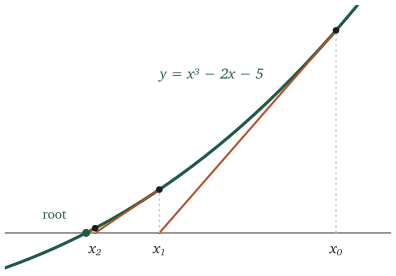
Newton–Raphson follows the tangent. From a point on the curve, slide down the tangent to where it meets the -axis. That is usually much closer to the root, so repeat from there.
Key result
The tangent at has gradient , so it meets the axis after a horizontal distance of .
Worked example 14.4 · Newton–Raphson
Use the Newton–Raphson method with to find the root of to 6 decimal places.
-
and , so
-
, then and (6 d.p.).
-
too, so the root is to 6 decimal places.
The number of correct digits roughly doubles at each step, far faster than the iteration in Example 14.2.
Common mistake
Newton–Raphson fails if : the tangent is horizontal and never meets the axis. For , starting at gives . A start near a stationary point is almost as bad: the tangent is nearly flat, so the next value lands far away, perhaps near a different root.
4. The trapezium rule
To estimate , split the area into strips of width and treat each strip as a trapezium.
Key result
With and the heights at the equally spaced -values,
The first and last heights are counted once and the rest twice, because each inner height is shared by two trapezia. More strips give a better estimate.
Worked example 14.5 · Estimating an area
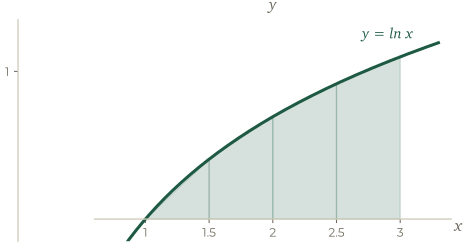
Use the trapezium rule with strips to estimate . State whether it is an overestimate or an underestimate.
, so the heights are at :
Apply the rule:
is concave, so each trapezium’s slanted top lies below the curve, and is an underestimate. The exact value, found by a method in Chapter 15, is (4 d.p.).
Over or under?
- Where the curve is convex, the tops of the trapezia lie above it, so the rule overestimates.
- Where the curve is concave, they lie below it, so the rule underestimates.
Practice
Twelve questions in three tiers. Try each one properly before opening the solution — the solutions show full method, not just answers.
Warm-up
Show that has a root between and .
Show solution
Let . Then and (3 s.f.). is continuous, so the change of sign shows there is a root between and .
and . Explain why this does not show that has a root between and .
Show solution
is not continuous on : it has an asymptote at . The change of sign comes from the asymptote, not a root.
Use the iteration with to find , and to 4 decimal places.
Show solution
, and (4 d.p.), keeping full calculator values between steps.
Use the trapezium rule with strips to estimate . State whether your answer is an overestimate or an underestimate, and explain why.
Show solution
, and the heights at are :
is convex, so the trapezia lie above the curve and is an overestimate. (The exact value is .)
Standard
- Show that has a root between and . [2]
- Show that to 2 decimal places. [2]
Show solution
(a) Let . and . is continuous, so there is a root between and .
(b) and (3 s.f.). The change of sign shows , so to 2 decimal places.
Use the Newton–Raphson method with to find the root of to 4 decimal places.
Show solution
and , so
, , and (4 d.p.). So the root is to 4 decimal places.
- Show that can be written as . [1]
- Use with to find to , to 4 decimal places. [2]
- Say whether the iteration makes a staircase or a cobweb diagram, and why. [2]
Show solution
(a) , so .
(b) , , , (4 d.p.).
(c) A cobweb: the values go above and below the root in turn, closing in from alternate sides.
- Use the trapezium rule with strips to estimate , to 4 decimal places. [3]
- Given that , state whether your estimate is too big or too small. [2]
Show solution
(a) . The heights at are , , , and , so the estimate is
(b) The second derivative is positive, so the curve is convex and the estimate is too big.
.
- Explain why the Newton–Raphson method fails with . [2]
- Using , find , and comment on your answer. [2]
Show solution
(a) , so . The formula would divide by zero: the tangent at is horizontal and never meets the -axis.
(b) and , so
The tangent is nearly flat, so lands far away, past the root near and nowhere near the one near .
Exam style
A town’s population years from now is modelled by thousand, and the number of homes it can support by thousand. Let .
- Show that has a root between and . [2]
- Use the Newton–Raphson method with to find this root to 2 decimal places. [4]
- Interpret your answer. [1]
Show solution
(a) and (3 s.f.). is continuous, so there is a root between and .
(b) , so
, and (4 d.p.), so the root is to 2 decimal places.
(c) After about years the population outgrows the homes available.
has two roots, near and .
- Show that the equation can be written as and as . [2]
- Starting from , find , and for each rearrangement, to 4 decimal places. [3]
- Explain why the two iterations lead to different roots. [2]
Show solution
(a) , so . Dividing by gives .
(b) The first gives , , (4 d.p.), heading for the root near . The second gives , , (4 d.p.), heading for the root near .
(c) An iteration closes in on a root where . For , , which is about at the small root but at the large one. For , , about at the small root but at the large one. So each iteration can only find one of the roots.
- Use the trapezium rule with strips to estimate , to 4 decimal places. [3]
- Given that the exact value is , find the percentage error in your estimate. [2]
- Explain why the estimate is too big, and say how it could be improved. [2]
Show solution
(a) . The heights at are , , , and :
(b) , so the percentage error is
to 2 significant figures.
(c) is convex for , so the trapezia lie above the curve. More, narrower strips would give a better estimate.