Year 2 Pure · Chapter 4
Modulus and Graph Transformations
Specification: Edexcel Pure 2.7, 2.9 — Algebra and functions · AQA section B7, B9
In this chapter
Key facts — this chapter
- The modulus is the size of , ignoring its sign: when , and when .
- is a V shape with its vertex on the -axis at .
- means is within of : .
- To solve , solve and , then check each answer, since can’t be negative.
- : reflect the parts of below the -axis in the -axis.
- : keep the part for and reflect it in the -axis.
- Combining transformations: apply them one at a time. Changes inside the bracket act on , in reverse.
The modulus takes the sign off a number, so . On a graph that is a fold: whatever dips below the axis is flipped back up. This chapter draws those folds, solves equations with them in, and finishes the Year 1 work on transformations by combining several at once.
1. The modulus function
Key result
is the distance of from , and is the distance between and . The graph of is the line with its negative part reflected in the -axis: a V with its vertex at .
Worked example 4.1 · A V-shaped graph
Sketch , giving the coordinates of the points where it meets the axes.
-
The vertex is where , at .
-
When , , so it meets the -axis at .
-
To the right of the vertex the graph is . To the left it is . Both arms have gradient of size .
2. Modulus equations and inequalities
The equation says that is either or . So there are two equations to solve, but only answers that make can work, because a modulus is never negative.
Solving modulus equations
- Solve and .
- Check each solution in the original equation, rejecting any that make negative.
A sketch of both graphs shows how many solutions to expect.
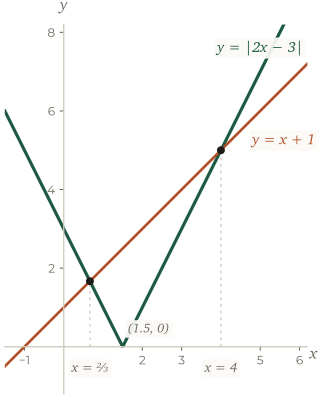
Worked example 4.2 · A V meets a line twice
Solve .
-
First case, : .
-
Second case, , so and .
-
Check: at both sides are , and at both sides are . Both solutions stand.
Worked example 4.3 · One answer rejected
Solve .
-
First case, : . But then , and a modulus can’t equal a negative number. Reject it.
-
Second case, , so and . Check: and .
-
The only solution is .
Common mistake
Always check your answers. The two cases produce candidates, not solutions: here solves perfectly well, but it doesn’t solve the modulus equation.
For inequalities, find where the graphs meet, then read off from the sketch where one is above the other.
Modulus inequalities
- means : is within of .
- means or .
- For anything more complicated, sketch both sides and use the points where they meet.
Worked example 4.4 · An inequality from the graph
Solve .
The graphs meet at and (Example 4.2). The V is above the line outside those points, so
3. The graphs of |f(x)| and f(|x|)
The modulus can go on the outside of a function or on the inside, and the two give different graphs.
Key result
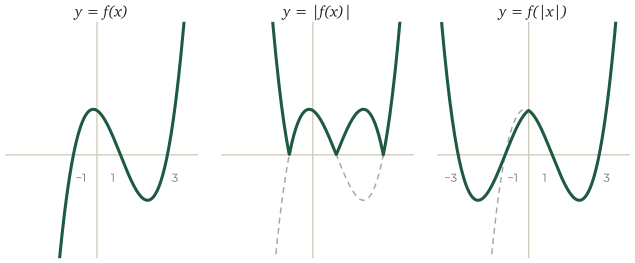
- : any part of below the -axis is reflected in the -axis. Nothing is ever below the axis.
- : the part of for is kept, and reflected in the -axis to replace the left half. The graph is symmetrical about the -axis.
Common mistake
The two are easy to swap. Ask what the modulus acts on. In it acts on the output, the -value, so it folds the graph up over the -axis. In it acts on the input, the -value, so it mirrors across the -axis.
Worked example 4.5 · Four solutions
Solve .
-
The graph of is the parabola with its dip between and folded up, so its bump has height at . The line lies below that height, so it meets the graph four times.
-
Case : , so .
-
Case : , so or .
-
The right-hand side is positive, so all four stand: , , , .
Put the modulus outside the function to fold the graph up over the x-axis, or inside to mirror its right half across the y-axis. Then move the line y = k and count the solutions.
4. Combining transformations
In Year 1 you met the four basic transformations one at a time. A function such as applies several at once.
Combining transformations
- Outside the bracket acts on , in the order you would calculate: is a vertical stretch by scale factor , then a translation up by .
- Inside the bracket acts on , in reverse: is a translation left by , then a horizontal stretch by scale factor .
- A point on moves to on .
Why it works
The graph of passes through when the original function passes through . So a point on reappears where and . Undoing “multiply by , then add ” means subtracting first, then dividing by , which is why the inside changes run in reverse.
Worked example 4.6 · Where a point moves to
The curve has a minimum at . Find the minimum of .
-
Inside: , so .
-
Outside: .
-
A vertical stretch by a positive factor keeps a minimum a minimum, so the minimum is at .
Worked example 4.7 · A transformed V
Sketch , giving the vertex and the points where it meets the axes.
-
Start from : translate right by , stretch vertically by , then translate down by . The vertex moves from to .
-
-axis: , so and or .
-
-axis: , so it meets it at .
Practice
Twelve questions in three tiers. Try each one properly before opening the solution — the solutions show full method, not just answers.
Warm-up
Find the coordinates of the points where meets the coordinate axes.
Show solution
The vertex is where , so it meets the -axis at . When , , so it meets the -axis at .
Solve:
Show solution
(a) or , so or .
(b) or , so or .
Solve .
Show solution
is the distance from to , and it must be less than :
The point lies on the curve . Find the image of on each curve.
Show solution
(a) A translation left by : .
(b) A vertical stretch by , then down by : .
(c) gives : .
Standard
Solve .
Show solution
First case, : .
Second case, , so and .
Check: at both sides are ; at both sides are . So or .
Solve .
Show solution
First case, : . Check: . ✓
Second case, : . But then , which is negative, so reject it.
The only solution is .
Solve .
Show solution
Both sides are non-negative, so squaring keeps the inequality the same way round:
A quadratic with positive coefficient is positive outside its roots, so or .
.
- Sketch , giving the coordinates of the points where it meets the axes and of the maximum between them. [3]
- State the values of for which has exactly four solutions. [1]
Show solution
(a) , so the graph meets the -axis at and . Between them is negative, with minimum ; the modulus folds this up to a maximum at . It meets the -axis at .
(b) A horizontal line meets the graph four times when it cuts the folded bump and both outer arms: .
.
- Write down an expression for when . [1]
- Solve . [2]
Show solution
(a) For , , so .
(b) , so or . That gives or .
Exam style
.
- Sketch , giving the coordinates of the vertex and of the points where the graph meets the axes. [3]
- Solve . [3]
Show solution
(a) The vertex is at . It meets the -axis where , at and , and the -axis at .
(b) For : , so and , which is at least . ✓
For : , so and , which is less than . ✓
So or .
The curve has a maximum at and meets the -axis at . For each curve below, find the images of these two points, and say whether the image of the maximum is a maximum or a minimum.
- [2]
- [2]
- [2]
Show solution
(a) Right , up : the maximum moves to and is still a maximum; moves to .
(b) Each -value is multiplied by : , which is now a minimum, and .
(c) Solve : , so the maximum is at and is still a maximum. Solve : , so moves to .
- Sketch , giving the coordinates of the points where it meets the axes. [2]
- Solve . [4]
Show solution
(a) at , so the graph meets the -axis at and . Between them the parabola dips to , which folds up to a maximum at , where it meets the -axis.
(b) Any solution needs , so .
Case : , so . Only has .
Case : , so . Only has .
Check: and . So or .