∫ekxdx=k1ekx+c, ∫x1dx=ln∣x∣+c, ∫coskxdx=k1sinkx+c and ∫sinkxdx=−k1coskx+c.
Reverse chain rule:∫f(x)f′(x)dx=ln∣f(x)∣+c, and ∫f′(x)(f(x))ndx=n+1(f(x))n+1+c.
Use identities to turn sin2x, cos2x and tan2x into things you can integrate.
Substitution: replace x by u, dx by dudxdu, and change the limits.
By parts:∫udxdvdx=uv−∫vdxdudx. Choose u to be the factor that gets simpler when differentiated, except that lnx is always u.
Partial fractions split a fraction into pieces that each integrate to a logarithm.
Year 1 integrated powers of x. This chapter reverses every derivative from
Chapter 12, then adds methods for the integrals that don’t match anything
directly: spotting a reversed chain rule, substituting a new variable,
integrating a product by parts, and splitting a fraction.
1. Standard integrals
Each derivative from Chapter 12, read backwards, gives an integral.
More generally, if ∫f(x)dx=F(x)+c, then
∫f(ax+b)dx=a1F(ax+b)+c.
Worked example 15.1 · A sum of standard integrals
Find ∫(e3x+x4−2sin5x)dx.
Integrate term by term:
31e3x+4ln∣x∣+52cos5x+c
Worked example 15.2 · A definite integral
Find the exact value of ∫0π/6sec22xdx.
∫0π/6sec22xdx=[21tan2x]0π/6=21tan3π−0=23
Common mistake
The integral of x1 is ln∣x∣, with the modulus, because lnx is
only defined for x>0. So ∫−3−1x1dx=ln1−ln3=−ln3,
which is negative, as it should be for an area below the axis.
2. Recognising a reversed chain rule
Differentiating ln∣f(x)∣ or (f(x))n+1 by the chain rule gives a
recognisable pattern: something multiplied by the derivative of its inside. When
an integral has that pattern, you can reverse the chain rule directly.
The second works for any n=−1. If the top is only a multiple of f′(x),
adjust by that constant.
Worked example 15.3 · The top is the derivative of the bottom
Find (a) ∫x2+12xdx and
(b) ∫tanxdx.
(a) The top is the derivative of x2+1, so the integral is
ln(x2+1)+c. No modulus is needed, because x2+1>0.
(b)tanx=cosxsinx, and sinx is minus the derivative of
cosx. So
∫tanxdx=−ln∣cosx∣+c=ln∣secx∣+c
Worked example 15.4 · A power of a bracket
Find ∫x(x2+3)4dx.
The derivative of x2+3 is 2x, and the integral has x, which is half of
it. So try (x2+3)5: its derivative is 10x(x2+3)4, which is ten times
too big. Adjust:
∫x(x2+3)4dx=101(x2+3)5+c
Using trigonometric identities
sin2x and cos2x have no standard integral, but the double-angle formulae
of Chapter 10 turn them into ones that do. tan2x becomes sec2x−1.
With the limits changed, there’s no need to go back to x.
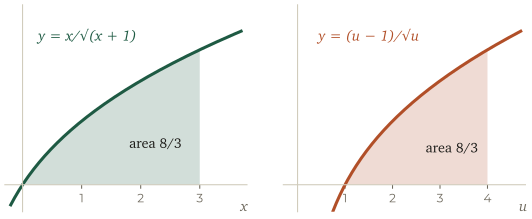
The substitution u = x + 1 turns the area on the left into the one on the right. They are equal: both are 8/3.
The left panel is an integral in x; the right is the same integral after the
substitution. Move the upper limit and compare the shaded areas: as x runs over
its interval, u runs over the new one, and the two areas stay equal.
4. Integration by parts
Integrating the product rule gives a way to integrate some products.
Key result
∫udxdvdx=uv−∫vdxdudx
Choose u to be the factor that gets simpler when you differentiate it, such as
a power of x, so the new integral is easier. The exception is lnx: it has
no standard integral, so always make it u.
Where it comes from
The product rule says dxd(uv)=udxdv+vdxdu.
Integrate both sides with respect to x: uv=∫udxdvdx+∫vdxdudx.
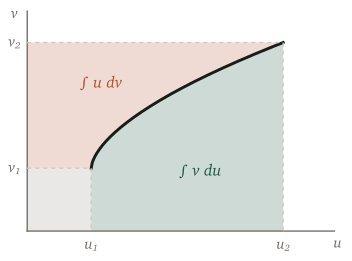
Rearranging gives the formula. The figure shows the same thing with areas.
The two integrals are the two areas either side of the curve. Together they fill the difference between the rectangles, u₂v₂ − u₁v₁.
Worked example 15.8 · A power times an exponential
Find ∫xe2xdx.
Let u=x, which gets simpler, and dxdv=e2x. Then
dxdu=1 and v=21e2x.
By parts:
∫xe2xdx=21xe2x−∫21e2xdx=21xe2x−41e2x+c
Worked example 15.9 · Integrating ln x
Find ∫lnxdx, and hence the exact value
of ∫13lnxdx.
Write lnx as lnx×1. Let u=lnx and dxdv=1, so
dxdu=x1 and v=x:
∫lnxdx=xlnx−∫x×x1dx=xlnx−x+c
So ∫13lnxdx=(3ln3−3)−(0−1)=3ln3−2. This
is the exact value the trapezium rule estimated in Chapter 14.
Common mistake
Some integrals need parts twice. For ∫x2exdx, the first use leaves
∫2xexdx, which needs parts again with u=2x. Keep choosing the power of
x as u each time, or the integral gets worse instead of better.
5. Using partial fractions
A fraction whose bottom factorises can be split into partial fractions
(Chapter 2). Each piece with a linear bottom integrates to a logarithm.
Key result
∫ax+bAdx=aAln∣ax+b∣+c
Worked example 15.10 · A definite integral with partial fractions