Year 2 Pure · Chapter 13
Implicit and Parametric Differentiation
Specification: Edexcel Pure 7.1, 7.3–7.5 — Differentiation · AQA section G1, G3, G4, G5
In this chapter
Key facts — this chapter
- Parametric: if and are functions of , then .
- Implicit: differentiate every term with respect to . A term in gets an extra factor by the chain rule, so .
- A product such as needs the product rule: .
- Connected rates: link the rate you want to the one you know with the chain rule, such as .
- A curve is convex where and concave where . A point of inflection is where it changes from one to the other, so changes sign.
Not every curve comes as . Some are parametric, some are given by an equation like that mixes and , and some quantities change with time together. The chain rule handles all three. The last section uses the second derivative to describe which way a curve bends.
1. Parametric differentiation
Key result
If and are both functions of a parameter , then
wherever . The answer is in terms of .
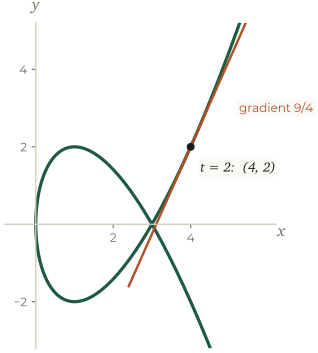
Worked example 13.1 · A tangent to a parametric curve
A curve has parametric equations , . Find the equation of the tangent at the point where .
-
Differentiate each with respect to and divide:
-
At the gradient is , and the point is .
-
The tangent is
Worked example 13.2 · A normal to an ellipse
A curve has parametric equations , . Find the equation of the normal at the point where .
-
and , so
-
At the tangent’s gradient is , so the normal’s is . The point is .
-
The normal is . Multiplying by and rearranging gives .
2. Implicit differentiation
An equation like defines in terms of without solving for it: the relationship is implicit. You can still differentiate every term with respect to .
Key result
To differentiate a function of with respect to , differentiate it with respect to , then multiply by (the chain rule):
Terms that mix and , such as , need the product rule as well.
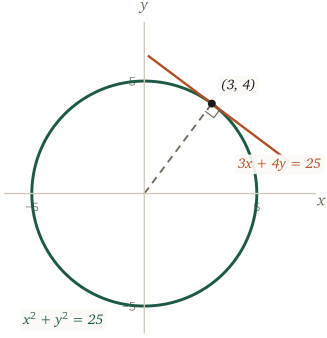
Worked example 13.3 · A tangent to a circle
Find the equation of the tangent to at the point .
-
Differentiate every term with respect to :
-
At the gradient is . The tangent is , which is .
Worked example 13.4 · A product term
A curve has equation . Find the gradient of the curve at the point .
-
Differentiate term by term, using the product rule on :
-
Collect the terms:
-
At the gradient is .
Worked example 13.5 · Stationary points of an implicit curve
Find the stationary points of the curve .
-
Differentiate and rearrange:
-
The gradient is when , that is . Substitute into the curve’s equation:
-
The stationary points are and .
Another route to the exponential derivative
If , then . Differentiating implicitly, , so , as in Chapter 12.
3. Connected rates of change
When two quantities are linked, their rates of change are linked too. The chain rule connects them.
Key result
If is a function of , and changes with time ,
Write down the rate you know and the rate you want. Then find the link between the variables and differentiate it.
Worked example 13.6 · A balloon
A spherical balloon is inflated at a rate of cm³ per second. Find the rate at which its radius is increasing when the radius is cm.
-
You know and want . The link is , so , which is when .
-
So
That is about cm per second.
4. Concave and convex curves
Key result
- A curve is convex where : its gradient is increasing, and it bends upwards like a bowl.
- A curve is concave where : its gradient is decreasing, and it bends downwards like an arch.
- A point of inflection is where the curve changes from concave to convex, or the other way. There and changes sign.
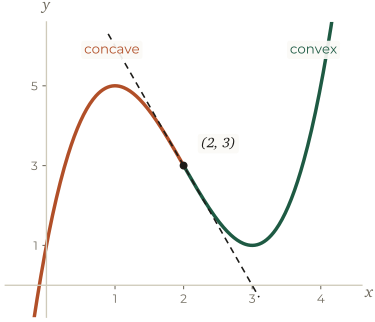
Green is convex (f″ > 0), orange is concave (f″ < 0). Step x along and watch the tangent: it stays below a convex curve and above a concave one, and at a point of inflection it crosses over.
Worked example 13.7 · Finding a point of inflection
For , find where the curve is concave, where it is convex, and its point of inflection.
-
and .
-
for , so the curve is concave there. for , so it is convex there.
-
changes sign at , and . So is a point of inflection.
Worked example 13.8 · Convex everywhere
Show that is convex for all .
By the product rule, , so . This is positive for every , so the curve is convex there.
Common mistake
is not enough on its own. For , is at , but it is positive on both sides, so the curve is convex throughout and has no point of inflection. Always check that changes sign.
Practice
Twelve questions in three tiers. Try each one properly before opening the solution — the solutions show full method, not just answers.
Warm-up
A curve has parametric equations , . Find in terms of .
Show solution
Find for the curve , in terms of .
Show solution
Differentiating implicitly, , so .
Find for the curve , in terms of and .
Show solution
By the product rule, , so .
Find the values of for which the curve is concave.
Show solution
, which is when . So the curve is concave for .
Standard
A curve has parametric equations , , .
- Find in terms of . [2]
- Find the equation of the tangent at the point where . [3]
Show solution
(a) and . Multiplying top and bottom by :
(b) At the gradient is and the point is . The tangent is , which is .
A curve has equation .
- Find in terms of and . [3]
- Find the equation of the normal at the point . [2]
Show solution
(a) Differentiating implicitly, with the product rule on :
(b) At the gradient is , so the normal has gradient : , which is .
The edges of a cube are increasing at cm per second. Find the rate at which its volume is increasing when the edges are cm long.
Show solution
, so when . Then
For , find the values of for which the curve is concave, and the coordinates of its points of inflection.
Show solution
and .
for , so the curve is concave there, and convex for . changes sign at , where . So the points of inflection are and .
Show that the curve has exactly one point of inflection, and find its coordinates.
Show solution
By the product rule, , and again, .
, so has the sign of . It changes sign only at , so there is exactly one point of inflection, at .
Exam style
A curve has parametric equations , , .
- Find in terms of . [2]
- Find the coordinates of the points where the tangent is horizontal. [3]
- Find the coordinates of the points where the tangent is vertical. [2]
Show solution
(a)
(b) Horizontal when . With , or , so or . The points are and .
(c) Vertical when (and ), so or : the points and .
A curve has equation .
- Show that . [4]
- Find the exact coordinates of the points where the tangent is parallel to the -axis. [3]
Show solution
(a) Differentiating implicitly, with the product rule on :
Dividing by gives .
(b) The gradient is when . Substituting, , so and . The points are and .
The area of a circular ripple increases at a constant cm² per second.
- Find the rate at which the radius is increasing when the radius is cm. [3]
- Find the rate at which the radius is increasing when the area is cm². [2]
- Find the rate at which the circumference is increasing when the radius is cm. [2]
Show solution
(a) , so . Then
which is cm per second when .
(b) gives , so cm per second (3 s.f.).
(c) , so cm per second.