Year 2 Pure · Chapter 12
Differentiation Rules
Specification: Edexcel Pure 7.1, 7.2, 7.4 — Differentiation · AQA section G1, G2, G4
In this chapter
Key facts — this chapter
- With in radians, and .
- , and .
- Chain rule: if is a function of and is a function of , then .
- Product rule: .
- Quotient rule: .
- , and .
In Year 1 you could differentiate powers of . This chapter adds the other functions, sines, exponentials and logarithms, and three rules for combining them: one for a function of a function, one for a product and one for a quotient. Together they differentiate almost anything you can write down.
1. sin and cos from first principles
The proof uses two limits. Both come from the small-angle approximations of Chapter 8, which is why the angle must be in radians.
Key result
With in radians, as ,
For small , , and , so the second fraction is about .
Worked example 12.1 · The derivative of sin from first principles
Prove from first principles that the derivative of is .
-
Expand with the addition formula and collect terms:
-
Divide by :
-
As , the limits above turn this into .
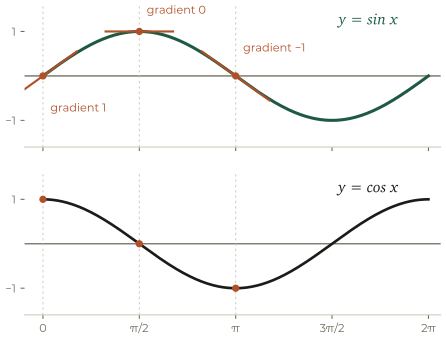
The same method with shows that the derivative of is .
Common mistake
These derivatives are only true in radians. In degrees the gradient of at is , not , and every result in this chapter would need an extra factor.
2. Exponentials and logarithms
Key result
The second follows from the first, because , so : that is with . Section 6 shows where the third comes from. Since , the derivative of is also .
Worked example 12.2 · Standard derivatives
Differentiate , and find the gradient of the curve at .
-
Differentiate term by term:
-
At :
3. The chain rule
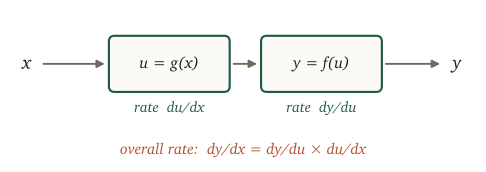
is a function of a function: first work out , then . A small change in changes at the rate , and each change in changes at the rate , so the rates multiply.
Key result
If is a function of , and is a function of , then
In words: differentiate the outside, keeping the inside as it is, then multiply by the derivative of the inside.
Worked example 12.3 · A power of a bracket
Differentiate .
-
Let , so . Then and .
-
Multiply, and write the answer in terms of :
Worked example 12.4 · Chains with the new functions
Differentiate (a) , (b) and (c) .
Each time, differentiate the outside function, then multiply by the derivative of the inside.
(a) The outside is and the inside is : .
(b) The outside is and the inside is : .
(c) means , so the outside is the cube: .
A special case comes up so often that it’s worth knowing on its own: if the inside is , the chain rule just multiplies by . So and .
4. The product rule
Key result
If and are functions of ,
Think of as the area of a rectangle with sides and . When grows a little, grows by and by , and the area gains three pieces: along one side, along the other, and a tiny corner . Divide by and let : the corner vanishes, and what’s left is the product rule.
The rectangle has sides u = 1 + x and v = 1 + ½x², so its area is uv. Increase x by δx and the area gains two strips and a corner. Make δx smaller and watch the corner's share shrink to nothing.
Worked example 12.5 · Stationary points of a product
Find the -coordinates of the stationary points of .
-
With and , and :
-
is never , so when or .
5. The quotient rule
Key result
If and are functions of ,
The order on top matters, because it’s a subtraction: start with .
Worked example 12.6 · The derivative of tan
Show that .
Write , with and :
The reciprocal functions follow in the same way, from the quotient rule or the chain rule:
The other trig derivatives
Worked example 12.7 · A maximum
Find the coordinates of the stationary point of , , and show that it is a maximum.
-
With and :
-
This is when , so and .
-
is positive, so has the sign of : positive for and negative for . The curve rises then falls, so is a maximum.
6. Using dx/dy
Key result
So when is given as a function of , find and turn it upside down.
Worked example 12.8 · Turning the gradient upside down
A curve has equation . Find the gradient of the curve at the point .
-
, which is when .
-
So at .
Where the derivative of ln comes from
If , then , so . Turning it upside down gives .
Practice
Twelve questions in three tiers. Try each one properly before opening the solution — the solutions show full method, not just answers.
Warm-up
Differentiate each of these with respect to .
- [1]
- [1]
- [1]
- [1]
Show solution
(a) (b) (c) (d)
Differentiate .
Show solution
By the chain rule, with inside :
Differentiate .
Show solution
By the product rule, with and :
Differentiate .
Show solution
By the quotient rule, with and :
Standard
Find the gradient of at the point where .
Show solution
By the chain rule, . At this is .
Find the coordinates of the stationary points of , and determine their nature.
Show solution
By the product rule,
which is when or : the points and .
Differentiating again, . At this is , so is a minimum. At it is , so is a maximum.
Show that .
Show solution
Write and use the chain rule:
A curve has equation . Find the gradient of the curve at the point .
Show solution
, which is when . So at .
Find the equation of the tangent to at the point where .
Show solution
When , . By the chain rule, , which is when . The tangent is , that is .
Exam style
- Show that . [3]
- Find the coordinates of the stationary point of , and show that it is a minimum. [3]
Show solution
(a) By the quotient rule,
(b) For , only when , and . The denominator and are positive, so has the sign of : negative just before and positive just after. So is a minimum.
Given that and as , prove from first principles that the derivative of is .
Show solution
Using the addition formula,
Dividing by ,
As this tends to .
A hot drink cools so that its temperature minutes after it is made is °C.
- State its temperature when it is made. [1]
- Find the rate at which it is cooling after 10 minutes. [3]
- Find when it is cooling at °C per minute, and its temperature then. [3]
Show solution
(a) At , °C.
(b) . At this is (3 s.f.), so it is cooling at °C per minute.
(c) gives , so
Then °C.