Year 2 Pure · Chapter 16

Areas and Differential Equations

Specification: Edexcel Pure 7.6, 8.3, 8.4, 8.7, 8.8 — Differentiation and integration  ·  AQA section G6, H3, H4, H7, H8

In this chapter
  1. 1. The area between two curves
  2. 2. The area under a parametric curve
  3. 3. Integration as the limit of a sum
  4. 4. Setting up differential equations
  5. 5. Solving separable differential equations
  6. Practice

Key facts — this chapter

  • The area between y=f(x)y = f(x) above and y=g(x)y = g(x) below, from x=ax = a to x=bx = b, is ∫ab(f(x)−g(x)) dx\displaystyle\int_a^b \big(f(x) - g(x)\big)\,dx.
  • Under a parametric curve, the area is ∫y dxdt dt\displaystyle\int y\,\frac{dx}{dt}\,dt, with limits that are values of tt.
  • An integral is the limit of a sum of thin strips: ∫aby dx=lim⁡δx→0∑x=aby δx\displaystyle\int_a^b y\,dx = \lim_{\delta x \to 0}\sum_{x=a}^{b} y\,\delta x.
  • A differential equation links a rate of change to the quantity itself. “Proportional to” means “equals a constant kk times”.
  • To solve a separable equation dydx=f(x)g(y)\dfrac{dy}{dx} = f(x)g(y), write ∫1g(y) dy=∫f(x) dx\displaystyle\int \frac{1}{g(y)}\,dy = \int f(x)\,dx.
  • The general solution contains a constant. A particular solution uses a given value to fix it.

This chapter puts the integration methods to work. The first half finds areas: between two curves, under a parametric curve, and as the limit of a sum of thin strips. The second half solves differential equations, where the unknown is a function and the equation says how fast it changes. They model anything whose rate of change depends on its current state, from cooling tea to growing populations.

1. The area between two curves

Key result

If f(x)≥g(x)f(x) \ge g(x) for a≤x≤ba \le x \le b, the area between the curves is

∫ab(f(x)−g(x)) dx\int_a^b \big(f(x) - g(x)\big)\,dx

Subtracting first means that parts below the xx-axis take care of themselves. To find aa and bb when they aren’t given, solve f(x)=g(x)f(x) = g(x).

Worked example 16.1 · Two parabolas

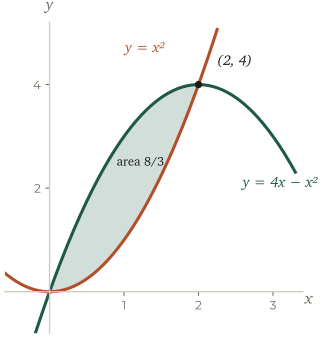
Find the area enclosed by the curves y=4x−x2y = 4x - x^2 and y=x2y = x^2.


  1. They meet where x2=4x−x2x^2 = 4x - x^2, so 2x2−4x=02x^2 - 4x = 0 and x=0x = 0 or 22. Between these, 4x−x24x - x^2 is the upper curve.

  2. So the area is

    ∫02(4x−2x2) dx=[2x2−23x3]02=8−163=83\begin{aligned} &\int_0^2 (4x - 2x^2)\,dx \\ &= \Big[2x^2 - \tfrac{2}{3}x^3\Big]_0^2 = 8 - \tfrac{16}{3} = \tfrac{8}{3} \end{aligned}
The parabolas y = 4x minus x squared, opening downwards, and y = x squared, opening upwards, meeting at the origin and at (2, 4), with the region between them shaded
The region between y = 4x − x² (above) and y = x² (below), from x = 0 to x = 2.

Worked example 16.2 · Between sin and cos

Find the area enclosed between y=sin⁡xy = \sin x and y=cos⁡xy = \cos x from x=π4x = \tfrac{\pi}{4} to x=5π4x = \tfrac{5\pi}{4}.


The curves cross at both limits, and sin⁡x≥cos⁡x\sin x \ge \cos x between them:

∫π/45π/4(sin⁡x−cos⁡x) dx=[−cos⁡x−sin⁡x]π/45π/4=2−(−2)=22\begin{aligned} &\int_{\pi/4}^{5\pi/4} (\sin x - \cos x)\,dx \\ &= \Big[-\cos x - \sin x\Big]_{\pi/4}^{5\pi/4} \\ &= \sqrt2 - (-\sqrt2) = 2\sqrt2 \end{aligned}

Part of this region lies below the xx-axis, but subtracting the curves first counts all of it correctly.

2. The area under a parametric curve

For a curve x=x(t)x = x(t), y=y(t)y = y(t), the area under it is still ∫y dx\int y\,dx. The chain rule turns dxdx into dxdt dt\frac{dx}{dt}\,dt, so you can integrate with respect to tt without finding the Cartesian equation.

Key result

Area=∫t1t2y dxdt dt\text{Area} = \int_{t_1}^{t_2} y\,\frac{dx}{dt}\,dt

where t1t_1 and t2t_2 are the values of tt at the ends of the region.

Worked example 16.3 · A parabola in parametric form

The curve x=t2x = t^2, y=2ty = 2t runs from the origin to the point (4,4)(4, 4) as tt goes from 00 to 22. Find the area under this part of the curve.


dxdt=2t\frac{dx}{dt} = 2t, so

∫022t×2t dt=[43t3]02=323\int_0^2 2t \times 2t\,dt = \Big[\tfrac{4}{3}t^3\Big]_0^2 = \tfrac{32}{3}

As a check, the Cartesian curve is y=2xy = 2\sqrt{x}, and ∫042x12 dx=43×8=323\int_0^4 2x^{\frac{1}{2}}\,dx = \tfrac{4}{3} \times 8 = \tfrac{32}{3} too.

Worked example 16.4 · The area under a cycloid

A point on the rim of a rolling wheel traces the cycloid x=t−sin⁡tx = t - \sin t, y=1−cos⁡ty = 1 - \cos t. Find the area under one arch, 0≤t≤2π0 \le t \le 2\pi.


  1. dxdt=1−cos⁡t\frac{dx}{dt} = 1 - \cos t, so the area is ∫02π(1−cos⁡t)2 dt\int_0^{2\pi} (1 - \cos t)^2\,dt.

  2. Expand, and use cos⁡2t=12(1+cos⁡2t)\cos^2 t = \tfrac{1}{2}(1 + \cos 2t):

    ∫02π(32−2cos⁡t+12cos⁡2t)dt=[32t−2sin⁡t+14sin⁡2t]02π=3π\begin{aligned} &\int_0^{2\pi} \left(\tfrac{3}{2} - 2\cos t + \tfrac{1}{2}\cos 2t\right)dt \\ &= \Big[\tfrac{3}{2}t - 2\sin t + \tfrac{1}{4}\sin 2t\Big]_0^{2\pi} \\ &= 3\pi \end{aligned}

The wheel has radius 11, so the arch has exactly three times the wheel’s area.
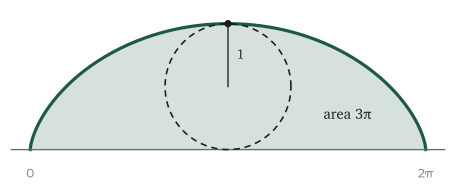
One arch of a cycloid from x = 0 to x = 2 pi, with the region under it shaded and labelled area 3 pi, and the rolling wheel of radius 1 drawn at the top of the arch
One arch of the cycloid traced by a wheel of radius 1. The area under it is 3π, three times the wheel's area.

3. Integration as the limit of a sum

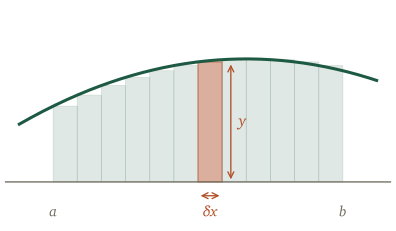
Split the region under a curve into thin strips of width δx\delta x. A strip at xx is nearly a rectangle of height yy, so its area is about y δxy\,\delta x. Adding all the strips and letting their width shrink to zero gives the exact area.

Key result

∫aby dx=lim⁡δx→0∑x=aby δx\int_a^b y\,dx = \lim_{\delta x \to 0}\sum_{x=a}^{b} y\,\delta x

The integral sign is a stretched S, for “sum”, and dxdx is what δx\delta x becomes in the limit.

The area under a curve between x = a and x = b divided into thin vertical strips, with one strip at x highlighted: its height is y and its width is delta x
One strip: height y, width δx, area about y δx. The integral adds them up as δx → 0.

Worked example 16.5 · Recognising a limit of a sum

Find lim⁡δx→0∑x=13(2x+1) δx\displaystyle\lim_{\delta x \to 0}\sum_{x=1}^{3} (2x + 1)\,\delta x.


This is the integral of 2x+12x + 1 from 11 to 33:

∫13(2x+1) dx=[x2+x]13=12−2=10\begin{aligned} \int_1^3 (2x + 1)\,dx &= \Big[x^2 + x\Big]_1^3 \\ &= 12 - 2 = 10 \end{aligned}

4. Setting up differential equations

A differential equation is an equation involving a derivative. In a model it usually says how fast a quantity changes, given its current value.

Key result

  • “The rate of change of PP is proportional to PP” means dPdt=kP\dfrac{dP}{dt} = kP.
  • ”… inversely proportional to rr” means drdt=kr\dfrac{dr}{dt} = \dfrac{k}{r}.
  • A quantity that decreases has a negative rate, so write −k-k with k>0k > 0.

Worked example 16.6 · Newton's law of cooling

A cup of tea cools in a room at 2020 °C. Its temperature TT °C falls at a rate proportional to the difference between TT and the room temperature. Write down a differential equation for TT.


The difference is T−20T - 20, and TT is falling, so

dTdt=−k(T−20)\frac{dT}{dt} = -k(T - 20)

where kk is a positive constant and tt is the time.

5. Solving separable differential equations

If dydx\frac{dy}{dx} is a function of xx times a function of yy, the variables can be separated: everything with yy goes with dydy, and everything with xx goes with dxdx.

Key result

dydx=f(x)g(y)⇒  ∫1g(y) dy=∫f(x) dx\begin{gathered} \frac{dy}{dx} = f(x)g(y) \\ \Rightarrow\; \int \frac{1}{g(y)}\,dy = \int f(x)\,dx \end{gathered}

One constant of integration is enough: put it on the xx side. That gives the general solution, a family of curves. A given point on the curve picks out one of them, the particular solution.

Each short line shows the gradient the differential equation gives at that point. Tap anywhere, or change the starting value, and the solution through that point follows the lines. Every curve you can draw is one member of the general solution.

Worked example 16.7 · A particular solution

Solve dydx=xy\dfrac{dy}{dx} = xy, given that y=2y = 2 when x=0x = 0.


  1. Separate the variables and integrate:

    ∫1y dy=∫x dxln⁡∣y∣=12x2+c\begin{aligned} \int \frac{1}{y}\,dy &= \int x\,dx \\ \ln|y| &= \tfrac{1}{2}x^2 + c \end{aligned}
  2. Take exponentials: y=Ae12x2y = Ae^{\frac{1}{2}x^2}, where A=±ecA = \pm e^c.

  3. y=2y = 2 when x=0x = 0 gives A=2A = 2, so y=2e12x2y = 2e^{\frac{1}{2}x^2}.

Worked example 16.8 · Solving the cooling model

The tea in Example 16.6 is at 9090 °C when it is made, and at 5555 °C ten minutes later. Find TT in terms of tt, and the time at which it reaches 3030 °C.


  1. Separate and integrate:

    ∫1T−20 dT=∫−k dtln⁡(T−20)=−kt+c\begin{aligned} \int \frac{1}{T - 20}\,dT &= \int -k\,dt \\ \ln(T - 20) &= -kt + c \end{aligned}

    so T=20+Ae−ktT = 20 + Ae^{-kt}.

  2. At t=0t = 0, 90=20+A90 = 20 + A, so A=70A = 70. At t=10t = 10, 55=20+70e−10k55 = 20 + 70e^{-10k}, so e−10k=12e^{-10k} = \tfrac{1}{2} and k=ln⁡210=0.0693k = \tfrac{\ln 2}{10} = 0.0693 (3 s.f.). So T=20+70e−0.0693tT = 20 + 70e^{-0.0693t}.

  3. T=30T = 30 when 70e−kt=1070e^{-kt} = 10, so

    t=ln⁡7k=10ln⁡7ln⁡2=28.1 minutes (3 s.f.)\begin{aligned} t = \frac{\ln 7}{k} &= \frac{10\ln 7}{\ln 2} \\ &= 28.1 \text{ minutes (3 s.f.)} \end{aligned}

Reading the model

As tt grows, e−kt→0e^{-kt} \to 0, so T→20T \to 20: the tea cools towards room temperature but never quite reaches it. The model assumes the room stays at 2020 °C and that nothing else, such as stirring or adding milk, changes how fast the tea loses heat.

Common mistake

Add the constant as soon as you integrate, not after rearranging. Writing ln⁡y=12x2\ln y = \tfrac{1}{2}x^2 and then adding cc at the end gives y=e12x2+cy = e^{\frac{1}{2}x^2} + c, which is wrong: the constant should multiply, as AA does in Example 16.7.

Practice

Twelve questions in three tiers. Try each one properly before opening the solution — the solutions show full method, not just answers.

Warm-up

1 [3 marks]

Find the area enclosed between y=xy = x and y=x2y = x^2.

Show solution

They meet where x2=xx^2 = x, at x=0x = 0 and x=1x = 1, and x≥x2x \ge x^2 between them:

∫01(x−x2) dx=[12x2−13x3]01=16\int_0^1 (x - x^2)\,dx = \Big[\tfrac{1}{2}x^2 - \tfrac{1}{3}x^3\Big]_0^1 = \tfrac{1}{6}
2 [2 marks]

Find lim⁡δx→0∑x=03x2 δx\displaystyle\lim_{\delta x \to 0}\sum_{x=0}^{3} x^2\,\delta x.

Show solution
∫03x2 dx=[13x3]03=9\int_0^3 x^2\,dx = \Big[\tfrac{1}{3}x^3\Big]_0^3 = 9
3 [2 marks]

Write down a differential equation for each situation.

  1. A population PP grows at a rate proportional to its size. [1]
  2. A liquid cools at a rate proportional to the difference between its temperature θ\theta and 1515 °C. [1]
Show solution

(a) dPdt=kP\dfrac{dP}{dt} = kP, with k>0k > 0.

(b) dθdt=−k(θ−15)\dfrac{d\theta}{dt} = -k(\theta - 15), with k>0k > 0.

4 [3 marks]

Find the general solution of dydx=3x2y\dfrac{dy}{dx} = 3x^2y.

Show solution
∫1y dy=∫3x2 dxln⁡∣y∣=x3+c\begin{aligned} \int \frac{1}{y}\,dy &= \int 3x^2\,dx \\ \ln|y| &= x^3 + c \end{aligned}

so y=Aex3y = Ae^{x^3}.

Standard

5 [3 marks]

A curve has parametric equations x=3t2x = 3t^2, y=2ty = 2t. Find the area under the curve between t=0t = 0 and t=1t = 1.

Show solution

dxdt=6t\dfrac{dx}{dt} = 6t, so the area is

∫012t×6t dt=[4t3]01=4\int_0^1 2t \times 6t\,dt = \Big[4t^3\Big]_0^1 = 4
6 [4 marks]

Find the area enclosed between y=x2−2xy = x^2 - 2x and y=xy = x.

Show solution

They meet where x2−2x=xx^2 - 2x = x, so x(x−3)=0x(x - 3) = 0: x=0x = 0 or 33. Between them the line is above the curve:

∫03(3x−x2) dx=[32x2−13x3]03=272−9=92\begin{aligned} \int_0^3 (3x - x^2)\,dx &= \Big[\tfrac{3}{2}x^2 - \tfrac{1}{3}x^3\Big]_0^3 \\ &= \tfrac{27}{2} - 9 = \tfrac{9}{2} \end{aligned}
7 [5 marks]

Solve dydx=ex−y\dfrac{dy}{dx} = e^{x - y}, given that y=ln⁡2y = \ln 2 when x=0x = 0. Give yy in terms of xx.

Show solution

ex−y=exe−ye^{x - y} = e^xe^{-y}, so the variables separate:

∫ey dy=∫ex dxey=ex+c\begin{aligned} \int e^y\,dy &= \int e^x\,dx \\ e^y &= e^x + c \end{aligned}

At x=0x = 0, 2=1+c2 = 1 + c, so c=1c = 1. Then ey=ex+1e^y = e^x + 1 and y=ln⁡(ex+1)y = \ln(e^x + 1).

8 [4 marks]

Solve dydx=cos⁡xy\dfrac{dy}{dx} = \dfrac{\cos x}{y}, given that y=2y = 2 when x=0x = 0.

Show solution
∫y dy=∫cos⁡x dx12y2=sin⁡x+c\begin{aligned} \int y\,dy &= \int \cos x\,dx \\ \tfrac{1}{2}y^2 &= \sin x + c \end{aligned}

At x=0x = 0, 2=0+c2 = 0 + c, so y2=2sin⁡x+4y^2 = 2\sin x + 4. Since y=2>0y = 2 > 0 at the start, take the positive root: y=2sin⁡x+4y = \sqrt{2\sin x + 4}.

9 [5 marks]

The ellipse x=2cos⁡tx = 2\cos t, y=3sin⁡ty = 3\sin t is traced as tt goes from 00 to 2π2\pi.

  1. Show that the area of the quarter of the ellipse in the first quadrant is ∫0π/26sin⁡2t dt\displaystyle\int_0^{\pi/2} 6\sin^2 t\,dt. [3]
  2. Hence find the area of the whole ellipse. [2]
Show solution

(a) In the first quadrant, xx runs from 00 to 22 as tt runs from π2\tfrac{\pi}{2} down to 00. With dxdt=−2sin⁡t\dfrac{dx}{dt} = -2\sin t,

∫π/203sin⁡t×(−2sin⁡t) dt=∫π/20−6sin⁡2t dt=∫0π/26sin⁡2t dt\begin{aligned} &\int_{\pi/2}^{0} 3\sin t \times (-2\sin t)\,dt \\ &= \int_{\pi/2}^{0} -6\sin^2 t\,dt = \int_0^{\pi/2} 6\sin^2 t\,dt \end{aligned}

(b) ∫0π/23(1−cos⁡2t) dt=[3t−32sin⁡2t]0π/2=3π2\displaystyle\int_0^{\pi/2} 3(1 - \cos 2t)\,dt = \Big[3t - \tfrac{3}{2}\sin 2t\Big]_0^{\pi/2} = \tfrac{3\pi}{2}, so the whole ellipse has area 4×3π2=6π4 \times \tfrac{3\pi}{2} = 6\pi.

Exam style

10 [7 marks]

A liquid is made at 8080 °C and cools in a room at 1515 °C. Its temperature after tt minutes is θ\theta °C, where dθdt=−k(θ−15)\dfrac{d\theta}{dt} = -k(\theta - 15). After 55 minutes it is at 6060 °C.

  1. Show that θ=15+65e−kt\theta = 15 + 65e^{-kt}. [3]
  2. Find kk, to 3 significant figures. [2]
  3. Find the time at which the liquid reaches 2525 °C. [2]
Show solution

(a) Separate the variables:

∫1θ−15 dθ=∫−k dtln⁡(θ−15)=−kt+c\begin{aligned} \int \frac{1}{\theta - 15}\,d\theta &= \int -k\,dt \\ \ln(\theta - 15) &= -kt + c \end{aligned}

So θ=15+Ae−kt\theta = 15 + Ae^{-kt}, and θ=80\theta = 80 at t=0t = 0 gives A=65A = 65.

(b) 60=15+65e−5k60 = 15 + 65e^{-5k}, so e−5k=913e^{-5k} = \tfrac{9}{13} and k=15ln⁡139=0.0735k = \tfrac{1}{5}\ln\tfrac{13}{9} = 0.0735 (3 s.f.).

(c) 65e−kt=1065e^{-kt} = 10, so

t=ln⁡6.5k=25.5 minutes (3 s.f.)t = \frac{\ln 6.5}{k} = 25.5 \text{ minutes (3 s.f.)}
11 [8 marks]

A rumour spreads through a school. The proportion xx of students who have heard it after tt days is modelled by dxdt=x(1−x)\dfrac{dx}{dt} = x(1 - x), and at t=0t = 0 half the students have heard it.

  1. Express 1x(1−x)\dfrac{1}{x(1 - x)} in partial fractions. [2]
  2. Hence show that x=11+e−tx = \dfrac{1}{1 + e^{-t}}. [5]
  3. Describe what happens to xx in the long run. [1]
Show solution

(a) 1x(1−x)=1x+11−x\dfrac{1}{x(1 - x)} = \dfrac{1}{x} + \dfrac{1}{1 - x}.

(b) Separate and integrate:

∫(1x+11−x)dx=∫dtln⁡x−ln⁡(1−x)=t+c\begin{aligned} \int \left(\frac{1}{x} + \frac{1}{1 - x}\right)dx &= \int dt \\ \ln x - \ln(1 - x) &= t + c \end{aligned}

(no modulus signs are needed, since 0<x<10 < x < 1). So x1−x=Aet\dfrac{x}{1 - x} = Ae^t. At t=0t = 0, x=12x = \tfrac{1}{2} gives A=1A = 1. Then x=et(1−x)x = e^t(1 - x), so x=et1+et=11+e−tx = \dfrac{e^t}{1 + e^t} = \dfrac{1}{1 + e^{-t}}.

(c) As tt grows, e−t→0e^{-t} \to 0, so x→1x \to 1: eventually everyone hears the rumour.

12 [7 marks]

Water drains from a tank so that the depth hh metres after tt minutes satisfies dhdt=−0.2h\dfrac{dh}{dt} = -0.2\sqrt h. The depth is 1616 m at t=0t = 0.

  1. Show that h=(4−0.1t)2h = (4 - 0.1t)^2. [4]
  2. Find the time at which the tank is empty. [1]
  3. Explain why the formula should not be used after that time. [2]
Show solution

(a) Separate the variables:

∫h−12 dh=∫−0.2 dt2h=−0.2t+c\begin{aligned} \int h^{-\frac{1}{2}}\,dh &= \int -0.2\,dt \\ 2\sqrt h &= -0.2t + c \end{aligned}

At t=0t = 0, 2×4=c2 \times 4 = c, so c=8c = 8. Then h=4−0.1t\sqrt h = 4 - 0.1t and h=(4−0.1t)2h = (4 - 0.1t)^2.

(b) h=0h = 0 when 4−0.1t=04 - 0.1t = 0, that is after t=40t = 40 minutes.

(c) After t=40t = 40, (4−0.1t)2(4 - 0.1t)^2 grows again, which would mean the tank refilling. The formula came from h=4−0.1t\sqrt h = 4 - 0.1t, which needs 4−0.1t≥04 - 0.1t \ge 0, so it only describes 0≤t≤400 \le t \le 40.