Year 2 Pure · Chapter 7
The Binomial Series
Specification: Edexcel Pure 4.1 — Sequences and series · AQA section D1
In this chapter
Key facts — this chapter
- For any rational and :
- When is a positive whole number the series stops. Otherwise it goes on for ever, and is only valid for .
- For , replace by throughout. It is valid for , that is .
- For , take out first: , valid for .
- To approximate a value, choose small and inside the interval of validity, then use the first few terms.
- For a fraction, split it into partial fractions, expand each one, and add. The result is valid where both expansions are.
In Year 1 you expanded for positive whole numbers , and the expansion stopped after terms. The same formula works for negative and fractional powers too, but then it never stops. That turns and into series you can use for approximations, as long as is small enough.
1. The binomial series for any power
Key result
For any rational number , and ,
If is a positive whole number, a factor eventually appears, every later term is , and the expansion is the finite one from Year 1. For any other it is an infinite series.
Worked example 7.1 · A negative power
Expand in ascending powers of up to the term in .
With , the coefficients are
So , valid for . It’s the geometric series with first term and ratio , which converges exactly when .
Worked example 7.2 · A square root
Expand up to the term in .
-
Write it as , so .
-
Work out each coefficient:
-
So
valid for .
Why the terms must shrink
Each term carries a power of . When the powers shrink, and the terms become small enough for the series to settle on a value. When the powers grow and the series can’t settle. Try in Example 7.1: the series swings further and further, although .
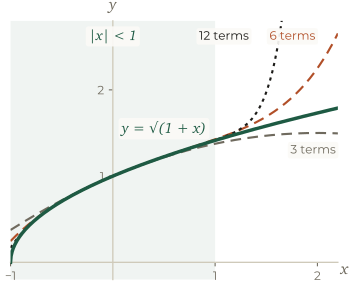
The solid curve is (1 + x)n; the dashed one is the series cut off after a number of terms. Add terms, then move x outside the shaded band |x| < 1 and watch what extra terms do there.
2. Expanding (1 + kx) to a power
Replace every in the formula by , brackets and all. The series is valid while .
Worked example 7.3 · A cube in the denominator
Expand up to the term in , and state the values of for which it is valid.
-
Write it as : , with in place of .
-
Term by term, keeping the brackets:
-
It is valid for , that is .
Common mistake
Put the whole of in a bracket before you raise it to a power: and . Writing gets both the number and the sign wrong.
Worked example 7.4 · Finding the constants
In the expansion of , the coefficient of is and the coefficient of is . Find and , and state the values of for which the expansion is valid.
-
Write down the two coefficients:
-
Square the first, , and double the second, . Divide the second by the first:
-
Then . The expansion is of , valid for , that is .
3. Expanding (a + bx) to a power
The formula needs a at the front of the bracket. So take out first, remembering that it comes out raised to the power .
Key result
Expand the bracket as before, with in place of , then multiply every term by . The result is valid for .
Worked example 7.5 · Taking out the 4
Expand up to the term in , and state the values of for which it is valid.
-
Take out :
-
Use Example 7.2 with in place of :
-
It is valid for , that is .
Common mistake
The you take out is raised to the power too. So , not , which is twice as big.
4. Approximations
The first few terms of a series make a good approximation when is small, because the later terms carry high powers of a small number.
Worked example 7.6 · Estimating a square root
Use the expansion in Example 7.5 to estimate .
-
with , which is well inside .
-
Substitute into the four terms:
-
The true value is , so four terms are already correct to decimal places.
When the number isn’t of the form with small, look for a value of that turns the bracket into something related to it.
Worked example 7.7 · Approximating √2
Expand up to the term in . By substituting , find an approximation to .
-
Use Example 7.2 with in place of :
valid for , so is allowed.
-
When , the left side is , and the series gives .
-
So
which agrees with to decimal places.
5. Using partial fractions
A fraction with two factors underneath is easiest to expand in pieces: split it into partial fractions, expand each, and add.
Worked example 7.8 · Expanding a fraction
Given that , expand it up to the term in and state the values of for which it is valid.
-
Expand each partial fraction up to the term in :
-
Subtract:
-
The first series is valid for and the second for . Both hold when , so that is where the expansion is valid.
Practice
Twelve questions in three tiers. Try each one properly before opening the solution — the solutions show full method, not just answers.
Warm-up
Expand in ascending powers of up to the term in , and state the values of for which the expansion is valid.
Show solution
With :
It is valid for .
Expand up to the term in , and state the values of for which the expansion is valid.
Show solution
Write it as : , with in place of .
It is valid for , that is .
State the values of for which the binomial expansion of each of these is valid.
- [1]
- [1]
Show solution
(a) , that is .
(b) , so it is valid for , that is .
Expand up to the term in , and state the values of for which the expansion is valid.
Show solution
Take out : .
It is valid for , that is .
Standard
- Expand up to the term in . [3]
- By substituting , find an approximation to , giving your answer to 5 decimal places. [1]
- Hence find an approximation to . [2]
Show solution
(a) , with in place of :
(b) , which is to 5 decimal places.
(c) , so
The true value is to 5 decimal places.
Expand in ascending powers of up to the term in , and state the values of for which the expansion is valid.
Show solution
(Question 1 with in place of ). Multiply by , keeping terms up to :
It is valid for .
Given that , where is not a positive integer,
- find the values of and [4]
- find the coefficient of [1]
- state the values of for which the expansion is valid. [1]
Show solution
(a) and . So and . Dividing,
and .
(b)
(c) , that is .
- Express in partial fractions. [3]
- Hence find the expansion of in ascending powers of up to the term in . [4]
- State the values of for which the expansion is valid. [1]
Show solution
(a) . Put : , so . Put : , so .
(b) Expand each part. For the second, take out the : .
Subtracting,
(c) The first expansion needs and the second . Both hold when .
- Expand up to the term in . [3]
- Use your expansion to estimate , to 4 decimal places. [2]
- Explain why the expansion should not be used with to estimate . [1]
Show solution
(a) Take out :
(b) Put : (4 d.p.).
(c) The expansion is only valid for , that is . is outside this interval, so the series does not converge to .
Exam style
- Find the binomial expansion of up to the term in . [4]
- State the values of for which it is valid. [1]
- Hence find the expansion of up to the term in . [3]
Show solution
(a) Take out :
The middle line uses with in place of : and .
(b) , that is .
(c) Multiply by and keep terms up to :
- Express in the form . [4]
- Hence show that, in the expansion of in ascending powers of , the coefficient of is zero, and find the coefficient of . [4]
- State the values of for which the expansion is valid. [1]
Show solution
(a) .
- Put : , so .
- Put : , so .
- Compare terms: , so .
(b) Expand each part:
The terms add to , and the terms to . So , and the coefficient of is .
(c) All three expansions are valid for .
- Expand up to the term in . [3]
- State the values of for which the expansion is valid. [1]
- By substituting , show that . [3]
- Find the percentage error in this approximation, to 1 significant figure. [2]
Show solution
(a) Use with in place of :
(b) , that is .
(c) When , the left side is . The series gives
so .
(d) , so the percentage error is
to 1 significant figure.