Year 2 Pure · Chapter 5

Sequences and Arithmetic Series

Specification: Edexcel Pure 4.2–4.4 — Sequences and series  ·  AQA section D2, D3, D4

In this chapter
  1. 1. Two ways to define a sequence
  2. 2. Increasing, decreasing and periodic
  3. 3. Sigma notation
  4. 4. Arithmetic sequences
  5. 5. Arithmetic series
  6. Practice

Key facts — this chapter

  • A sequence can be given by a formula for its nnth term, un=f(n)u_n = f(n), or by a recurrence relation un+1=f(un)u_{n+1} = f(u_n) with a first term.
  • Increasing: un+1>unu_{n+1} > u_n for every nn. Decreasing: un+1<unu_{n+1} < u_n. Periodic: the terms repeat, un+k=unu_{n+k} = u_n, and the smallest such kk is the order.
  • Sigma notation: ∑r=1nur=u1+u2+⋯+un\sum_{r=1}^{n} u_r = u_1 + u_2 + \dots + u_n.
  • An arithmetic sequence adds the same common difference dd each time: un=a+(n−1)du_n = a + (n - 1)d.
  • The sum of the first nn terms is Sn=n2(2a+(n−1)d)=n2(a+l)S_n = \frac{n}{2}\big(2a + (n - 1)d\big) = \frac{n}{2}(a + l), where ll is the last term.
  • In particular ∑r=1nr=n(n+1)2\sum_{r=1}^{n} r = \frac{n(n + 1)}{2}.

A sequence is a list of numbers made by a rule. Some rules say how to find any term directly; others say how to get from one term to the next. This chapter covers both, the notation for adding terms up, and the first family with a formula for its sum: the arithmetic series.

1. Two ways to define a sequence

Key result

  • An nnth-term formula gives each term from its position: un=f(n)u_n = f(n). For un=n2+1u_n = n^2 + 1 the terms are 2,5,10,17,…2, 5, 10, 17, \dots
  • A recurrence relation gives each term from the one before: un+1=f(un)u_{n+1} = f(u_n), together with a starting value such as u1u_1.

Worked example 5.1 · Terms from a recurrence relation

A sequence is defined by un+1=3un−2u_{n+1} = 3u_n - 2, u1=2u_1 = 2. Find the next three terms.


Apply the rule to each term in turn:

u2=3(2)−2=4u3=3(4)−2=10u4=3(10)−2=28\begin{aligned} u_2 &= 3(2) - 2 = 4 \\ u_3 &= 3(4) - 2 = 10 \\ u_4 &= 3(10) - 2 = 28 \end{aligned}

Worked example 5.2 · Finding a constant

A sequence is defined by un+1=kun+3u_{n+1} = ku_n + 3, u1=2u_1 = 2, where kk is a constant. Given that u3=23u_3 = 23, find the possible values of kk.


  1. Work forward from u1u_1:

    u2=2k+3u3=k(2k+3)+3\begin{aligned} u_2 &= 2k + 3 \\ u_3 &= k(2k + 3) + 3 \end{aligned}
  2. Set u3=23u_3 = 23 and solve:

    2k2+3k−20=0(2k−5)(k+4)=0\begin{aligned} 2k^2 + 3k - 20 &= 0 \\ (2k - 5)(k + 4) &= 0 \end{aligned}
  3. So k=52k = \tfrac{5}{2} or k=−4k = -4.

2. Increasing, decreasing and periodic

Key result

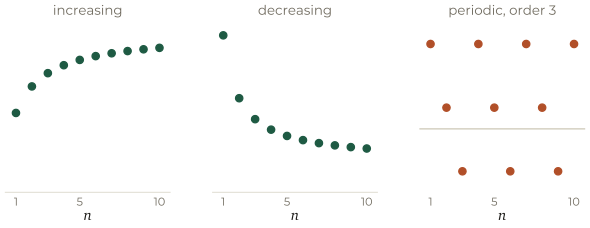
  • A sequence is increasing if un+1>unu_{n+1} > u_n for every nn, and decreasing if un+1<unu_{n+1} < u_n for every nn.
  • It is periodic if the terms repeat in a cycle: un+k=unu_{n+k} = u_n for every nn. The smallest such kk is the order of the sequence.
Three dot plots of the first ten terms of a sequence against n: one rising, one falling, and one repeating the values 2, one half and minus 1 in a cycle of three
Increasing, decreasing, and periodic with order 3.

To show a sequence is increasing, show that un+1−unu_{n+1} - u_n is positive for every nn, not just for the first few.

Worked example 5.3 · Proving a sequence is increasing

Show that the sequence un=3nn+1u_n = \dfrac{3n}{n + 1} is increasing.


  1. Subtract consecutive terms over a common denominator:

    un+1−un=3(n+1)n+2−3nn+1=3(n+1)2−3n(n+2)(n+1)(n+2)=3(n+1)(n+2)\begin{aligned} &u_{n+1} - u_n \\ &= \frac{3(n + 1)}{n + 2} - \frac{3n}{n + 1} \\ &= \frac{3(n + 1)^2 - 3n(n + 2)}{(n + 1)(n + 2)} \\ &= \frac{3}{(n + 1)(n + 2)} \end{aligned}
  2. For n≥1n \geq 1 the top and bottom are both positive, so un+1−un>0u_{n+1} - u_n > 0 and the sequence is increasing.

Worked example 5.4 · A periodic sequence

A sequence is defined by un+1=1−1unu_{n+1} = 1 - \dfrac{1}{u_n}, u1=2u_1 = 2. Show that it is periodic, state its order, and find u100u_{100}.


  1. The first few terms:

    u2=1−12=12u3=1−2=−1u4=1−(−1)=2\begin{aligned} u_2 &= 1 - \tfrac{1}{2} = \tfrac{1}{2} \\ u_3 &= 1 - 2 = -1 \\ u_4 &= 1 - (-1) = 2 \end{aligned}
  2. u4=u1u_4 = u_1, and each term depends only on the one before, so the terms repeat 2,12,−12, \tfrac{1}{2}, -1 for ever. The sequence is periodic with order 33.

  3. 100=3×33+1100 = 3 \times 33 + 1, so u100u_{100} is at the same point in the cycle as u1u_1: u100=2u_{100} = 2.

3. Sigma notation

The Greek capital sigma means “add up”. Below and above it go the first and last values of the counter rr.

Key result

∑r=1nur=u1+u2+u3+⋯+un\sum_{r=1}^{n} u_r = u_1 + u_2 + u_3 + \dots + u_n

For example,

∑r=15(2r+1)=3+5+7+9+11=35\begin{aligned} \sum_{r=1}^{5} (2r + 1) &= 3 + 5 + 7 + 9 + 11 \\ &= 35 \end{aligned}

Common mistake

Count the terms carefully. ∑r=520\sum_{r=5}^{20} has 20−5+1=1620 - 5 + 1 = 16 terms, not 1515: both ends are included.

4. Arithmetic sequences

An arithmetic sequence goes up or down by the same amount every time, like 5,8,11,14,…5, 8, 11, 14, \dots That amount is the common difference.

Key result

With first term aa and common difference dd, the nnth term is

un=a+(n−1)du_n = a + (n - 1)d

The nnth term needs n−1n - 1 steps of dd from the first term.

Worked example 5.5 · Two terms fix the sequence

The 5th term of an arithmetic sequence is 1717 and the 12th term is 4545. Find the first term and the common difference, and how many terms are less than 200200.


  1. Write both terms using the formula:

    a+4d=17a+11d=45\begin{aligned} a + 4d &= 17 \\ a + 11d &= 45 \end{aligned}
  2. Subtracting, 7d=287d = 28, so d=4d = 4 and a=1a = 1.

  3. The nnth term is 1+4(n−1)=4n−31 + 4(n - 1) = 4n - 3. For 4n−3<2004n - 3 < 200 we need n<50.75n < 50.75, so 5050 terms are less than 200200.

5. Arithmetic series

Adding up the terms of an arithmetic sequence gives an arithmetic series. There’s a neat trick for the sum, said to have been found by the mathematician Gauss as a schoolboy.

The sum of an arithmetic series

The sum of the first nn terms, with first term aa, common difference dd and last term ll, is

Sn=n2(2a+(n−1)d)=n2(a+l)S_n = \frac{n}{2}\big(2a + (n - 1)d\big) = \frac{n}{2}(a + l)

In particular, 1+2+3+⋯+n=n(n+1)21 + 2 + 3 + \dots + n = \dfrac{n(n + 1)}{2}.

Proof

Write the sum forwards, then backwards underneath:

Sn=a+(a+d)+⋯+lSn=l+(l−d)+⋯+a\begin{aligned} S_n &= a + (a + d) + \dots + l \\ S_n &= l + (l - d) + \dots + a \end{aligned}

Add the two lines pair by pair. Every pair adds to a+la + l, and there are nn pairs, so 2Sn=n(a+l)2S_n = n(a + l). Since l=a+(n−1)dl = a + (n - 1)d, this gives Sn=n2(2a+(n−1)d)S_n = \frac{n}{2}\big(2a + (n - 1)d\big).

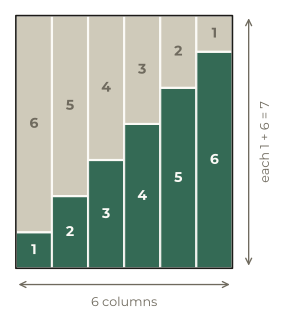
A staircase of columns of heights 1 to 6, and an upside-down copy stacked on top, together filling a 6 by 7 rectangle
Two copies of 1 + 2 + … + 6 fill a 6 × 7 rectangle, so the sum is half of 42.

The dark columns are the terms of an arithmetic series. Stack the same series upside down on top and every column reaches the same height, first term plus last, so two copies of the sum make a rectangle.

Worked example 5.6 · A sum with a known last term

Find the sum 1+5+9+⋯+1971 + 5 + 9 + \dots + 197.


  1. Here a=1a = 1 and d=4d = 4. The last term is the nnth, where 1+4(n−1)=1971 + 4(n - 1) = 197, so n=50n = 50.

  2. So

    S50=502(1+197)=4950S_{50} = \frac{50}{2}(1 + 197) = 4950

Worked example 5.7 · When does the sum pass a target?

Find the smallest number of terms of 3+5+7+…3 + 5 + 7 + \dots that add up to more than 10001000.


  1. With a=3a = 3 and d=2d = 2:

    Sn=n2(6+2(n−1))=n(n+2)\begin{aligned} S_n &= \tfrac{n}{2}\big(6 + 2(n - 1)\big) \\ &= n(n + 2) \end{aligned}
  2. Solve n2+2n−1000=0n^2 + 2n - 1000 = 0: the positive root is n=−1+1001=30.6n = -1 + \sqrt{1001} = 30.6 (3 s.f.).

  3. nn must be a whole number, so n=31n = 31. Check: S30=960S_{30} = 960 and S31=1023S_{31} = 1023.

Worked example 5.8 · A sum in sigma notation

Evaluate ∑r=120(3r+2)\displaystyle\sum_{r=1}^{20} (3r + 2).


The terms are 5,8,11,…,625, 8, 11, \dots, 62: an arithmetic series with 2020 terms, first term 55 and last term 6262. So

∑r=120(3r+2)=202(5+62)=670\sum_{r=1}^{20} (3r + 2) = \frac{20}{2}(5 + 62) = 670

Series in context

A salary starts at £24 000£24\,000 and rises by £800£800 each year. Over 1010 years the total earned is an arithmetic series with a=24 000a = 24\,000 and d=800d = 800: S10=5(48 000+9×800)=£276 000S_{10} = 5\big(48\,000 + 9 \times 800\big) = £276\,000.

Practice

Twelve questions in three tiers. Try each one properly before opening the solution — the solutions show full method, not just answers.

Warm-up

1 [3 marks]

A sequence has nnth term un=n2−3nu_n = n^2 - 3n.

  1. Find u5u_5. [1]
  2. Which term of the sequence is equal to 4040? [2]
Show solution

(a) u5=25−15=10u_5 = 25 - 15 = 10.

(b) n2−3n=40n^2 - 3n = 40 gives n2−3n−40=0n^2 - 3n - 40 = 0, so (n−8)(n+5)=0(n - 8)(n + 5) = 0. nn is a positive integer, so it is the 88th term.

2 [3 marks]

A sequence is defined by un+1=2un−1u_{n+1} = 2u_n - 1, u1=3u_1 = 3.

  1. Find u2u_2, u3u_3 and u4u_4. [2]
  2. Find ∑r=14ur\displaystyle\sum_{r=1}^{4} u_r. [1]
Show solution

(a) u2=2(3)−1=5u_2 = 2(3) - 1 = 5, u3=2(5)−1=9u_3 = 2(5) - 1 = 9 and u4=2(9)−1=17u_4 = 2(9) - 1 = 17.

(b) 3+5+9+17=343 + 5 + 9 + 17 = 34.

3 [3 marks]

An arithmetic sequence begins 7,11,15,…7, 11, 15, \dots

  1. Find the 20th term. [1]
  2. Find the sum of the first 20 terms. [2]
Show solution

(a) a=7a = 7 and d=4d = 4, so u20=7+19×4=83u_{20} = 7 + 19 \times 4 = 83.

(b) S20=202(7+83)=900S_{20} = \dfrac{20}{2}(7 + 83) = 900.

4 [2 marks]

Evaluate ∑r=110(4r−1)\displaystyle\sum_{r=1}^{10} (4r - 1).

Show solution

The terms are 3,7,11,…,393, 7, 11, \dots, 39: an arithmetic series with 1010 terms. So

∑r=110(4r−1)=102(3+39)=210\sum_{r=1}^{10} (4r - 1) = \frac{10}{2}(3 + 39) = 210

Standard

5 [4 marks]

The 3rd term of an arithmetic sequence is 1313 and the 10th term is 4848. Find the first term, the common difference, and the sum of the first 25 terms.

Show solution

a+2d=13a + 2d = 13 and a+9d=48a + 9d = 48. Subtracting, 7d=357d = 35, so d=5d = 5 and a=3a = 3.

S25=252(2×3+24×5)=252×126=1575\begin{aligned} S_{25} &= \tfrac{25}{2}\big(2 \times 3 + 24 \times 5\big) \\ &= \tfrac{25}{2} \times 126 = 1575 \end{aligned}
6 [4 marks]

A sequence is defined by un+1=kun−4u_{n+1} = ku_n - 4, u1=3u_1 = 3, where kk is a positive constant. Given that u3=11u_3 = 11, find the value of kk.

Show solution

u2=3k−4u_2 = 3k - 4, so u3=k(3k−4)−4=3k2−4k−4u_3 = k(3k - 4) - 4 = 3k^2 - 4k - 4. Setting this equal to 1111:

3k2−4k−15=0(3k+5)(k−3)=0\begin{aligned} 3k^2 - 4k - 15 &= 0 \\ (3k + 5)(k - 3) &= 0 \end{aligned}

kk is positive, so k=3k = 3.

7 [4 marks]

Show that the sequence un=2n+1n+1u_n = \dfrac{2n + 1}{n + 1} is increasing.

Show solution
un+1−un=2n+3n+2−2n+1n+1u_{n+1} - u_n = \frac{2n + 3}{n + 2} - \frac{2n + 1}{n + 1}

Over the common denominator (n+1)(n+2)(n + 1)(n + 2), the numerator is

(2n+3)(n+1)−(2n+1)(n+2)=2n2+5n+3−2n2−5n−2=1\begin{aligned} &(2n + 3)(n + 1) - (2n + 1)(n + 2) \\ &= 2n^2 + 5n + 3 - 2n^2 - 5n - 2 \\ &= 1 \end{aligned}

So un+1−un=1(n+1)(n+2)u_{n+1} - u_n = \dfrac{1}{(n + 1)(n + 2)}, which is positive for n≥1n \geq 1: un+1>unu_{n+1} > u_n and the sequence is increasing.

8 [4 marks]

A sequence is defined by un+1=11−unu_{n+1} = \dfrac{1}{1 - u_n}, u1=2u_1 = 2.

  1. Show that the sequence is periodic and state its order. [2]
  2. Find ∑r=130ur\displaystyle\sum_{r=1}^{30} u_r. [2]
Show solution

(a) u2=11−2=−1u_2 = \dfrac{1}{1 - 2} = -1, u3=12u_3 = \dfrac{1}{2} and u4=11−12=2=u1u_4 = \dfrac{1}{1 - \frac{1}{2}} = 2 = u_1. The terms repeat 2,−1,122, -1, \tfrac{1}{2}, so the sequence is periodic with order 33.

(b) Each cycle adds to 2−1+12=322 - 1 + \tfrac{1}{2} = \tfrac{3}{2}, and 3030 terms make 1010 cycles. The sum is 10×32=1510 \times \tfrac{3}{2} = 15.

9 [4 marks]

Find the smallest number of terms of the series 5+8+11+…5 + 8 + 11 + \dots whose sum is greater than 500500.

Show solution

With a=5a = 5 and d=3d = 3, Sn=n2(3n+7)S_n = \dfrac{n}{2}(3n + 7). Solve 3n2+7n−1000=03n^2 + 7n - 1000 = 0: the positive root is

n=−7+12 0496=17.1 (3 s.f.)n = \frac{-7 + \sqrt{12\,049}}{6} = 17.1 \text{ (3 s.f.)}

So n=18n = 18. Check: S17=493S_{17} = 493 and S18=549S_{18} = 549.

Exam style

10 [7 marks]
  1. Prove that the sum of the first nn terms of an arithmetic series with first term aa and common difference dd is n2(2a+(n−1)d)\dfrac{n}{2}\big(2a + (n - 1)d\big). [4]
  2. Find the sum of all the multiples of 77 between 100100 and 500500. [3]
Show solution

(a) Write the sum forwards and backwards, where l=a+(n−1)dl = a + (n - 1)d is the last term:

Sn=a+(a+d)+⋯+(l−d)+lSn=l+(l−d)+⋯+(a+d)+a\begin{aligned} S_n &= a + (a + d) + \dots + (l - d) + l \\ S_n &= l + (l - d) + \dots + (a + d) + a \end{aligned}

Adding term by term, each of the nn pairs sums to a+la + l, so

2Sn=n(a+l)=n(2a+(n−1)d)2S_n = n(a + l) = n\big(2a + (n - 1)d\big)

and dividing by 22 gives the result.

(b) The multiples of 77 from 105=15×7105 = 15 \times 7 to 497=71×7497 = 71 \times 7 form an arithmetic series with 71−15+1=5771 - 15 + 1 = 57 terms:

S=572(105+497)=57×301=17 157\begin{aligned} S &= \frac{57}{2}(105 + 497) \\ &= 57 \times 301 = 17\,157 \end{aligned}
11 [6 marks]

Ali saves £50£50 in the first month. Each month after that, he saves £5£5 more than the month before.

  1. How much does he save in the 12th month? [1]
  2. How much has he saved in total after 12 months? [2]
  3. In which month does his total savings first go over £3000£3000? [3]
Show solution

(a) 50+11×5=£10550 + 11 \times 5 = £105.

(b) S12=122(50+105)=£930S_{12} = \dfrac{12}{2}(50 + 105) = £930.

(c) Sn=n2(100+5(n−1))=n(5n+95)2S_n = \dfrac{n}{2}\big(100 + 5(n - 1)\big) = \dfrac{n(5n + 95)}{2}. Setting Sn=3000S_n = 3000 gives n2+19n−1200=0n^2 + 19n - 1200 = 0, with positive root

n=−19+51612=26.4 (3 s.f.)n = \frac{-19 + \sqrt{5161}}{2} = 26.4 \text{ (3 s.f.)}

Check: S26=£2925S_{26} = £2925 and S27=£3105S_{27} = £3105. So his total first goes over £3000£3000 in the 27th month.

12 [6 marks]

The sum of the first 10 terms of an arithmetic series is 175175, and the sum of the first 20 terms is 650650.

  1. Find the first term and the common difference. [4]
  2. Find the sum of the 21st to the 30th terms. [2]
Show solution

(a) S10=5(2a+9d)=175S_{10} = 5(2a + 9d) = 175, so 2a+9d=352a + 9d = 35.

S20=10(2a+19d)=650S_{20} = 10(2a + 19d) = 650, so 2a+19d=652a + 19d = 65.

Subtracting, 10d=3010d = 30, so d=3d = 3, and then 2a=35−27=82a = 35 - 27 = 8, so a=4a = 4.

(b) The 21st to 30th terms are S30−S20S_{30} - S_{20}:

S30=15(8+87)=1425S30−S20=1425−650=775\begin{aligned} S_{30} &= 15(8 + 87) = 1425 \\ S_{30} - S_{20} &= 1425 - 650 = 775 \end{aligned}