Year 2 Pure · Chapter 10
Addition and Double-Angle Formulae
Specification: Edexcel Pure 5.6–5.9 — Trigonometry · AQA section E6, E7, E8, E9
In this chapter
Key facts — this chapter
- and .
- .
- , and .
- .
- , where and . Its largest value is and its smallest is .
- To solve , write the left side in this form first.
is not : try , which gives on the left and on the right. This chapter finds what it really is. The formulae that come out of it turn sums of sines and cosines into single waves, which is how a wave’s height and timing are found in models.
1. The addition formulae
Key result
Watch the signs in the cosine formulae: a inside the bracket gives a between the terms.
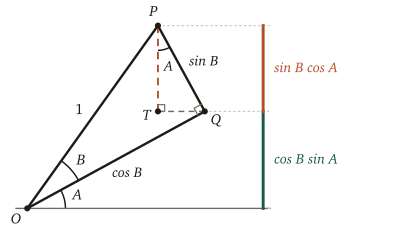
A geometric proof
In the figure, makes angle with the horizontal, so is at height . The right-angled triangle has angle at , so and .
- is at height .
- makes angle with the vertical, so is a further above .
Adding the two pieces, . The horizontal distances give in the same way. Replacing with gives the two minus formulae, and dividing by gives the one for .
Worked example 10.1 · An exact value
Find the exact value of .
-
Write as a difference of angles you know: .
-
Use :
Worked example 10.2 · Two angles in different quadrants
is acute with , and is obtuse with . Find the exact value of .
-
Find the missing ratios, with the right signs. is acute, so . is obtuse, where sine is positive, so .
-
Substitute:
Worked example 10.3 · Undoing the formula
Given that , find the exact value of .
, so the formula gives
2. Double-angle formulae
Put in the addition formulae and they become the double-angle formulae. Using turns the cosine one into three versions: choose the one that leaves only the function you want.
Key result
Rearranging the cosine versions gives and . With these are the half-angle formulae, and they are what you’ll use to integrate and in Chapter 15.
Worked example 10.4 · Double angles from a single ratio
Given that and is acute, find the exact values of and .
-
, positive because is acute.
-
Then
Worked example 10.5 · Solving with a double angle
Solve for .
-
Expand and factorise. Don’t divide by , which would lose solutions:
-
gives . gives .
So .
Worked example 10.6 · Choosing the right version
Solve for .
-
The right side has , so use :
-
is impossible, so and or .
Worked example 10.7 · Proving an identity
Prove that .
Use , which makes the s cancel:
3. The form R cos(θ − α)
Adding a cosine wave and a sine wave with the same period gives another wave with that period: it’s just taller and shifted along. Writing it as a single cosine tells you its height and where its peaks are.
Key result
For positive and ,
where and , with .
The same method gives the other forms: for , and for .
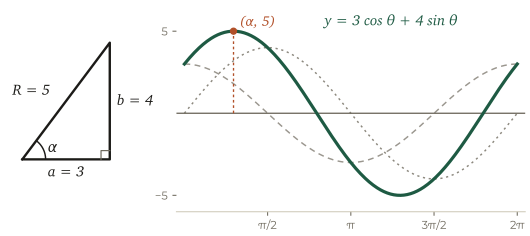
To see why, expand the right side:
Matching the coefficients with needs
Squaring and adding gives . Dividing gives .
Choose a and b. The faint waves are a cos θ and b sin θ; the solid one is their sum. However you choose them, the sum is a single cosine wave, and the right-angled triangle on the left gives its height R and its shift α.
Worked example 10.8 · Writing it as one wave
Express in the form , where and . State its maximum value and the smallest positive value of where it occurs.
-
and , so
So , to 3 s.f.
-
The largest value of a cosine is , so the maximum is , when , that is (3 s.f.).
Worked example 10.9 · Solving with the R form
Solve for , giving your answers to 3 significant figures.
-
From Example 10.8, , so , where
-
As runs from to , runs from to . In that interval,
( is too small to be in the interval.)
-
Add : or (3 s.f.).
Common mistake
Find from , not : the coefficient goes on top. Then check by expanding: should give back .
4. Modelling with the R form
Worked example 10.10 · Temperature in a greenhouse
The temperature in a greenhouse, °C, hours after midnight is modelled by . Find the highest temperature and the time of day at which it happens.
-
Write . By Example 10.8, with , so .
-
is largest when the cosine is , so the highest temperature is °C.
-
That happens when :
hours is minutes to the nearest minute, so the greenhouse is warmest at about 3:33 pm.
Practice
Twelve questions in three tiers. Try each one properly before opening the solution — the solutions show full method, not just answers.
Warm-up
Find the exact value of .
Show solution
, so use :
Write each of these as a single trigonometric function or an exact value.
- [1]
- [1]
- [1]
Show solution
(a) .
(b) .
(c) .
and are acute angles with and . Find , and hence show that .
Show solution
and are acute, so , and the only angle there with tangent is .
Given that , find the exact value of .
Show solution
Use the version with only: .
Standard
Solve for .
Show solution
Use :
gives or , and gives or . So .
Prove that .
Show solution
- Express in the form , where and , giving exact values of and . [3]
- Hence solve for . [3]
Show solution
(a) and , so and , giving . So the expression is .
(b) . As runs from to , runs from to , and in that interval
So or .
is obtuse with , and is acute with . Find the exact value of .
Show solution
is obtuse, so (positive). is acute, so . Then
- Show that . [4]
- Hence find the exact value of when . [1]
Show solution
(a) Write as :
(b) .
Exam style
- Express in the form , where and . Give to 4 decimal places. [3]
- State the maximum value of , and the smallest positive value of at which it occurs. [2]
- Solve for , to 3 significant figures. [3]
Show solution
(a) , so and . Then and (4 d.p.).
(b) The maximum is , when , that is (3 s.f.).
(c) . As runs from to , runs from to , and in that interval or . So
to 3 significant figures.
The depth of water in a harbour, metres, hours after midnight is modelled by
- Write in the form , giving exactly and to 4 decimal places. [3]
- Find the greatest depth, and the first time after midnight when it occurs, to the nearest minute. [3]
- State the least depth. [1]
- Give one reason why the model may not be realistic. [1]
Show solution
(a) and , so and (4 d.p.). So .
(b) The greatest depth is m, when the cosine is , so and Then hours is minutes, so this is at about 1:46 am.
(c) m.
(d) For example, real tides don’t repeat exactly every hours, and the depth also depends on the weather.
- Prove that . [3]
- Hence solve for . [3]
Show solution
(a) Use , which makes the s cancel:
(b) With , the equation is . As runs from to , runs from to , so or , and or . At both, , so the original fraction is defined.