Year 2 Mechanics · Chapter 3
Projectiles
Specification: Edexcel Paper 3 §7.5 — Projectiles · AQA section Q5
In this chapter
Key facts — this chapter
- Treat the horizontal and vertical motion separately. Ignoring air resistance, the only acceleration is vertically downwards.
- Projected at speed at angle above the horizontal: horizontal component , which never changes; vertical component , which changes at .
- The time links the two directions: find it from one, use it in the other.
- On level ground: time of flight , greatest height , range , greatest at .
- The path is a parabola: .
- The velocity at any time has components and : use Pythagoras for the speed and for the direction.
A thrown ball moves forwards and up and down at the same time. The trick is that these two motions don’t interfere: horizontally nothing acts on the ball, so it keeps a steady speed, while vertically it rises and falls under gravity exactly as in Year 1. Solve each direction on its own, joined by the time.
Modelling assumption
The ball is modelled as a particle with no air resistance, moving under a constant . Real balls spin and are slowed by the air, so they fall short of these predictions, especially over long distances.
1. Projected horizontally
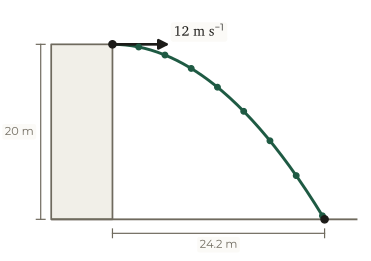
Worked example 3.1 · Thrown from a cliff
A ball is thrown horizontally at from the top of a vertical cliff m high. Find how long it takes to reach the ground, how far from the foot of the cliff it lands, and its speed as it lands.
-
Vertically, it starts with no vertical velocity and falls m:
-
Horizontally, it moves at a steady : m.
-
Landing: the horizontal velocity is still , and the vertical velocity is , so the speed is (3 s.f.).
In context
The ball lands m from the cliff after s, moving at at below the horizontal.
2. Projected at an angle
Components of the velocity
A particle projected at speed at an angle above the horizontal starts with
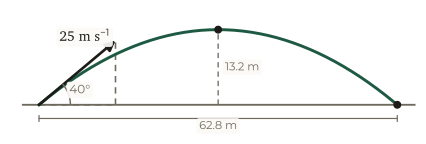
Worked example 3.2 · Time, range and height
A ball is kicked from level ground at at above the horizontal. Find its time of flight, its range and its greatest height.
-
Vertically, with up positive, and . It lands when the vertical displacement is zero again:
-
Horizontally: range m.
-
At the top the vertical velocity is zero. From :
Common mistake
At the top of the flight the vertical velocity is zero, but the ball is still moving: its horizontal velocity, , hasn’t changed. The speed at the top is , not zero.
Worked example 3.3 · The velocity after one second
For the ball in Example 3.2, find its speed and direction of motion s after it is kicked.
The speed is , at above the horizontal: is still positive, so the ball is still rising.
Launch a ball from level ground. Set its speed and angle: the path is drawn to scale, with a dot every half second, and the view fits the longest throw at that speed. The dashed path is the launch at the complementary angle, 90° minus yours, which lands in exactly the same place.
3. The general formulae
Doing Example 3.2 with letters instead of numbers gives formulae for any launch from level ground. You may be asked to derive them, so know the steps, not just the results.
Launch from level ground
For speed at angle to the horizontal:
Worked example 3.4 · Deriving the range
Show that the range on level ground is , and deduce the angle that gives the greatest range.
-
Vertically, , so (the other root, , is the launch).
-
Horizontally,
using from Chapter 10 of Year 2 Pure.
-
is greatest, , when . So the greatest range is , at .
Because , the angles and give the same range: a high lob and a low drive can land in the same place.
4. The path
The horizontal and vertical positions are both functions of : a pair of parametric equations, as in Chapter 11 of Year 2 Pure. Eliminating gives the Cartesian equation of the path.
The equation of the path
a parabola, taking the launch point as the origin.
Why it works
gives . Substitute into : the first term becomes and the second .
Worked example 3.5 · Over the wall?
A ball is thrown from ground level at at an angle above the horizontal, where . Find the equation of its path, and decide whether it clears a wall m high, m away.
-
, so , and
-
At : m (3 s.f.).
In context
The ball is m high as it reaches the wall, so it clears the m wall.
5. Launched above the ground
When the launch point is above the landing point, the flight doesn’t end when the vertical displacement returns to zero: it ends when the displacement equals minus the height. Choose up as positive and keep the sign.
Worked example 3.6 · Thrown up from a cliff
A stone is thrown at at above the horizontal from the top of a cliff m above the sea. Find how far from the foot of the cliff it enters the water.
-
Vertically, with up positive, it ends m below its start:
The positive root is s.
-
Horizontally: m (3 s.f.).
Practice
Twelve questions in three tiers. Try each one properly before opening the solution. The solutions show the full method, not just answers. Take , ignore air resistance, and give answers to 3 significant figures where they aren’t exact.
Warm-up
A stone is thrown horizontally at from a point m above level ground. Find the time it takes to land and how far it travels horizontally.
Show solution
Vertically: , so s. Horizontally: m.
A particle is projected at at above the horizontal. Find the horizontal and vertical components of its initial velocity.
Show solution
Horizontal: . Vertical: .
A ball is projected from level ground at at above the horizontal. Find its time of flight and its range.
Show solution
Vertically: , so s.
Horizontally: m.
A particle is projected at at above the horizontal. Find its greatest height above the point of projection.
Show solution
At the top : , so m.
Standard
A ball is projected at at above the horizontal. Find its speed and direction of motion s later.
Show solution
The speed is . is negative, so the ball is falling, at below the horizontal.
A particle is projected from level ground at speed at an angle above the horizontal. Show that its greatest height is .
Show solution
Vertically the initial velocity is and the acceleration is . At the greatest height the vertical velocity is zero, so by :
A ball is struck from level ground at and lands m away. Find the two possible angles of projection.
Show solution
The range is , so
or , so or : a low drive or a high lob.
A marble rolls off a horizontal table m high and lands on the floor m from the edge of the table. Find the speed of the marble as it leaves the table.
Show solution
Vertically: , so s. Horizontally the speed is constant: .
A particle is projected from the origin at at above the horizontal. Find the equation of its path.
Show solution
and , so
Exam style
A golf ball is hit from level ground at at an angle above the horizontal, where .
- Find the time of flight. [2]
- Find the range. [2]
- Find the greatest height. [2]
- Find for how long the ball is more than m above the ground. [3]
Show solution
and , so the components are vertically and horizontally.
(a) , so s.
(b) m.
(c) , so m.
(d) Solve , that is :
The ball is above m between these times, for s.
A stone is thrown at at above the horizontal from the top of a cliff m above the sea.
- Find the time taken for the stone to reach the sea. [4]
- Find how far from the foot of the cliff it enters the water. [2]
- Find its speed as it enters the water. [2]
Show solution
(a) Vertically, with up positive, and the displacement is :
The positive root is s.
(b) m.
(c) and , so the speed is .
A ball is kicked from ground level at at above the horizontal, towards a wall m high that is m away.
- Show that the ball passes over the wall. [4]
- Find how far beyond the wall the ball lands. [3]
Show solution
(a) The path is . At :
That is more than m, so the ball clears the wall.
(b) The range is m, so it lands m beyond the wall.