Year 2 Mechanics · Chapter 1
Moments
Specification: Edexcel Paper 3 §9.1 — Moments · AQA section S1
In this chapter
Key facts — this chapter
- The moment of a force about a point is the force times the perpendicular distance from the point to the line of the force. Its unit is the newton metre (N m), and it turns either clockwise or anticlockwise.
- A force at an angle to a rod, applied a distance along it, has moment about the other end.
- A rigid body is in equilibrium when the resultant force is zero and the resultant moment about every point is zero.
- Take moments about a point where an unknown force acts: that force has no moment there, so it drops out of the equation.
- A uniform rod’s weight acts at its midpoint. A non-uniform rod’s weight acts at its centre of mass, which you may need to find.
- A beam on the point of tilting about one support has zero reaction at the other.
Year 1 treated every body as a particle, a single point where all the forces act. A particle can speed up or slow down, but it can’t turn. Real objects can: a seesaw rocks, a door swings, a shelf tips off its brackets. This chapter models them as rigid bodies, which keep their shape but can rotate, and asks what it takes to stop them turning.
1. The moment of a force
Push a door near the hinge and it barely moves. Push the same amount near the handle and it swings easily. The turning effect depends on the force and on how far from the turning point it acts.
The moment of a force
The moment of a force about a point is
where is the perpendicular distance from to the line of action of the force. It is measured in newton metres (N m) and has a sense: clockwise or anticlockwise.
To find the resultant moment of several forces, choose one sense as positive, then add the moments that turn that way and subtract the rest.
Worked example 1.1 · The resultant moment
Three forces act on a light horizontal rod: N vertically down at a point m to the left of , N vertically down m to the right of , and N vertically up m to the right of . Find the resultant moment about .
-
The N force pulls down on the left, so it turns the rod anticlockwise. The N force pulls down on the right: clockwise. The N force pushes up on the right: anticlockwise.
-
Taking anticlockwise as positive:
In context
The resultant moment about is N m anticlockwise.
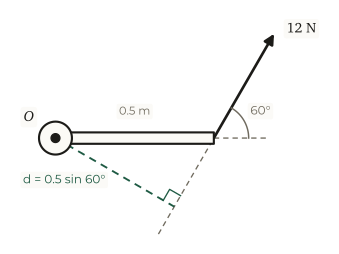
When a force is not perpendicular to the rod, only its perpendicular component turns it. Equivalently, use the perpendicular distance to the line of the force. Both routes give the same product.
Worked example 1.2 · A force at an angle
A force of N is applied to the end of a spanner of length m, at to the handle. Find its moment about the nut.
The perpendicular distance from the nut to the line of the force is , so
Resolving instead gives the same thing: the component of the force perpendicular to the handle is , acting m from the nut.
Common mistake
Don’t multiply by the distance along the rod when the force is at an angle to it. A force that points straight at the pivot has no turning effect at all, however far away it acts.
2. Rigid bodies in equilibrium
Equilibrium of a rigid body
A rigid body is in equilibrium when
- the resultant force on it is zero (it doesn’t start moving), and
- the resultant moment about any point is zero (it doesn’t start turning).
Why it works
The first condition is Newton’s first law, as in Year 1. The second is new, and it doesn’t matter which point you take moments about: if the forces balance, the resultant moment is the same about every point. So choose the point that makes the algebra easiest, usually one where an unknown force acts.
Modelling assumption
Modelling a plank as a rigid rod means it doesn’t bend. Modelling it as uniform means its mass is spread evenly, so its weight acts at its midpoint. Modelling a person on it as a particle means their weight acts at a single point.
Worked example 1.3 · A plank on two supports
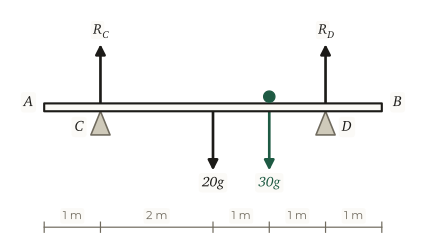
A uniform plank of length m and mass kg rests horizontally on supports at and , where m and m. A child of mass kg stands on the plank m from . Find the reactions at the supports.
-
Take moments about , so drops out. The plank’s weight acts m from , the child m from , and acts m from :
-
Resolve vertically: , so N.
In context
The support at pushes up with N and the support at with N: the child stands closer to , so takes more of the load.
To check, take moments about instead. Every other force acts to the left of : at m, the plank’s weight at m and the child at m. turns the plank one way and both weights turn it the other, so and again. Getting the side of each force right is most of the work.
3. Centres of mass
A non-uniform rod is heavier at one end, so its weight doesn’t act at the midpoint. It acts at the rod’s centre of mass, and the conditions for equilibrium can find where that is.
Worked example 1.4 · Finding the centre of mass
A non-uniform rod of length m and mass kg hangs horizontally from two vertical strings, one at and one at . The tension in the string at is twice the tension in the string at . Find the distance of the centre of mass from .
-
Resolve vertically: and , so .
-
Let the centre of mass be m from . Take moments about :
so .
In context
The centre of mass is m from : the rod is heavier towards , which is why that string carries more of the weight.
4. On the point of tilting
Walk out along a plank that overhangs its support and, at some point, it tips up. Just before that happens, the plank is about to lift off the other support, so the reaction there has fallen to zero.
On the point of tilting
When a beam is on the point of tilting about one support, the reaction at the other support is zero. Take moments about the support it tilts about.
Worked example 1.5 · How far can he walk?
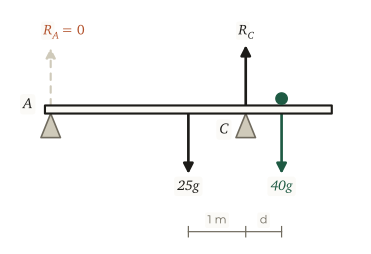
A uniform plank of length m and mass kg rests horizontally on two supports, one at its end and one at , where m. A man of mass kg walks along the plank from towards the other end. How far beyond can he go before the plank tilts?
-
On the point of tilting about , the reaction at is zero.
-
The plank’s weight acts at its midpoint, m from , which is m on the side of . Let the man be m beyond . Taking moments about :
-
The plank overhangs by m, so he reaches this point before the end.
In context
He can walk m beyond . Any further and the plank tilts about .
A uniform 6 m plank of mass 20 kg rests on supports at C, 1 m from A, and D, 2 m from B. Move the child along it and change their mass. The two reactions share the load between them, and when one of them would have to pull down instead of pushing up, the plank tilts.
5. Forces at an angle
A shelf bracket, a drawbridge or a sign hanging from a pole: a rod hinged at one end and held up by a slanting string. The string pulls at an angle, so only its perpendicular component turns the rod, and the hinge supplies whatever force is needed to keep the rest in balance.
Worked example 1.6 · A rod held by a string
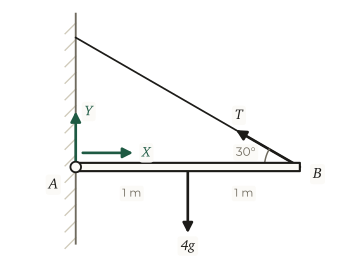
A uniform rod of length m and mass kg is hinged to a vertical wall at . It is held horizontal by a light string attached to and to a point on the wall above , and the string makes an angle of with the rod. Find the tension in the string and the force exerted by the hinge.
-
Take moments about , so the unknown hinge force drops out. The component of the tension perpendicular to the rod is , acting m from :
-
Resolve for the hinge force, with components horizontally and vertically:
-
Its size is N, at an angle above the horizontal.
In context
The string pulls with N. The hinge pushes on the rod with N at above the horizontal, out from the wall.
Common mistake
A hinge can push or pull in any direction, so give its force two unknown components. Don’t assume it acts along the rod.
Practice
Twelve questions in three tiers. Try each one properly before opening the solution. The solutions show the full method, not just answers. Take throughout. Rods and planks are rigid, and strings are light, unless a question says otherwise.
Warm-up
Find the moment about of
- a force of N whose line of action is a perpendicular distance of m from ,
- a force of N acting at the end of a rod m long, pivoted at , at to the rod.
Show solution
(a) N m.
(b) The perpendicular distance is m, so the moment is N m.
A light rod of length m rests on a pivot at , where m. A weight of N hangs from . Find the vertical force that must act at to keep the rod horizontal, and the force on the pivot.
Show solution
Take moments about : , so N, acting vertically downwards at .
Resolve vertically: the pivot pushes up with N.
Three vertical forces act on a light horizontal rod of length m: N down at , N up at , where m, and N down at . Find the resultant moment about .
Show solution
The N force acts at , so it has no moment about . The N force acts m to the left of (anticlockwise, N m); the N force acts m to the right of (clockwise, N m).
The resultant moment is N m clockwise.
A uniform rod of length m and mass kg rests horizontally on supports at and . A particle of mass kg is placed on the rod m from . Find the reactions at the supports.
Show solution
Take moments about :
Resolve vertically: N.
Standard
A uniform plank of length m and mass kg rests horizontally on supports at and , where m and m. A child of mass kg stands on the plank at , and the reactions at the two supports are equal. Find the distance .
Show solution
The total weight is , so each reaction is . m, the plank’s weight acts m from , and the child is from . Taking moments about :
so and m.
A non-uniform rod of length m and mass kg rests horizontally on supports at and . The reaction at is N. Find the distance of the centre of mass of the rod from .
Show solution
Resolve vertically: .
Take moments about , with the centre of mass m from : , so m (3 s.f.).
A uniform plank of length m and mass kg rests horizontally on two supports, one at and one at , where m.
- Find the greatest mass that can be placed at without the plank tilting. [3]
- A particle of mass kg is placed at . Find the reactions at and . [2]
Show solution
(a) On the point of tilting about , the reaction at is zero. The plank’s weight acts m on the side of , and is m on the other side:
The greatest mass is kg.
(b) Take moments about : , so N. Then N.
A uniform rod of length m and mass kg is hinged to a vertical wall at . It is held horizontal by a light string attached to and to a point on the wall above , making an angle of with the rod.
- Find the tension in the string. [3]
- Show that the force exerted by the hinge has the same size as the tension. [2]
Show solution
(a) Take moments about :
(b) From (a), . The hinge’s components are horizontally and vertically, so
A uniform rod of length m and mass kg has a particle of mass kg fixed at and a particle of mass kg fixed at . Find the distance from of the point where the rod balances on a single support.
Show solution
Let the support be m from . The rod’s weight acts from it and the kg particle from it, both on the side:
so the rod balances m from .
Exam style
A uniform beam of length m and mass kg rests horizontally on supports at and , where m and m. A man of mass kg stands on the beam.
- The reactions at and are equal. Find the man’s distance from . [4]
- The man walks towards . How far beyond can he go before the beam tilts? [3]
- State one modelling assumption you have made about the man. [1]
Show solution
(a) Each reaction is . Let the man be m from . m and the beam’s weight acts m from . Taking moments about :
so m.
(b) On the point of tilting about , the reaction at is zero. The beam’s weight acts m on the side of . With the man m beyond : , so m. That is less than m, so he reaches it: he can go m beyond .
(c) The man is modelled as a particle, so his weight acts at a single point.
A non-uniform rod of length m and mass kg hangs horizontally from two vertical strings attached at and , where m and m. A particle of mass kg is attached to the rod at , and the tensions in the two strings are then equal.
- Find the distance of the centre of mass of the rod from . [5]
- The particle is removed. Find the new tensions in the strings. [3]
Show solution
(a) Each tension is . Let the centre of mass be m from . The particle at is m on one side of ; and the centre of mass are on the other. Taking moments about :
so m.
(b) Take moments about : , so N. Then N.
A uniform rod of length m and mass kg is hinged to a vertical wall at , and a particle of mass kg is attached at . The rod is held horizontal by a light string attached at , where m, and to a point on the wall above . The string makes an angle of with the rod.
- Find the tension in the string. [3]
- Find the horizontal and vertical components of the force exerted by the hinge, and describe its direction. [5]
Show solution
(a) Take moments about :
so N, or N (3 s.f.).
(b) Horizontally the hinge balances the pull of the string towards the wall: , so N (3 s.f.) out from the wall.
Vertically, taking upwards: , so N.
The vertical component is negative: the hinge pulls the rod down with N. The string holds up slightly more than the total weight, because it is attached nearer the wall than the load at .