Year 2 Mechanics · Chapter 2
Forces and Friction
Specification: Edexcel Paper 3 §8.2, 8.4–8.6 — Forces and Newton's laws · AQA section R2, R4–R6
In this chapter
Key facts — this chapter
- A force at an angle to a direction has component along that direction and perpendicular to it.
- To find a resultant, add the components in two perpendicular directions: magnitude , direction from the direction.
- A particle is in equilibrium when the forces on it balance in two perpendicular directions.
- Friction opposes motion, or the tendency to move. , where is the coefficient of friction and the normal reaction. When the body moves or is on the point of moving, (limiting friction).
- On a slope at angle , the weight splits into down the slope and into it.
- A particle rests on a rough slope, with no other forces along it, exactly when .
Year 1 kept every force along one of two perpendicular lines: horizontal and vertical, or along a string. Real forces pull at angles, slopes tilt the weight out of line, and surfaces grip. This chapter adds the tools for all three: resolving forces, the friction model , and particles on inclined planes.
1. Resolving forces
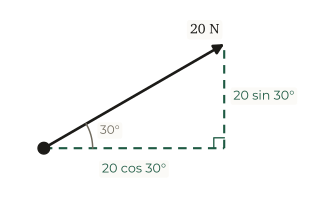
Resolving a force
A force making an angle with a direction has components
Together the two components have exactly the same effect as .
Worked example 2.1 · Components of a force
A force of N acts at above the horizontal. Find its horizontal and vertical components.
To combine several forces, resolve each one in the same two directions, add, and then put the two totals back together with Pythagoras.
Worked example 2.2 · The resultant of three forces
Three forces act on a particle: N due east, N due north, and N in the direction west of north. Find the magnitude and direction of the resultant.
-
Resolve east and north:
-
The magnitude is N (3 s.f.), and the angle east of north is .
In context
The resultant is N on a bearing of (to the nearest degree).
2. Particles in equilibrium
A particle is in equilibrium when the resultant force is zero. That is two equations: the forces balance in each of two perpendicular directions. Choose the directions that make the equations simplest, usually horizontal and vertical, or along and perpendicular to a slope.
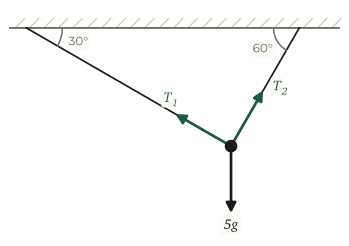
Worked example 2.3 · Hanging from two strings
A particle of mass kg hangs in equilibrium from two light strings. One makes an angle of with the horizontal and has tension ; the other makes with the horizontal and has tension . Find both tensions.
-
Resolve horizontally and vertically:
-
The first gives . Substituting, , so N and N (3 s.f.).
In context
The steeper string does more of the holding up: N against N.
3. Friction
Push a heavy box gently and nothing happens: friction pushes back just as hard. Push harder and friction grows to match, but only up to a limit. Beyond it, the box slides.
The friction model
Friction acts along the surface, opposing motion or the tendency to move, and
where is the normal reaction and is the coefficient of friction, a number that depends on the two surfaces. A smooth surface has .
When the body is moving, or on the point of moving, friction is limiting: .
Worked example 2.4 · Will it move?
A box of mass kg rests on a rough horizontal floor, and the coefficient of friction is . A horizontal force acts on it. Describe what happens when (a) N and (b) N.
N, so the greatest friction available is N.
(a) , so friction can match the push: the box stays at rest, with friction N.
(b) , so the box slides, with friction N:
Common mistake
Friction is not always . It is only as large as it needs to be, up to . In Example 2.4(a) it is N, not N: if it were N, the box would accelerate backwards.
When a force pulls at an angle, it also lifts: the normal reaction, and with it the friction, both fall.
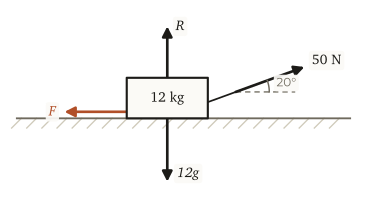
Worked example 2.5 · Pulling at an angle
A sledge of mass kg is pulled across rough horizontal ground by a rope with tension N at above the horizontal. The coefficient of friction is . Find the acceleration of the sledge.
-
Resolve vertically: , so N.
-
The sledge moves, so N.
-
Resolve horizontally:
to 3 significant figures.
4. Inclined planes
On a slope, resolve along and perpendicular to the slope. The normal reaction and friction then each lie along one direction, and only the weight needs splitting.
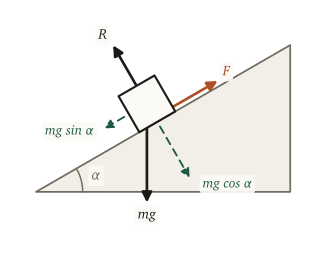
A particle on a slope
On a plane inclined at to the horizontal, the weight has components
With no other forces perpendicular to the slope, .
Why it works
The angle between the weight and the perpendicular to the slope is too: tilt the slope by and its perpendicular tilts by the same angle away from the vertical. So the component into the slope is the adjacent side, , and the component down it is .
Worked example 2.6 · A smooth slope
A particle is released from rest on a smooth plane inclined at to the horizontal. Find its acceleration and its speed after s.
Resolving down the slope, , so . The mass cancels. After s, .
The classic slope in exam questions has , so and exactly: the , , right-angled triangle.
Worked example 2.7 · Does it slide?
A particle of mass kg is placed on a rough plane inclined at to the horizontal, where . The coefficient of friction is . Show that the particle slides, and find its acceleration.
-
Perpendicular to the slope: N, so the greatest friction is N.
-
Down the slope the weight pulls with N, more than friction can hold, so the particle slides.
-
Down the slope:
A 5 kg block rests on a rough slope. Tilt the slope and change the coefficient of friction. Friction supplies whatever is needed to hold the block, up to its limit μR; once the slope asks for more than that, the block slides.
Friction always opposes the way the body would move, so its direction depends on the other forces. Push up a slope and friction acts down it; hold a particle back from sliding and friction acts up it.
Worked example 2.8 · Friction changes direction
The particle of Example 2.7 is held on the slope by a force acting up the slope, parallel to it. Find when the particle is on the point of moving (a) up the slope and (b) down the slope.
(a) About to move up: friction acts down the slope, so N.
(b) About to slide down: friction acts up the slope, so N.
In context
Any force between N and N keeps the particle at rest. Below that it slides down; above it, it moves up.
Common mistake
On a slope, is not . It is , and less again if another force pulls away from the slope. Every friction calculation starts from , so find it first.
Modelling assumption
The block is modelled as a particle, so it can’t topple, and is taken as constant, the same at rest and when sliding. In reality friction just before sliding is usually a little larger than once the body is moving.
Practice
Twelve questions in three tiers. Try each one properly before opening the solution. The solutions show the full method, not just answers. Take throughout, and give answers to 3 significant figures where they aren’t exact.
Warm-up
A force of N acts at above the horizontal. Find its horizontal and vertical components.
Show solution
Horizontal: N. Vertical: N.
Forces of N due east and N due north act on a particle. Find the magnitude of the resultant and the angle it makes with east.
Show solution
The magnitude is N, at north of east.
A box of mass kg rests on rough horizontal ground, where the coefficient of friction is . A horizontal force of N acts on it. Does the box move? Find the friction force.
Show solution
N, so friction can be at most N. That is more than N, so the box stays at rest, and friction is N: just enough to balance the push.
A particle slides down a smooth plane inclined at to the horizontal. Find its acceleration.
Show solution
.
Standard
A particle is in equilibrium under three forces: N due east, N due north, and N in the direction south of west. Find and .
Show solution
Resolve east: , so N.
Resolve north: N.
A particle of mass kg hangs in equilibrium from two light strings, which make angles of and with the horizontal. Find the tension in each string.
Show solution
Let the tensions be (at ) and (at ). Resolving:
The first gives . Substituting and solving, N and N.
A sledge of mass kg is pulled across rough horizontal snow at constant speed by a rope with tension N at above the horizontal. Find the coefficient of friction.
Show solution
Constant speed, so the forces balance.
Vertically: N.
Horizontally: N.
It is moving, so : .
A block of mass kg rests on a rough plane inclined at to the horizontal. Find the friction force, and the least possible value of the coefficient of friction.
Show solution
Along the slope, friction balances the component of the weight: N.
It stays at rest, so with . That needs .
A particle of mass kg is released from rest on a rough plane inclined at to the horizontal, where . The coefficient of friction is . Find its acceleration and how far it slides in the first s.
Show solution
, so the friction is . Down the slope:
In s it slides m.
Exam style
A particle of mass kg rests on a rough plane inclined at to the horizontal. The coefficient of friction is . A force N acts on the particle up the slope, parallel to it.
- Find the value of when the particle is on the point of moving up the slope. [3]
- Find the least value of that stops it sliding down. [2]
- Given that , find the acceleration of the particle. [3]
Show solution
, so limiting friction is N. The weight’s component down the slope is N.
(a) Friction acts down the slope: N.
(b) Friction acts up the slope: N.
(c) , so the particle moves up the slope with limiting friction acting down it:
A box of mass kg is pushed across a rough horizontal floor by a force of N directed at below the horizontal. The coefficient of friction is .
- Find the acceleration of the box. [5]
- Explain why pushing downwards like this makes the friction larger. [2]
Show solution
(a) Vertically the push adds to the weight: N, so N. Horizontally:
(b) Part of the push presses the box into the floor, which increases the normal reaction, and the limiting friction grows with it.
A particle is projected with speed up a line of greatest slope of a rough plane inclined at to the horizontal, where . The coefficient of friction is .
- Find how far up the plane the particle travels before coming to rest. [5]
- Show that it then slides back down, and find its speed when it returns to its starting point. [4]
Show solution
Per kilogram: the weight’s component along the slope is and the limiting friction is .
(a) Moving up, both act down the slope, so the deceleration is . From : , so m.
(b) At rest, friction could hold at most per kilogram, less than the pulling it down, so it slides back (). Now friction acts up the slope and .