Year 2 Mechanics · Chapter 4
Applications of Forces
Specification: Edexcel Paper 3 §8.4, 8.6, 9.1 — Statics, friction and moments · AQA section R4, R6, S1
In this chapter
Key facts — this chapter
- Every problem in this chapter uses the same three tools: resolve in two perpendicular directions, the friction model , and, for a rigid body, moments.
- Friction opposes the motion that would happen without it. Decide which way the body is about to move first; the direction of friction follows.
- A rigid body is in equilibrium when the forces balance in two directions and the moments balance about any one point. Take moments about the point where most of the unknown forces act.
- Ladders: a smooth wall pushes at right angles to itself only; rough ground gives a normal reaction and friction towards the wall. On the point of slipping, .
- Connected particles: write an equation of motion for each particle, joined by the tension and the shared acceleration. First check that the system moves at all.
- When a string goes slack its tension is zero, and each particle moves on its own under the forces that remain.
Chapters 1 and 2 built the tools one at a time: moments for rigid bodies, resolving and friction for particles. Real problems need them together. A ladder leans on a wall and relies on friction at its foot; a crate is dragged up a rough ramp by a falling weight. This chapter puts the tools to work, and the skill it builds is choosing which one to use at each step.
1. Particles in limiting equilibrium
A force that pushes at an angle to a surface does two jobs: part of it drives the particle along, and part presses it into the surface or lifts it away. That second part changes , and with it the greatest friction . So find first, with every force included.
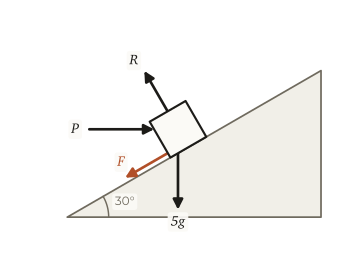
Worked example 4.1 · Pushed horizontally
A particle of mass kg rests on a rough plane inclined at to the horizontal, with coefficient of friction . It is held by a horizontal force in the vertical plane through a line of greatest slope. Find when the particle is on the point of moving (a) up the plane and (b) down the plane.
-
Perpendicular to the plane, presses the particle into it as well:
so the greatest friction is . The weight’s component down the plane is N.
-
(a) About to move up: friction acts down the plane. Along the plane,
so and N (3 s.f.).
-
(b) About to slide down: friction acts up the plane. Along the plane,
so and N (3 s.f.).
In context
Any horizontal force from N to N holds the particle still. Pushing up the plane costs more than it would with a force parallel to the plane, because part of the push, , presses the particle in and raises the friction.
Common mistake
Friction has no fixed direction. It opposes the motion that is about to happen, so it flips between parts (a) and (b), and its size changes too, because depends on . Draw a separate force diagram for each case.
2. Rigid bodies with friction
A rigid body resting on rough ground can slide as well as turn. The conditions from Chapter 1 still hold, and friction adds one more unknown and one more fact.
A rigid body in limiting equilibrium
Resolve horizontally, resolve vertically, and take moments about one point: three equations. Where the body is on the point of slipping, add at that contact.
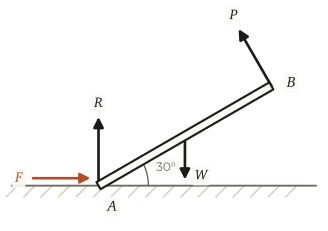
Worked example 4.2 · The least coefficient of friction
A uniform rod of length and weight rests with on rough horizontal ground. It is held at to the ground by a force at , acting at right angles to the rod in the vertical plane containing it. Find in terms of , and the least possible value of the coefficient of friction.
-
Take moments about , where both unknown ground forces act. is at right angles to the rod, from ; the weight acts at the midpoint, a horizontal distance from :
-
makes with the vertical. Resolve horizontally and vertically:
-
The rod rests only if , so .
In context
The coefficient of friction must be at least (3 s.f.). The length and the weight both cancel, so the answer holds for any such rod.
3. Ladders
The standard ladder problem is the model at its clearest. The ladder is a uniform rod. The wall is smooth, so it pushes at right angles to itself, horizontally and away from the wall. The ground is rough, so it gives an upward reaction and a friction force . If the ladder slipped, its foot would slide out from the wall, so friction acts towards the wall.
Modelling assumption
The ladder is a uniform rod: rigid, straight, with its weight at the midpoint. The wall is smooth. A climber is a particle at one point of the ladder. A real wall has some friction, which helps: the ladder is a little safer than the model predicts.
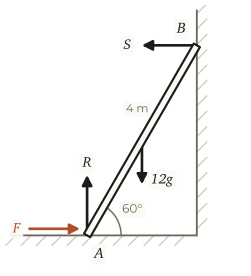
Worked example 4.3 · On the point of slipping
A uniform ladder , of length m and mass kg, rests with its foot on rough horizontal ground and its top against a smooth vertical wall. It makes with the ground and is on the point of slipping. Find the coefficient of friction between the ladder and the ground.
-
Vertically: .
-
Moments about . The wall’s force acts at , a height above ; the weight acts a horizontal distance from :
-
Horizontally , and on the point of slipping :
The length and the mass cancelled. With letters, the same steps show that a uniform ladder on its own is on the point of slipping when , where is its angle to the ground. Stand it any steeper and it holds; the smaller , the steeper it must stand.
Common mistake
Take moments about the foot, not the top. Two unknowns, and , act at the foot, so both drop out of the moments equation there. About the top only drops out, and you are left with two unknowns in one equation.
Worked example 4.4 · How far can he climb?
A uniform ladder of length m and mass kg rests on rough horizontal ground against a smooth vertical wall, at an angle to the ground, where . The coefficient of friction is . A man of mass kg climbs the ladder. How far up the ladder can he climb before it slips?
-
Vertically: , so friction can be at most . On the point of slipping , and horizontally the wall’s force is .
-
and . With the man m up the ladder, measured from the foot, the distances from the foot are:
- the top: m up;
- the ladder’s centre: m across;
- the man: m across.
-
Take moments about the foot and divide through by :
In context
He can climb m, just over halfway. As he climbs, stays at , but the wall must push harder to balance his growing moment, so the foot needs more friction. At m it needs all the ground can give.
A uniform 5 m ladder of mass 20 kg stands on rough ground against a smooth wall, and a climber of mass 80 kg goes up it. With each step the wall has to push harder, so the foot needs more friction, but the ground can give at most μR. Set the angle and μ, then climb.
4. Connected particles
Year 1 joined particles by strings over smooth pulleys, on smooth surfaces. Add slopes and friction and the method is the same: an equation of motion for each particle, joined by the tension and the shared acceleration . There is one new first step.
Does it move?
Before finding an acceleration, compare the force trying to move the system with the greatest friction that can resist it. If the friction can match it, the system stays at rest, and the friction is only as large as it needs to be.
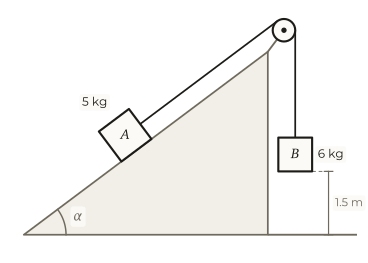
Worked example 4.5 · Up a rough slope
Particle , of mass kg, rests on a rough plane inclined at to the horizontal, where . The coefficient of friction is . A light inextensible string, parallel to a line of greatest slope, joins over a smooth pulley at the top of the plane to particle , of mass kg, which hangs freely. The system is released from rest. Find the acceleration and the tension in the string.
-
For : , so friction is at most . The weight down the plane is .
-
Does it move? pulls with , more than , so falls and moves up the plane, with limiting friction acting down it.
-
An equation of motion for each particle:
-
Adding eliminates : , so (3 s.f.). Then N (3 s.f.).
Worked example 4.6 · When the string goes slack
In Example 4.5, starts m above the ground and does not rebound. Find how much further moves up the plane, and what happens to it next.
-
falls m from rest at : , so (3 s.f.).
-
Then the string goes slack. With , the weight component and the friction both act down the plane on , so it decelerates at .
-
From with final speed zero:
-
At rest, is more than , so friction cannot hold on the plane.
In context
moves a further m up the plane, stops for an instant, then slides back down.
Common mistake
Once the string is slack, don’t carry on using the acceleration you found for the connected system. The forces on have changed: the tension has gone, and if turns round, friction changes direction too.
Practice
Twelve questions in three tiers. Try each one properly before opening the solution. The solutions show the full method, not just answers. Take and give answers to 3 significant figures where they aren’t exact. Ladders and rods are uniform, strings are light and inextensible, and pulleys are smooth, unless a question says otherwise.
Warm-up
A box of mass kg rests on rough horizontal ground, with coefficient of friction . It is pushed by a force acting at below the horizontal. Find when the box is on the point of moving.
Show solution
Vertically, the push adds to the weight: .
Horizontally, on the point of moving:
so N.
A ladder of length m and mass kg rests on rough horizontal ground against a smooth vertical wall, at to the ground. Find the force exerted by the wall, and the friction and normal reaction at the foot.
Show solution
Moments about the foot:
Horizontally N, and vertically N.
Particle , of mass kg, lies on a smooth plane inclined at . A string parallel to the plane joins it, over a pulley at the top, to particle , of mass kg, which hangs freely. The system is released from rest. Find the acceleration and the tension.
Show solution
Adding: , so , and N.
A ladder rests on rough horizontal ground, with coefficient of friction , against a smooth vertical wall. Find the smallest angle to the ground at which it can rest.
Show solution
A ladder on its own is on the point of slipping when , so . Any smaller angle and it slips.
Standard
A particle of mass kg rests on a rough plane inclined at , with coefficient of friction . A string pulls it with tension at above a line of greatest slope, up the plane. Find when the particle is on the point of moving up the plane.
Show solution
The string lifts the particle a little: .
About to move up, friction acts down the plane:
so N.
A ladder of length m and mass kg rests at to rough horizontal ground, with coefficient of friction , against a smooth vertical wall. A woman of mass kg climbs the ladder. How far up can she go before it slips?
Show solution
, so on the point of slipping , and . Take moments about the foot, with the woman m up, and divide through by . The ladder’s weight acts m across, and the woman m across:
so m.
A rod of length m and mass kg rests with on rough horizontal ground and touches a smooth peg at , where m. The rod makes with the ground and is in limiting equilibrium. Find the force from the peg and the coefficient of friction.
Show solution
The peg is smooth, so its force is at right angles to the rod. Moments about :
makes with the vertical. Resolving:
Limiting, so .
Particle , of mass kg, rests on a rough plane inclined at , with coefficient of friction . A string parallel to the plane joins it, over a pulley at the top, to particle , of mass kg, which hangs freely. Show that the system stays at rest, and find the friction on .
Show solution
Up the plane, pulls with N. Down the plane, the weight component is N, and friction can give up to N.
is less than , so can’t be pulled up; and is less than , so it can’t slide down either. The system stays at rest.
With , the friction needed is N, acting down the plane, well within its limit.
Particle , of mass kg, lies on a rough horizontal table, with coefficient of friction . A string joins it, over a pulley at the edge, to particle , of mass kg, which hangs m above the floor. The system is released from rest.
- Find the acceleration and the tension. [4]
- hits the floor and does not rebound. Find how much further slides, assuming it does not reach the pulley. [3]
Show solution
(a) Friction on is :
Adding: , so , and N.
(b) . Then only friction acts on , decelerating it at :
Exam style
Particle , of mass kg, rests on a rough plane inclined at , where , with coefficient of friction . A string parallel to a line of greatest slope joins it, over a pulley at the top of the plane, to particle , of mass kg, which hangs m above the ground. The system is released from rest.
- Find the acceleration of the system. [3]
- Find the tension in the string. [1]
- Find the speed of as it hits the ground. [2]
- does not rebound. Find how much further moves up the plane, and state what happens to it next. [3]
Show solution
(a) For : , so friction is ; the weight component is . pulls with , more than , so the system moves:
Adding: , so .
(b) N.
(c) , so .
(d) Now and both act down the plane on , a deceleration of . So m.
is more than , so then slides back down the plane.
A ladder , of length m and mass kg, rests with on rough horizontal ground and against a smooth vertical wall, at an angle to the ground, where . A painter of mass kg stands on the ladder at , where m, and the ladder is on the point of slipping.
- Find the coefficient of friction. [5]
- Find the least coefficient of friction that would let the painter stand at the top of the ladder. [2]
- State how you have used the fact that the ladder is uniform. [1]
Show solution
(a) Vertically, . Take moments about : the ladder’s weight acts across and the painter across, so the weights give :
Horizontally , and limiting, so .
(b) With the painter at , , so
(c) Uniform means the ladder’s weight acts at its midpoint, m from .
A ladder of weight rests with its foot on rough horizontal ground and its top against a rough vertical wall. The coefficient of friction is at both. The ladder is on the point of slipping, at an angle to the ground.
- Show that the normal reaction at the ground is . [4]
- Show that . [4]
Show solution
(a) On the point of slipping, friction is limiting at both ends: at the foot towards the wall, and at the top up the wall, resisting the top sliding down. Resolving:
so and .
(b) . Let the ladder’s length be . Moments about the foot: and the wall’s friction act at the top, which is up and across:
putting and dividing by . So .