Year 1 Pure · Chapter 15
Vectors
Specification: Edexcel Pure 10 — Vectors · AQA section J
In this chapter
Key facts — this chapter
- A vector has magnitude and direction; in 2D it’s written or as a column .
- Magnitude (length): — Pythagoras on the components.
- Add/subtract component by component; multiply by a scalar multiplies each component.
- Displacement (position of minus position of ).
- Parallel vectors are scalar multiples of each other: .
- A point dividing in ratio has position vector .
A number tells you how much; a vector tells you how much and which way. Vectors package a size and a direction into one object, which makes journeys, forces and displacements clean to calculate with.
1. Vectors, components and magnitude
A 2D vector is described by how far it goes across and up: its components.
Key result
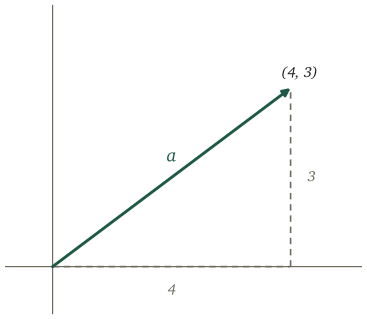
The vector goes across and up. Its magnitude (length) is
— just Pythagoras on the two components.
Worked example 15.1 · Magnitude of a vector
Find the magnitude of .
Apply Pythagoras to the components (the signs don’t matter once squared):
2. Vector arithmetic
Vectors add, subtract and scale exactly as you’d hope — one component at a time.
Key result
Geometrically, addition is tip-to-tail: draw the first vector, start the second at its tip, and the resultant runs from the very start to the very end.
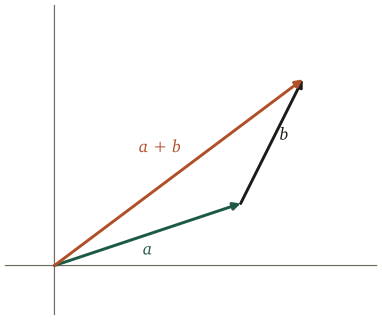
Set the components of a and b. Vector b is drawn from the tip of a, so the resultant a + b runs from the origin straight to the end — tip to tail.
Worked example 15.2 · Combining vectors
Given and , find .
-
Scale by :
-
Subtract component by component:
3. Position and displacement vectors
The position vector of a point is , the vector from the origin to . The vector between two points comes from subtracting their positions.
Key result
The distance is then .
Worked example 15.3 · Displacement and distance
Points and have position vectors and . Find and the distance .
-
Displacement is “end minus start”:
-
Distance is its magnitude:
Common mistake
is , not — end minus start. Getting it backwards gives , the same length but the opposite direction.
4. Ratios and geometric problems
Vectors shine at “prove these points are collinear” and “find the point dividing this line in a given ratio” — the kind of geometry that’s fiddly with coordinates alone.
Parallel, and dividing a line
-
Two vectors are parallel exactly when one is a scalar multiple of the other: . (If they also share a point, that makes the points collinear.)
-
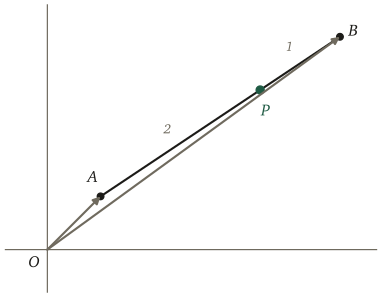
The point dividing in the ratio has position vector
(With this is the midpoint, .)
Worked example 15.4 · Dividing a line in a ratio
Points and have position vectors and . Find the position vector of the point that divides in the ratio .
-
is of the way from to :
-
Compute , so :
Worked example 15.5 · Showing points are collinear
Show that , and are collinear.
-
Find two displacement vectors from :
-
, so the two vectors are parallel — and since they share the point , the three points lie on one straight line. ∎
Common mistake
Parallel vectors alone don’t prove collinearity: you also need a shared point. just means two separate lines are parallel; it’s (same starting point ) that forces , , onto one line.
Practice
Twelve questions in three tiers. Try each one properly before opening the solution — the solutions show full method, not just answers.
Warm-up
Find the magnitude of each vector:
Show solution
(a) .
(b) .
Given and , find:
Show solution
(a) .
(b) .
(c) .
Points and have position vectors and . Find and the distance .
Show solution
, and .
Show that and are parallel.
Show solution
— one is a scalar multiple of the other, so they are parallel.
Standard
Find a unit vector in the direction of .
Show solution
The magnitude is . A unit vector divides by the magnitude:
Given and , find .
Show solution
The vector is parallel to . Find the value of .
Show solution
For parallel vectors, . The first components give , so . Then .
Points and have position vectors and . Find the position vector of the midpoint of .
Show solution
Exam style
Points , and have position vectors , and .
- Find and . [2]
- Hence show that , and are collinear, and state the ratio . [3]
Show solution
(a) , .
(b) , so the vectors are parallel and share the point — hence , , are collinear. Since , is one-third of the way along, so .
and . The point divides in the ratio .
- Find . [3]
- Find the exact distance . [2]
Show solution
(a) is of the way from to :
(b) .
and . Point is such that is a parallelogram (with and as adjacent sides). Find the position vector of .
Show solution
In parallelogram , (the diagonal is the sum of the two sides):
The vector has magnitude . Find the possible values of .
Show solution
Set the magnitude squared equal to :
Expand and tidy: , so , i.e. .
Factorise: , so or .
(Check: gives and gives — both of magnitude .)