Year 1 Pure · Chapter 3
Using Graphs
Specification: Edexcel Pure 2 — Algebra and functions · AQA section B
In this chapter
Key facts — this chapter
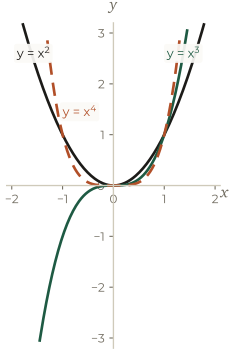
- : even gives a U-shaped curve symmetric about the -axis; odd runs from bottom-left to top-right through the origin.
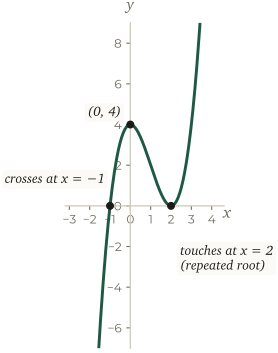
- A factorised cubic crosses the -axis at each single root and touches it at a repeated root.
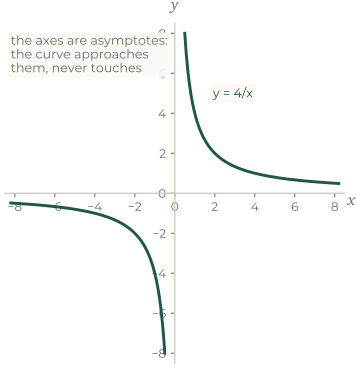
- has two branches with the axes as asymptotes — lines the curve approaches but never reaches.
- Curves meet where their equations are equal: solve simultaneously, and the number of solutions is the number of intersection points.
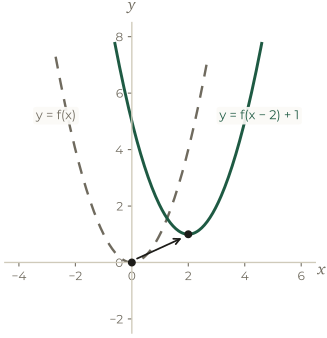
- Transformations: shifts up ; shifts left ; stretches vertically ; stretches horizontally .
- Inside the bracket acts on and does the opposite of what it looks like; outside acts on and does exactly what it looks like.
A sketch is the fastest piece of mathematics you can do: five seconds of curve drawing often replaces a page of algebra, and examiners ask for it constantly. This chapter builds your mental library of shapes — and then shows you how to slide, stretch and flip them.
1. Cubics, quartics and the shape of xⁿ
You already know the parabola. The rest of the family follows a simple pattern, split by whether is even or odd.
Key result
- Even powers (): U-shaped, symmetric about the -axis, never negative. Higher powers are flatter near the origin and steeper outside it.
- Odd powers (): run from bottom-left to top-right through the origin, with rotational symmetry — negative inputs give negative outputs.
For a factorised cubic like , the roots tell you almost everything:
Sketching a factorised cubic
- Each single root is a clean crossing of the -axis.
- Each repeated root (a squared bracket) is a point where the curve touches the axis and turns back — just like a parabola’s vertex sitting on it.
- The -intercept comes from substituting .
- For large the highest power wins: a positive- cubic ends up in the top right, a negative one in the bottom right.
Worked example 3.1 · Sketching a cubic from factorised form
Sketch the curve , marking the points where it meets the axes.
-
Roots from the factors: (single — the curve crosses) and (repeated — the curve touches and turns back).
-
The -intercept, from :
-
The bracket expansion would start , so the curve falls to the bottom-left and climbs to the top-right.
-
Join the features: up through , over the hump past , down to touch the axis at , then up and away.
Common mistake
A repeated root is not a crossing. keeps the same sign on both sides of , so the curve bounces off the axis there. Cross at single roots, touch at squared ones.
2. Reciprocal graphs
The curve behaves unlike any polynomial: it isn’t defined at , and it comes in two separate branches.
Key result
(for ) lives in the top-right and bottom-left quadrants; for , the other two. Both axes are asymptotes: as grows huge, shrinks towards zero; as creeps towards zero, blows up. The curve approaches the lines but never touches them. ( is similar but, with its even power, keeps both branches on the same side of the -axis.)
Worked example 3.2 · Pinning down a reciprocal curve
The curve passes through the point . Find , and the value of when .
-
Substitute the known point:
-
Then at :
3. Where graphs meet
Two curves intersect where their -values agree — so set the equations equal and solve. Every solution is an intersection point, and counting solutions counts crossings (which is exactly the discriminant trick from Chapter 2).
Worked example 3.3 · Intersection of a line and a curve
Find the points where the line meets the curve .
-
Set the right-hand sides equal:
-
Rearrange to zero and solve:
-
Substitute into the line for the -values: and .
Worked example 3.4 · Showing two graphs never meet
Show that the line does not meet the curve .
-
If they met, the equations would agree:
-
Check the discriminant:
No real solutions, so there are no intersection points — the line passes clean underneath the parabola. ∎
4. Transformations of graphs
One curve, four dials: you can slide a graph in either direction, stretch it, or flip it — and each move is a small edit to the equation.
The four transformations
Starting from :
- — translate up by
- — translate left by
- — stretch vertically, scale factor
- — stretch horizontally, scale factor
Negative values reflect: flips in the -axis, flips in the -axis.
Why it works
Changes outside happen after the function — they act on , so they do exactly what they say. Changes inside the bracket happen to before sees it, so they work in reverse: asks “what input is ahead of me?”, which drags the whole picture left. Inside the bracket, expect the opposite of what it looks like.
Take one curve and turn the four dials. The dashed ghost is the original y = f(x); the green curve is what your transformation does to it — notice which dials behave “in reverse”.
y = p f(q(x − h)) + k — h, k translate; p, q stretch and reflect
Worked example 3.5 · Tracking a point through transformations
The graph of has a maximum point at . Write down the coordinates of the maximum point of (a) , (b) , (c) .
-
(a) Inside the bracket, so it acts on , in reverse: translate left. Maximum at .
-
(b) Outside, acting on : stretch vertically . Maximum at .
-
(c) Inside, in reverse: horizontal stretch with scale factor — -coordinates halve. Maximum at .
Common mistake
The two classic reversals: moves left (not right), and squashes the graph towards the -axis (not stretches it away). If in doubt, track one known point through the transformation, like the maximum in the example above.
Practice
Twelve questions in three tiers. Try each one properly before opening the solution — the solutions show full method, not just answers.
Warm-up
The curve meets the coordinate axes at four points. Write down the coordinates of all four.
Show solution
Each factor gives a root: , and , so the curve crosses the -axis at , and .
For the -intercept, substitute :
Describe the single transformation that maps the graph of onto:
Show solution
(a) Outside the function — acts on : translation up.
(b) Inside the bracket — acts on , in reverse: translation right.
(c) Outside: vertical stretch, scale factor .
Write down the equations of the asymptotes of the curve , and state which pair of quadrants the curve occupies.
Show solution
The asymptotes are the axes: and .
Since , both coordinates share a sign: the branches sit in the top-right and bottom-left quadrants.
The curve is transformed. Write down the equation of the new curve after:
- a translation of to the right,
- a reflection in the -axis.
Show solution
(a) Right means subtracting inside the bracket: .
(b) Reflecting in the -axis flips : .
Standard
For the curve :
- Write down where the curve crosses the -axis and where it touches it.
- Find the -intercept.
- Describe the behaviour of as becomes large and positive.
Show solution
(a) The single root is a crossing; the repeated root is a touch — the curve meets the axis there and turns back.
(b) Substitute : , so .
(c) Expanding would start with , so as , — the curve climbs away to the top right.
Find the coordinates of the points where the line meets the curve .
Show solution
-
Set the equations equal:
-
Factorise: , so or .
-
Use the line for : gives ; gives .
The intersection points are and .
The curve passes through .
- Find the value of .
- Find the -coordinate of the point on the curve where .
Show solution
(a) Substitute the point: , so .
(b) .
The graph of has a maximum point at . Write down the coordinates of the corresponding maximum point on:
Show solution
(a) Inside the bracket, reversed: translate right — .
(b) Vertical stretch — .
(c) Horizontal stretch, scale factor — .
Show that the line does not intersect the curve .
Show solution
-
An intersection would satisfy both equations:
-
Discriminant:
No real solutions, so no intersection points exist. ∎
Exam style
- Sketch the curve , marking where it meets the coordinate axes. [3]
- The curve is translated to the right. Write the equation of the new curve in factorised form, and state its roots. [2]
Show solution
(a) Three single roots, so three clean crossings: , , . The -intercept is at the origin (since is a root). Positive cubic, so the curve rises from the bottom left, crosses at , turns over a hump, passes through the origin, dips, and crosses again at on its way to the top right.
(b) Translating right replaces with :
The roots shift with it: , and .
The curve is mapped onto the curve by a sequence of transformations.
- Describe a sequence of transformations that achieves this. [3]
- Write down the coordinates of the vertex of the new curve. [1]
Show solution
(a) Reading the equation from the inside out:
- — translate to the left;
- — vertical stretch, scale factor ;
- — translate down.
(b) The vertex of at tracks through: left → ; the stretch fixes points on the -axis; down → .
The line , where is a constant, and the curve .
Show that the line intersects the curve at two distinct points for all values of .
Show solution
-
At an intersection:
-
Discriminant:
-
for every real , so always — two distinct real solutions, and neither can be (zero doesn’t satisfy ). So there are always two intersection points. ∎
(Graphically: one crossing on each branch of the reciprocal curve.)