Year 1 Pure · Chapter 9
Trigonometry
Specification: Edexcel Pure 5 — Trigonometry · AQA section E
Key facts — this chapter
- On the unit circle, the point at angle is — this defines sin and cos for any angle.
- Graphs: and are waves of period between and ; has period with asymptotes at
- Exact values worth memorising: , , , and the rest of the family.
- Identities: and .
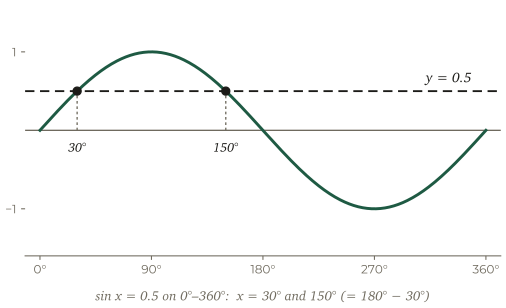
- Solving on an interval: find the first solution, then use the graph’s symmetry to get the rest within range.
- For or , widen the interval for first, solve there, then divide back.
In a right-angled triangle, , and only make sense for angles between and . The unit circle frees them — giving every angle a sine and cosine, and turning trig into the wave functions that model anything that repeats.
1. The unit circle
Place a circle of radius at the origin and mark the point reached by rotating from the positive -axis.
Key result
The point on the unit circle at angle has coordinates
So is its horizontal position and its vertical position — for any , not just acute ones. This is why sin and cos can be negative: past the point moves into other quadrants.
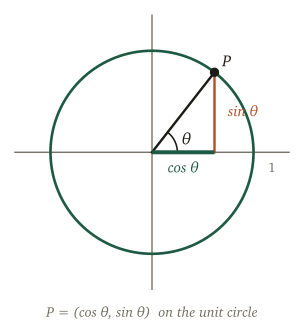
Step the angle θ round the unit circle. The point's height is sin θ — watch it trace out the sine wave on the right, while cos θ and tan θ update too.
Exact values
A few angles have exact sin/cos/tan worth knowing by heart — they come from the –– and –– triangles and appear constantly in exam answers.
The values to memorise
2. The graphs
Let run all the way round the circle (and beyond) and the height and width trace out waves.
Key result
- and are waves of period , oscillating between and . The cosine graph is the sine graph shifted left by .
- has period and shoots off to at — vertical asymptotes where .
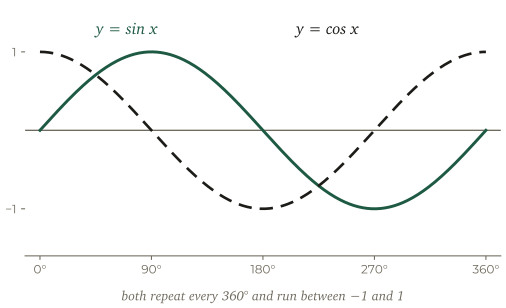
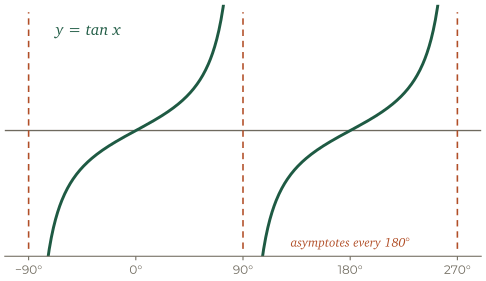
These shapes are what make solving equations possible: once you know one solution, the graph’s symmetry hands you all the others.
3. Trig identities
Two identities connect the three functions, and both fall straight out of the unit circle.
Key result
Why it works
On the unit circle the point is exactly from the origin, so Pythagoras gives immediately. And in the right-angled triangle formed by the radius, .
Worked example 9.1 · Using the identity
Given that and is acute, find the exact values of and .
-
Use :
-
is acute, so is positive:
-
Then
Common mistake
When you square-root to find , the sign depends on the quadrant. For an acute angle cosine is positive, but for an obtuse it would be negative — always check which quadrant lives in before fixing the sign.
4. Solving trig equations
To solve something like on a given interval, find the first solution with your calculator, then read the rest off the graph using its symmetry.
The method
- Get the principal value from , or .
- Use the graph’s symmetry for the others in range:
- : a second solution at ;
- : a second solution at ;
- : add each time.
- Add or subtract to land any further solutions inside the interval.
Worked example 9.2 · A cosine equation
Solve for .
-
Principal value: , so the related acute angle is . Since cosine is negative, is in the second and third quadrants.
-
Second-quadrant solution: . Third-quadrant solution: .
So or .
Worked example 9.3 · A multiple angle — widen the interval
Solve for .
-
Let . As runs over to , runs over to — solve in this wider interval.
-
has principal value , with sine positive in quadrants 1 and 2:
-
Divide each by to get :
Common mistake
With , don’t solve for and then worry about extra solutions — you’ll miss half of them. Widen the interval to cover first, collect every solution there, and divide back at the end.
Practice
Twelve questions in three tiers. Try each one properly before opening the solution — the solutions show full method, not just answers. Angles are in degrees.
Warm-up
Write down the exact values of:
Show solution
(a) .
(b) (also written ).
(c) .
Solve for .
Show solution
Principal value . Sine is positive in quadrants 1 and 2, so the second solution is .
State the period of each graph: (a) , (b) .
Show solution
(a) . (b) .
Given that and is acute, find .
Show solution
Using :
is acute, so .
Standard
Solve for .
Show solution
The related acute angle is . Cosine is negative in quadrants 2 and 3:
Solve for .
Show solution
Principal value . Tangent has period , so add for the next solution in range:
Given that and is obtuse, find the exact values of and .
Show solution
-
.
-
is obtuse (second quadrant), so is negative:
-
.
Solve for , then state how many solutions has for .
Show solution
-
Rearrange: .
-
On –: or (as in Question 2).
-
Over – the sine graph repeats once more, adding and — so 4 solutions in total.
Solve for .
Show solution
-
Let ; then .
-
has acute angle ; cosine is positive in quadrants 1 and 4, so in –, or . Adding : or as well.
-
Divide by :
Exam style
Solve for .
Show solution
Divide both sides by (valid where ):
Principal value ; tangent period :
Solve for .
Show solution
-
This is a quadratic in . Let : .
-
Factorise: , so or .
-
Solve each on –:
- : or .
- : .
So .
Solve for .
Show solution
-
Let . As runs –, runs –.
-
has acute angle ; sine positive in quadrants 1 and 2. In range –:
so or (note exceeds ).
-
Subtract :