Year 1 Pure · Chapter 8
Triangle Geometry
Specification: Edexcel Pure 5 — Trigonometry · AQA section E
In this chapter
Key facts — this chapter
- Labelling: side is opposite angle , side opposite , side opposite .
- Right-angled triangles: SOH-CAH-TOA — , , .
- Sine rule: — use it with a side and its opposite angle.
- Cosine rule: — use it for SAS (find a side) or SSS (find an angle).
- Area: — two sides and the angle between them.
- The sine rule can be ambiguous: , so a “find the angle” sine-rule problem can have two answers.
Once a triangle stops being right-angled, SOH-CAH-TOA alone can’t finish the job. The sine and cosine rules pick up where it leaves off — between them they solve any triangle, given enough information.
1. Labelling and right-angled triangles
First, the convention that makes every formula in this chapter readable: each side is named by the angle it faces.
Key result
In triangle , side is opposite angle , side opposite , and side opposite .
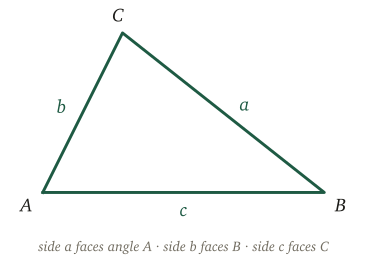
For a right-angled triangle you already have everything you need: SOH-CAH-TOA relates an angle to the opposite, adjacent and hypotenuse. Keep it in mind — the sine and cosine rules are both derived from it.
Worked example 8.1 · Right-angled refresher
A right-angled triangle has hypotenuse and one angle of . Find the side opposite the angle.
The opposite side and the hypotenuse call for sine (SOH):
2. The sine rule
The sine rule links each side to the sine of its opposite angle. Reach for it whenever you have (or want) a side paired with the angle across from it.
Key result
Turn it upside down — — when you’re finding an angle.
Why it works
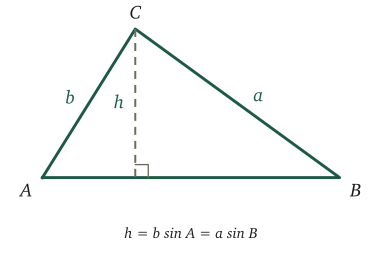
Drop a perpendicular of height from onto . It splits the triangle into two right-angled triangles, and in each one is the opposite side: from the left, from the right. Setting them equal, , which rearranges to .
Worked example 8.2 · Finding a side with the sine rule
In triangle , , and . Find .
-
Pair each side with its opposite angle:
-
Rearrange and evaluate:
The ambiguous case
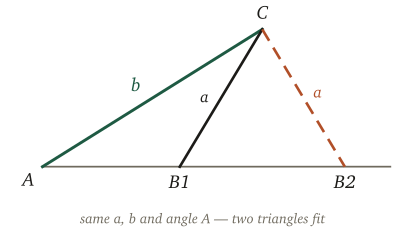
Finding an angle with the sine rule comes with a catch: and are equal, so the calculator’s answer might not be the only one.
Worked example 8.3 · Two possible triangles
In triangle , , and . Find the two possible values of angle .
-
Use the angle form of the sine rule:
-
The calculator gives . But , so is also possible.
-
Check both fit (): ✓ and ✓ — both are valid triangles.
So or .
Common mistake
Don’t trust the calculator’s single answer when finding an angle. Always ask whether the obtuse partner also fits (i.e. whether the angles still sum to less than ). If it does, the problem has two solutions.
3. The cosine rule
When the sine rule can’t start — because you don’t have a side-and-its-opposite-angle pair — the cosine rule steps in. It needs either two sides and the angle between them, or all three sides.
Key result
Here is the side opposite the angle , and , are the two sides that enclose . Use it to find a side from SAS (two sides and the included angle). Rearranged for the angle,
it finds an angle from SSS (all three sides). The letters just rotate — to find instead, use , and similarly for .
Worked example 8.4 · Finding a side (SAS)
In triangle , , and the included angle . Find .
-
Substitute into the cosine rule — is opposite the known angle :
-
Evaluate, using :
So .
Worked example 8.5 · Finding an angle (SSS)
A triangle has sides , and . Find the size of the angle opposite the side of length .
-
Put the wanted angle as , so its opposite side is , with the other two and . Rearrange the cosine rule:
-
So .
Common mistake
The angle in the cosine rule must be the one opposite the side you’re finding (equivalently, the angle between the two known sides). In , the angle sits between sides and and faces side — never one of the angles at the other corners.
4. Area of a triangle
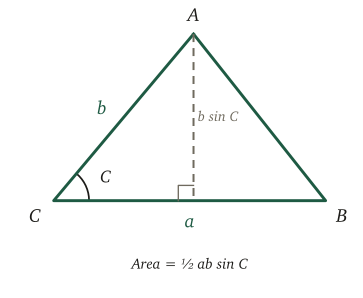
The familiar becomes far more useful once you can write the height in terms of a side and an angle.
Key result
— two sides and the angle between them. (Any pair of sides works, as long as you use the angle they enclose.)
Why it works
Take base . The perpendicular height onto it, dropped from the opposite vertex, is — the side times the sine of the angle it makes with the base. So .
Set two sides and the angle between them. The triangle is drawn to scale, and the opposite side (cosine rule) and the area (½ bc sin A) update as you go.
b and c enclose angle A · the opposite side a comes from the cosine rule
Worked example 8.6 · Area from two sides and the included angle
Find the area of the triangle with , and included angle .
(This is the same triangle as in Example 8.4 — sides , , — so its area is in exact form.)
Practice
Twelve questions in three tiers. Try each one properly before opening the solution — the solutions show full method, not just answers. Give non-exact answers to 3 s.f.
Warm-up
In triangle , , and . Find .
Show solution
Sine rule, pairing each side with its opposite angle:
In triangle , , and the included angle . Find .
Show solution
Cosine rule, with opposite the known angle :
So .
Find the area of the triangle with sides and enclosing an angle .
Show solution
A triangle has sides , and . State, with a reason, whether the angle opposite the side of length is acute or obtuse.
Show solution
By the cosine rule the cosine of that angle is
A negative cosine means the angle is obtuse.
Standard
In triangle , , and . Find angle .
Show solution
is opposite the longest side, so use the cosine rule rearranged:
In triangle , , and . Find the two possible values of angle .
Show solution
Angle form of the sine rule:
The calculator gives . Its obtuse partner also fits, since .
So or .
In triangle , , and .
- Find . [3]
- Find the area of the triangle. [2]
Show solution
(a) Cosine rule (SAS, angle between sides and ):
(b) Area .
In triangle , , and .
- Find angle . [1]
- Find side . [2]
- Find the area of the triangle. [2]
Show solution
(a) Angles sum to : .
(b) Sine rule:
(c) Two sides and the included angle — use , and angle , keeping the unrounded from part (b):
Rounding to first would give : carry full accuracy through, and round only the final answer.
The area of triangle is . Given cm and cm, find the two possible values of the included angle .
Show solution
The calculator gives ; the obtuse partner also gives this area. So or .
Exam style
A ship sails km on a bearing of from to , then km on a bearing of from to .
- Show that angle . [2]
- Find the distance . [3]
- Find the area of triangle . [1]
Show solution
(a) The bearing of from is . The angle between () and () is . ✓
(b) Cosine rule with the angle between and :
(c) Area .
In triangle , , and .
- Find the largest angle of the triangle. [3]
- Hence find the area of the triangle. [2]
Show solution
(a) The largest angle faces the longest side , so find :
(b) Area .
Points , and lie on a circle of radius , with centre . The angle (at the centre) is .
- Find the length of the chord . [3]
- Find the area of triangle . [1]
- Hence find the area of the minor segment cut off by the chord . [2]
Show solution
(a) Triangle has (radii) with the angle between them. Cosine rule:
(b) Area of triangle .
(c) The sector has area . The segment is the sector minus the triangle: