Year 1 Pure · Chapter 4
Coordinate Geometry of Straight Lines
Specification: Edexcel Pure 3 — Coordinate geometry · AQA section C
In this chapter
Key facts — this chapter
- Gradient between two points: — rise over run.
- Equation of a line: (gradient , -intercept ), or when you know a point on it.
- Parallel lines have equal gradients; perpendicular lines have gradients multiplying to : .
- Midpoint of and : — average the coordinates.
- Distance: — Pythagoras in disguise.
Straight lines are the workhorses of coordinate geometry. Master the handful of tools in this chapter — gradient, equation, midpoint, distance, perpendicularity — and you’ve already done most of the work for circles (Chapter 5) and tangents and normals in differentiation later on.
1. Gradient and the equation of a line
The gradient measures steepness: how much the line climbs for every unit it moves right.
Key result
Between any two points and on the line:
A negative gradient falls from left to right; a horizontal line has ; a vertical line has no gradient (its equation is ).
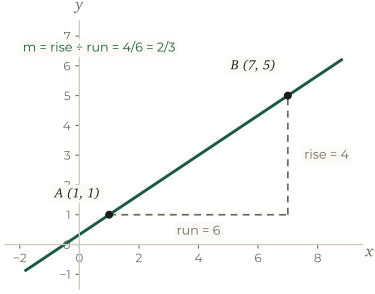
Drag A and B and watch the gradient triangle do the work — rise over run, the equation, the midpoint and the exact length all come from the same two points.
Drag A and B · the dashed triangle is rise over run · the hollow dot is the midpoint
Two ways to write a line
- — perfect when you know the gradient and the -intercept.
- — perfect when you know the gradient and any point ; no need to find first.
Exam answers sometimes ask for the form with integer coefficients — multiply through to clear fractions and gather everything on one side.
Worked example 4.1 · A line through two points
Find the equation of the line through and .
-
Gradient first:
-
Use with either point — take :
-
Tidy:
(Check with the other point: gives . ✓)
Common mistake
Keep the subtraction order consistent: , both differences the same way round. Swapping one but not the other flips the sign of the gradient — the single most common slip with lines.
2. Midpoints and distance
Two more tools, both straight from a picture.
Key result
For and :
The midpoint just averages the coordinates. The distance is Pythagoras: the horizontal and vertical gaps are the two legs, and is the hypotenuse.
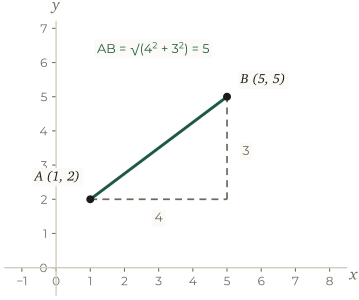
Worked example 4.2 · Midpoint and length of a segment
For and , find the midpoint of and the exact length .
-
Average the coordinates:
-
Pythagoras on the gaps ( across, up):
3. Parallel and perpendicular lines
Key result
-
Parallel lines never meet because they climb at the same rate: .
-
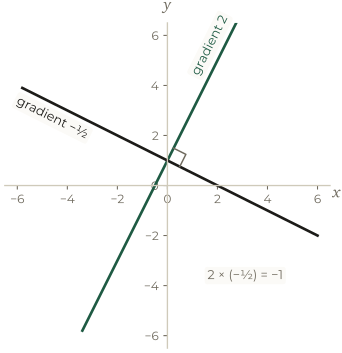
Perpendicular lines meet at right angles, and their gradients multiply to :
— flip the fraction, flip the sign. The perpendicular to gradient has gradient .
Why it works
Rotating a line a quarter turn swaps its rise and run — what used to be “along” is now “up” — and sends the line uphill if it was downhill. So a gradient becomes , and the product is .
Worked example 4.3 · A parallel line through a point
Find the equation of the line through that is parallel to the line .
-
Rearrange the given line to read off its gradient:
-
Parallel means the same gradient, so build the line through with :
Worked example 4.4 · A perpendicular line through a point
Find the equation of the line through that is perpendicular to . Give your answer in the form , where , and are integers.
-
The given gradient is , so the perpendicular gradient is — flip and negate.
-
Line through :
-
Multiply through by to clear the fraction, and gather:
Common mistake
Perpendicular needs both moves — flip the fraction and flip the sign. The perpendicular to is , not (sign forgotten) and not (flip forgotten).
4. Modelling with straight lines
A linear model is just wearing real-world clothes — and exam questions love asking what and mean in context.
Key result
In a linear model :
- is the rate of change — how much changes for each unit of (cost per mile, depth per minute, …);
- is the starting value — what is when (the fixed charge, the initial depth, …).
Worked example 4.5 · Building and reading a linear model
A taxi journey costs £ for miles and £ for miles. Assuming cost (£) is linear in distance (miles), find the model and interpret its constants.
-
The rate per mile is the gradient:
-
Use a known point to find the constant: gives .
-
Interpret: each extra mile costs £1.80 (), and the fixed charge just for getting in the taxi is £3.20 ().
Practice
Twelve questions in three tiers. Try each one properly before opening the solution — the solutions show full method, not just answers.
Warm-up
Find the equation of the line through and , giving your answer in the form .
Show solution
-
Gradient:
-
Line through with gradient :
(Check: gives . ✓)
For the points and , find:
- the midpoint of ,
- the length .
Show solution
(a) Average the coordinates:
(b) Pythagoras on the gaps ( across, up):
Write down the gradient and -intercept of the line .
Show solution
Rearrange for :
Gradient , -intercept .
- Show that the lines and are parallel.
- Write down the gradient of any line perpendicular to them.
Show solution
(a) Rearranging the second: , so . Both have gradient — parallel. (Different intercepts, so they’re distinct lines, not the same one.)
(b) Flip and negate: .
Standard
Find the equation of the line through that is parallel to the line .
Show solution
-
The given line rearranges to , so .
-
Same gradient through :
Find the equation of the line through that is perpendicular to .
Show solution
-
Perpendicular gradient: flip and negate to get .
-
Through :
The points , and form a triangle. Show that the triangle is right-angled and isosceles.
Show solution
-
Gradients of the sides:
-
, so — the triangle is right-angled at . ✓
-
Lengths of those two sides:
Two equal sides, so the triangle is also isosceles. ✓
Find the equation of the perpendicular bisector of the points and .
Show solution
-
The bisector passes through the midpoint:
-
Gradient of : , so the perpendicular gradient is .
-
Through with gradient :
(This is the Chapter 5 workhorse: a circle’s centre always sits on the perpendicular bisector of any chord.)
The line through and is perpendicular to the line . Find the value of .
Show solution
-
Perpendicular to gradient means gradient .
-
Set the gradient of equal to it:
-
Solve: , so .
Exam style
The line has equation . The line is perpendicular to and passes through the point .
- Find the equation of . [3]
- Find the coordinates of the point where and intersect. [3]
Show solution
(a)
-
Perpendicular gradient to : .
-
Through :
(b)
-
Set the two equations equal:
-
Multiply by 2 and solve: , so and .
-
Substitute back: . The lines meet at .
The points , , and are the vertices of a quadrilateral. Show that is a rhombus but not a square.
Show solution
-
Opposite sides parallel (gradients):
so is a parallelogram.
-
Adjacent sides equal:
A parallelogram with equal adjacent sides has all four sides equal — a rhombus. ✓
-
Not a square: adjacent sides would have to be perpendicular, but
so the corners aren’t right angles. ✓
A water tank is being drained. After minutes the depth of water is cm; after minutes it is cm. Assume the depth cm after minutes follows a linear model.
- Find the model in the form . [3]
- Interpret the values of and in context. [1]
- Find how long it takes for the tank to empty completely. [1]
Show solution
(a)
-
Gradient:
-
Use : , so .
(b) The depth falls by cm every minute (); the tank started at cm deep (, the depth at ).
(c) Empty means :