Year 1 Pure · Chapter 2
Quadratics
Specification: Edexcel Pure 2 — Algebra and functions · AQA section B
In this chapter
Key facts — this chapter
- A quadratic is a parabola: opens upwards if , downwards if ; -intercept at .
- Solve by factorising when you can, by the formula when you can’t.
- Completing the square: puts the turning point at .
- The discriminant counts real roots: two (), one repeated (), none ().
- Solve quadratic inequalities by finding the roots, then reading the answer off a sketch.
- A disguised quadratic becomes a real one with a substitution like or .
Quadratics are the most-used objects in A-level maths — they turn up inside coordinate geometry, trigonometry, logarithms and mechanics, usually uninvited. This chapter is about knowing them from every angle: as graphs, as equations to solve, and as expressions to rewrite.
1. The shape of a quadratic
Every quadratic draws the same curve — a parabola — and you can read its key features straight from the algebra:
Anatomy of a parabola
- Direction: opens upwards if , downwards if .
- -intercept: at — substitute .
- Roots: where , the crossings of the -axis (if any).
- Axis of symmetry: the vertical line midway between the roots.
- Vertex (turning point): sits on the axis of symmetry — the minimum if the parabola opens upwards, the maximum if it opens downwards.
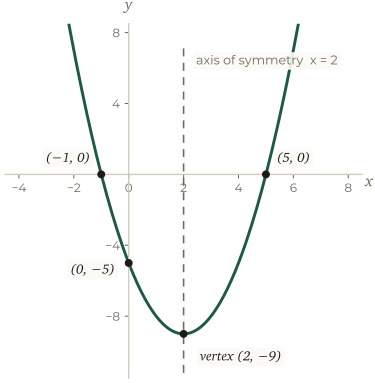
Worked example 2.1 · Reading off the features
For , find the direction, the -intercept, the roots, the axis of symmetry and the vertex.
-
, so the parabola opens upwards; the constant term gives the -intercept .
-
Factorise to find the roots:
-
The axis of symmetry is midway between the roots:
-
The vertex sits on that line — substitute :
2. Solving quadratic equations
Rearrange to first — always. Then factorise if the numbers cooperate, and reach for the formula when they don’t.
Worked example 2.2 · Factorising with a leading coefficient
Solve .
-
Look for a factorisation whose outer and inner terms combine to :
-
A product is zero only when one factor is zero:
The quadratic formula
The solutions of are
It always works — it’s completing the square done once, in general, so you never have to do it again.
Worked example 2.3 · Using the formula, leaving an exact answer
Solve , giving your answers in exact form.
-
Identify , , and substitute carefully:
-
Simplify under the root:
has no square factor, so this is the final exact answer — leave it as a surd unless the question asks for decimals.
Common mistake
Sign slips in the formula cost more marks than anything else here: when is already negative gives , and with turns into a plus. Write the substitution line in full before simplifying anything.
3. Completing the square
Completing the square rewrites a quadratic so that appears only once — and in that form, the graph’s vertex is sitting in plain sight.
Key result
A square is never negative, so is smallest (or largest, if ) exactly when the square is zero — at , where .
Drag the vertex and watch all three descriptions of the same parabola move together — and keep an eye on the discriminant as the curve crosses, touches or misses the x-axis.
Drag the dot to move the vertex · pick a to set width and direction
Worked example 2.4 · Completing the square
Write in the form and state the turning point of .
-
Halve the coefficient of , square it inside, correct it outside:
-
Read off the turning point: the square vanishes at , giving the minimum point .
Worked example 2.5 · Completing the square with a leading coefficient
Write in the form , and hence find the minimum value of the expression.
-
Take the factor of out of the -terms only:
-
Complete the square inside the bracket:
-
Multiply out the correction and tidy:
The square is never negative, so the minimum value is , at .
Common mistake
In step 3 the correction term gets multiplied by on the way out of the bracket: the becomes , not . Forgetting that factor is the classic completing-the-square error when .
4. The discriminant
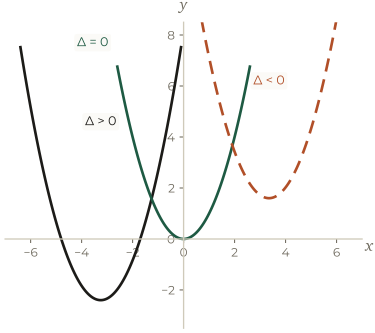
Inside the quadratic formula sits , the discriminant . Before any square root is taken, its sign already tells you how many real solutions exist — which is often all a question wants to know.
Key result
For :
- — two distinct real roots: the graph crosses the -axis twice
- — one repeated root: the graph touches the axis
- — no real roots: the graph misses the axis entirely
Worked example 2.6 · Using the discriminant to find an unknown
The equation has a repeated root. Find the possible values of .
-
A repeated root means , with , , :
-
Solve for :
(Sense check: and — both perfect squares, as a repeated root demands.)
5. Quadratic inequalities
To solve something like , don’t push symbols around — solve the matching equation, then let a sketch answer the question.
The sketch method
- Rearrange so one side is zero, and find the roots of the matching equation.
- Sketch the parabola through those roots (direction from the sign of ).
- Read off where the graph is above () or below () the axis: an upward parabola is below between its roots, above outside them.
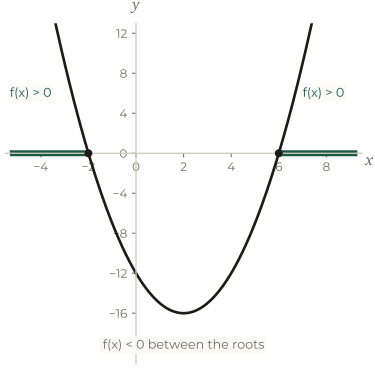
Worked example 2.7 · Solving a quadratic inequality
Solve .
-
Solve the equation first:
-
, so the parabola opens upwards: below the axis between the roots, above it outside them.
-
We want — the outside regions:
Common mistake
An answer like is impossible — no number is both greater than and less than . “Outside the roots” is always written as two separate inequalities joined by “or”. Save the single sandwich for the between case.
6. Disguised quadratics
Some equations are quadratics wearing a costume: the variable appears twice, once as the square of the other appearance. A substitution makes the costume fall off.
Key result
If an equation contains and for some block (like and , or and , or and ), substitute to get an ordinary quadratic in — then convert back to at the end.
Worked example 2.8 · A disguised quadratic
Solve .
-
Spot the disguise: , so let :
-
Factorise and solve for :
-
Convert back — each positive gives two values of :
Four solutions: .
Common mistake
Stopping at loses half the marks — the question asked about . And when converting back, check each value makes sense: can never be negative, so a negative root gets discarded, not converted.
Practice
Twelve questions in three tiers. Try each one properly before opening the solution — the solutions show full method, not just answers.
Warm-up
Solve by factorising:
Show solution
(a) Two numbers multiplying to and adding to : and .
(b) Two numbers multiplying to and adding to : and .
For the curve , write down:
- the -intercept,
- the roots,
- the equation of the axis of symmetry.
Show solution
(a) Substitute : the -intercept is .
(b) Factorise: , so the roots are and .
(c) Midway between the roots: .
Write in the form , and state the coordinates of the turning point of .
Show solution
Halve the , square it inside, correct outside:
The square vanishes at , so the turning point (a minimum) is .
Calculate the discriminant of and state the number of real roots.
Show solution
, so the equation has no real roots — the parabola never reaches the -axis.
Standard
Solve , giving your answers in exact form.
Show solution
It doesn’t factorise (check: , not a square), so use the formula with , , :
Write in the form , and hence write down the minimum value of and the value of at which it occurs.
Show solution
-
Take the out of the -terms only:
-
Complete the square inside the bracket:
-
Multiply the correction out and tidy:
The minimum value is , at .
The equation has a repeated root. Find the possible values of .
Show solution
A repeated root means the discriminant is zero:
(Check: gives and gives .)
Solve the inequality .
Show solution
-
Solve the matching equation by factorising:
-
: the parabola opens upwards, so it is below the axis between its roots.
-
We want , the between region:
Solve .
Show solution
-
Spot the disguise: , so let :
-
Factorise: , so or .
-
Convert back to :
Exam style
- Write in the form . [2]
- Hence explain why for all real values of . [1]
- Write down the coordinates of the minimum point of . [1]
Show solution
(a) .
(b) for every real , so — the expression can never reach zero, let alone go below it.
(c) The minimum is where the square vanishes: .
The curve , where is a constant.
- Find the value of for which the curve touches the -axis at exactly one point. [2]
- For that value of , state the -coordinate of the point of contact. [1]
- Find the range of values of for which the curve does not meet the -axis at all. [2]
Show solution
(a) Touching once means :
(b) With : , so the contact point is at .
(c) No meeting means :
The line is a tangent to the curve . Find the two possible values of .
Show solution
-
At an intersection the -values agree, so set the expressions equal:
-
A tangent touches exactly once, so this quadratic has a repeated root — discriminant zero:
-
Solve:
(Check : ✓ — a repeated root, as a tangent demands.)