Year 1 Pure · Chapter 10
Logarithms
Specification: Edexcel Pure 6 — Exponentials and logarithms · AQA section F
In this chapter
Key facts — this chapter
- A logarithm answers “what power?”: means (with , , ).
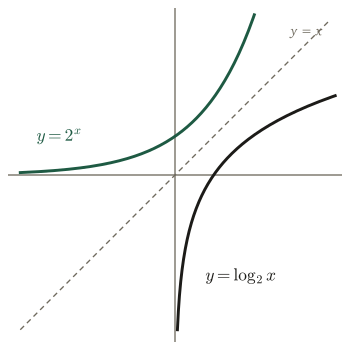
- So is the inverse of raising to a power — the graph of is reflected in .
- Laws of logs: , , .
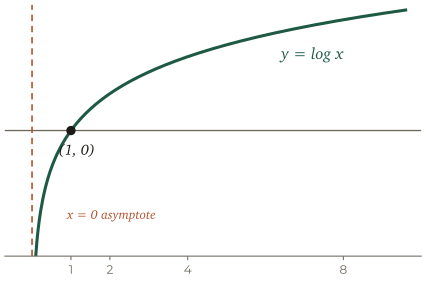
- Useful values: and .
- To solve , take logs of both sides: .
- usually means base ; means base (Chapter 11).
Indices answer “what do I get if I raise to the power ?” Logarithms run the question backwards: “what power of gives me ?” That single idea — log as the undo button for powers — is the whole chapter.
1. What a logarithm is
Key result
Read as “the power you raise to, to get ”. Because it undoes the exponential, is the reflection of in the line .
Worked example 10.1 · Reading logs straight off the definition
Evaluate (a) , (b) , (c) .
-
(a) “What power of gives ?” , so .
-
(b) , so .
-
(c) , so .
2. The laws of logarithms
The laws of logs are the index laws seen in a mirror — which is exactly why they look so similar.
Key result
Plus the two you’ll use constantly: and .
Why it works
Write and , so and . Then by the index laws, and taking the log gives . The product law for logs is just the multiplication law for indices, read backwards.
Pick a base and two numbers. The two lines below are the product law in action: adding the logs gives the same answer as the log of the product.
logb(x × y) = logb x + logb y
Worked example 10.2 · Combining logs into one
Write as a single logarithm, and hence evaluate it.
-
The subtraction is the quotient law:
-
And since .
Worked example 10.3 · Using the power law
Express as a single logarithm.
-
The coefficient goes inside as a power:
-
Then add using the product law:
Common mistake
There is no law for — it does not equal (that’s the law for ). Logs only simplify products, quotients and powers, never sums or differences inside the log.
3. Solving exponential equations
When the unknown is stuck in an exponent — like — take the log of both sides to bring it down.
Key result
To solve , take logs and use the power law:
Any base works (your calculator has and ) — just be consistent on both sides.
Worked example 10.4 · An exponential equation
Solve , giving your answer to 3 significant figures.
-
Take logs of both sides and drop the power down:
-
Evaluate:
Worked example 10.5 · The exponent is an expression
Solve , giving your answer to 3 significant figures.
-
Take logs; the whole exponent comes down:
-
So
4. Solving equations with logs
If the unknown sits inside logs, combine them into one log first, then undo it with the definition.
Worked example 10.6 · A logarithmic equation
Solve .
-
Combine using the product law:
-
Undo the log with the definition ( means ):
-
Factorise: , so or .
-
Check the domain: logs need positive inputs, so rules out (and works). The solution is .
Common mistake
Always check your answers against the domain at the end. A log is only defined for a positive argument, so any solution making or zero or negative must be discarded — even though it solved the quadratic.
Practice
Twelve questions in three tiers. Try each one properly before opening the solution — the solutions show full method, not just answers. Give non-exact answers to 3 s.f.
Warm-up
Evaluate:
Show solution
(a) , so .
(b) , so .
(c) for any base, so .
Write as a single logarithm: .
Show solution
Add as a product, subtract as a quotient:
Express as a logarithm of a single number.
Show solution
The coefficient becomes a power: .
Solve .
Show solution
By the definition, .
Standard
Solve , giving your answer to 3 significant figures.
Show solution
Take logs of both sides:
Solve , giving your answer to 3 significant figures.
Show solution
Take logs; the whole exponent comes down:
Given that and , find:
Show solution
(a) .
(b) .
Solve .
Show solution
-
Write , then move logs to one side:
-
Equate the arguments:
Solve .
Show solution
-
Combine: .
-
Undo the log: , so .
-
Factorise: , giving or .
-
The argument must be positive, so discard . Thus .
Exam style
Solve .
Show solution
-
This is a hidden quadratic. Let (so ):
-
Factorise: , so or .
-
Convert back to :
- ;
- .
So or .
- Express in terms of , with no logarithms. [4]
- Hence find when . [2]
Show solution
(a)
-
Turn the right-hand side into a single log: and , so
-
Equate arguments: .
(b) When : .
The number of bacteria after hours is modelled by .
- State the number of bacteria at . [1]
- Find the smallest whole number of hours after which the number exceeds . [4]
Show solution
(a) At , .
(b) Solve :
So passes during the th hour. At it is still below (), so the smallest whole number of hours after which it exceeds is ().