Year 1 Pure · Chapter 14

Integration

Specification: Edexcel Pure 8 — Integration  ·  AQA section H

In this chapter
  1. 1. The reverse of differentiation
  2. 2. Definite integrals and area
  3. 3. Finding a curve from its gradient
  4. 4. Area between a curve and a line
  5. Practice

Key facts — this chapter

  • Integration is the reverse of differentiation — it undoes the derivative.
  • Power rule: ∫xn dx=xn+1n+1+c\displaystyle\int x^n\,dx = \frac{x^{n+1}}{n+1} + c (for n≠−1n \neq -1) — raise the power by one, then divide by the new power.
  • An indefinite integral always carries a constant of integration +c+c.
  • A definite integral ∫abf(x) dx=[F(x)]ab=F(b)−F(a)\displaystyle\int_a^b f(x)\,dx = \big[F(x)\big]_a^b = F(b) - F(a) — no +c+c needed.
  • For f(x)≥0f(x) \geq 0, ∫abf(x) dx\displaystyle\int_a^b f(x)\,dx is the area under the curve between x=ax = a and x=bx = b.
  • Given dydx\dfrac{dy}{dx} and one point, integrate and use the point to find cc, recovering the curve.

Differentiation finds a gradient from a curve. Integration runs the other way: given the gradient, recover the curve — and, remarkably, the same operation measures the area underneath it.

1. The reverse of differentiation

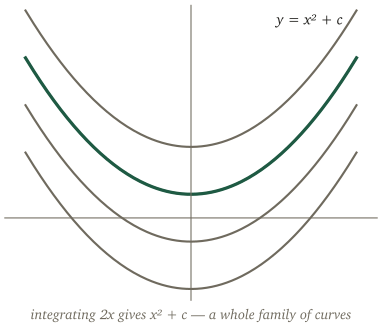
If differentiating x3x^3 gives 3x23x^2, then integrating 3x23x^2 should give back x3x^3. There’s a catch, though: any constant differentiates to zero, so we can never be sure it wasn’t there — hence the +c+c.

Key result

∫xn dx=xn+1n+1+c(n≠−1)\int x^n\,dx = \frac{x^{n+1}}{n+1} + c \qquad (n \neq -1)

Raise the power by one, then divide by the new power — the exact undo of the differentiation rule. The +c+c is the constant of integration.

A family of parabolas y = x squared + c for several values of c, all the same shape shifted vertically
Integrating 2x gives x² + c — a whole family of curves, one for each c.

Worked example 14.1 · Integrating a polynomial

Find ∫(6x2+2x−5) dx\displaystyle\int (6x^2 + 2x - 5)\,dx.


Integrate term by term, raising each power by one:

∫(6x2+2x−5) dx=6x33+2x22−5x+c=2x3+x2−5x+c\int (6x^2 + 2x - 5)\,dx = \frac{6x^3}{3} + \frac{2x^2}{2} - 5x + c = 2x^3 + x^2 - 5x + c

Worked example 14.2 · Negative and fractional powers

Find ∫(3x2+x)dx\displaystyle\int \left(\frac{3}{x^2} + \sqrt{x}\right)dx.


  1. Rewrite in index form:

    ∫(3x−2+x1/2)dx\int \left(3x^{-2} + x^{1/2}\right)dx
  2. Apply the rule to each (power up by one, divide):

    =3x−1−1+x3/23/2+c=−3x−1+23x3/2+c= \frac{3x^{-1}}{-1} + \frac{x^{3/2}}{3/2} + c = -3x^{-1} + \tfrac{2}{3}x^{3/2} + c

Common mistake

Never drop the +c+c on an indefinite integral — it’s part of the answer, and exam mark schemes penalise its absence. (Definite integrals are the exception: the cc cancels, so you leave it out there.)

2. Definite integrals and area

Put limits on the integral and it becomes a number — and that number is the area under the curve.

Key result

∫abf(x) dx=[F(x)]ab=F(b)−F(a)\int_a^b f(x)\,dx = \big[F(x)\big]_a^b = F(b) - F(a)

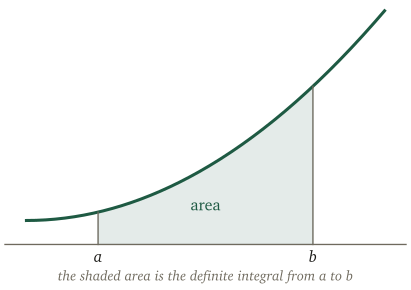
where FF is any integral of ff. Integrate, substitute the top limit, subtract the bottom limit. For f(x)≥0f(x) \geq 0 this equals the area between the curve and the xx-axis from aa to bb.

A curve with the region under it shaded between x = a and x = b
For a positive curve, the definite integral from a to b is the shaded area.

Why it works

Slice the area into thin rectangles of width hh and height f(x)f(x). Their total is an approximation; as the rectangles get thinner the approximation tightens onto the true area — and that limit is exactly the integral. The same “shrink it to zero” move that built the derivative builds the area.
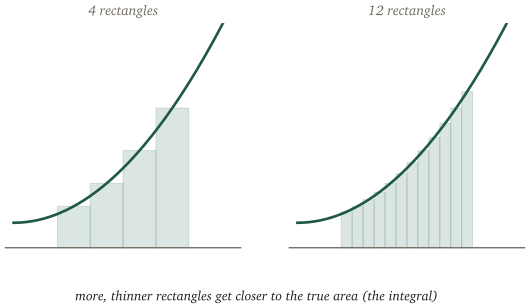
Two panels: 4 rectangles and 12 rectangles approximating the area under a curve, the 12 hugging the curve much more closely
Thin rectangles approximate the area; in the limit they give the integral.

Approximate the area under y = x² + 1 from x = 0 to 2 with n rectangles. Add more and the total closes in on the exact integral, 14⁄3 ≈ 4.667.

midpoint rectangles · the exact area is the limit as n → ∞

Worked example 14.3 · Evaluating a definite integral

Evaluate ∫133x2 dx\displaystyle\int_1^3 3x^2\,dx.


  1. Integrate (no +c+c for a definite integral):

    ∫3x2 dx=x3\int 3x^2\,dx = x^3
  2. Substitute the limits, top minus bottom:

    [x3]13=33−13=27−1=26\big[x^3\big]_1^3 = 3^3 - 1^3 = 27 - 1 = 26

Worked example 14.4 · Area under a curve

Find the area under y=x2+1y = x^2 + 1 between x=0x = 0 and x=2x = 2.


Since y>0y > 0 here, the area is the definite integral:

∫02(x2+1) dx=[x33+x]02=(83+2)−0=143\int_0^2 (x^2 + 1)\,dx = \left[\frac{x^3}{3} + x\right]_0^2 = \left(\frac{8}{3} + 2\right) - 0 = \frac{14}{3}

3. Finding a curve from its gradient

Because integration recovers a function from its derivative, a known point pins down the otherwise-mysterious +c+c.

Key result

Given dydx\dfrac{dy}{dx} and a point the curve passes through:

  1. Integrate to get yy (with +c+c);
  2. substitute the known point to find cc;
  3. write the full equation.

Worked example 14.5 · Recovering the curve

A curve passes through (1,3)(1, 3) and has gradient dydx=6x−4\dfrac{dy}{dx} = 6x - 4. Find its equation.


  1. Integrate:

    y=∫(6x−4) dx=3x2−4x+cy = \int (6x - 4)\,dx = 3x^2 - 4x + c
  2. Use (1,3)(1, 3) to find cc:

    3=3(1)2−4(1)+c=−1+c    ⟹    c=43 = 3(1)^2 - 4(1) + c = -1 + c \;\;\Longrightarrow\;\; c = 4
  3. So the curve is y=3x2−4x+4y = 3x^2 - 4x + 4.

4. Area between a curve and a line

To find the area enclosed between two graphs, integrate the difference (top curve minus bottom curve) between their points of intersection.

Key result

The area between y=f(x)y = f(x) (upper) and y=g(x)y = g(x) (lower) from aa to bb is

∫ab[f(x)−g(x)] dx.\int_a^b \big[f(x) - g(x)\big]\,dx.

The aa and bb are usually where the graphs meet — find them by solving f(x)=g(x)f(x) = g(x) first.

Worked example 14.6 · Area between a curve and a line

Find the area enclosed between the curve y=4x−x2y = 4x - x^2 and the xx-axis.


  1. Find where the curve meets the axis (y=0y = 0):

    4x−x2=x(4−x)=0    ⟹    x=0 or x=44x - x^2 = x(4 - x) = 0 \;\;\Longrightarrow\;\; x = 0 \text{ or } x = 4
  2. Integrate between those limits:

    ∫04(4x−x2) dx=[2x2−x33]04=(32−643)−0=323\int_0^4 (4x - x^2)\,dx = \left[2x^2 - \frac{x^3}{3}\right]_0^4 = \left(32 - \frac{64}{3}\right) - 0 = \frac{32}{3}

Common mistake

If part of the region dips below the xx-axis, its integral comes out negative. Splitting the integral at the roots and taking the size of each piece avoids positive and negative areas cancelling — a classic trap in “total area” questions.

Practice

Twelve questions in three tiers. Try each one properly before opening the solution — the solutions show full method, not just answers.

Warm-up

1 [3 marks]

Find:

  1. ∫x3 dx\displaystyle\int x^3\,dx
  2. ∫6x dx\displaystyle\int 6x\,dx
  3. ∫4 dx\displaystyle\int 4\,dx
Show solution

(a) x44+c\dfrac{x^4}{4} + c.

(b) 6x22+c=3x2+c\dfrac{6x^2}{2} + c = 3x^2 + c.

(c) 4x+c4x + c.

2 [3 marks]

Find ∫(4x3−6x2+2) dx\displaystyle\int (4x^3 - 6x^2 + 2)\,dx.

Show solution
∫(4x3−6x2+2) dx=x4−2x3+2x+c\int (4x^3 - 6x^2 + 2)\,dx = x^4 - 2x^3 + 2x + c
3 [3 marks]

Evaluate ∫02(3x2+1) dx\displaystyle\int_0^2 (3x^2 + 1)\,dx.

Show solution
[x3+x]02=(8+2)−0=10\big[x^3 + x\big]_0^2 = (8 + 2) - 0 = 10
4 [2 marks]

Find ∫5x2 dx\displaystyle\int \frac{5}{x^2}\,dx.

Show solution

Rewrite as ∫5x−2 dx=5x−1−1+c=−5x+c\displaystyle\int 5x^{-2}\,dx = \frac{5x^{-1}}{-1} + c = -\frac{5}{x} + c.

Standard

5 [3 marks]

Find ∫(2x+1x3)dx\displaystyle\int \left(2\sqrt{x} + \frac{1}{x^3}\right)dx.

Show solution

Rewrite as ∫(2x1/2+x−3)dx\displaystyle\int \left(2x^{1/2} + x^{-3}\right)dx:

=2x3/23/2+x−2−2+c=43x3/2−12x2+c= \frac{2x^{3/2}}{3/2} + \frac{x^{-2}}{-2} + c = \frac{4}{3}x^{3/2} - \frac{1}{2x^2} + c
6 [4 marks]

Evaluate ∫14(6x) dx\displaystyle\int_1^4 (6\sqrt{x})\,dx.

Show solution
  1. ∫6x1/2 dx=6x3/23/2=4x3/2\displaystyle\int 6x^{1/2}\,dx = \frac{6x^{3/2}}{3/2} = 4x^{3/2}.

  2. Apply the limits:

    [4x3/2]14=4(43/2)−4(1)=4(8)−4=28\big[4x^{3/2}\big]_1^4 = 4(4^{3/2}) - 4(1) = 4(8) - 4 = 28
7 [4 marks]

The area under y=x2y = x^2 between x=0x = 0 and x=kx = k is 99. Find the value of kk.

Show solution
∫0kx2 dx=[x33]0k=k33\int_0^k x^2\,dx = \left[\frac{x^3}{3}\right]_0^k = \frac{k^3}{3}

Set equal to 99: k33=9⇒k3=27⇒k=3\dfrac{k^3}{3} = 9 \Rightarrow k^3 = 27 \Rightarrow k = 3.

8 [4 marks]

A curve passes through (2,5)(2, 5) and has dydx=3x2−4x\dfrac{dy}{dx} = 3x^2 - 4x. Find the equation of the curve.

Show solution
  1. Integrate: y=x3−2x2+cy = x^3 - 2x^2 + c.

  2. Use (2,5)(2, 5): 5=8−8+c⇒c=55 = 8 - 8 + c \Rightarrow c = 5.

So y=x3−2x2+5y = x^3 - 2x^2 + 5.

9 [5 marks]

Find the area enclosed between the curve y=6x−x2y = 6x - x^2 and the xx-axis.

Show solution
  1. Roots: 6x−x2=x(6−x)=0⇒x=06x - x^2 = x(6 - x) = 0 \Rightarrow x = 0 or x=6x = 6.

  2. Integrate between them:

    ∫06(6x−x2) dx=[3x2−x33]06=(108−72)−0=36\int_0^6 (6x - x^2)\,dx = \left[3x^2 - \frac{x^3}{3}\right]_0^6 = (108 - 72) - 0 = 36

Exam style

10 [6 marks]

The curve CC has equation y=x3−4xy = x^3 - 4x.

  1. Find the coordinates of the points where CC meets the xx-axis. [2]
  2. Evaluate ∫02(x3−4x) dx\displaystyle\int_0^2 (x^3 - 4x)\,dx. [2]
  3. Explain why your answer to (b) is negative, and state the actual area between CC and the xx-axis from x=0x = 0 to x=2x = 2. [2]
Show solution

(a) x3−4x=x(x2−4)=x(x−2)(x+2)=0x^3 - 4x = x(x^2 - 4) = x(x-2)(x+2) = 0, so x=0,2,−2x = 0, 2, -2 — points (0,0)(0,0), (2,0)(2,0), (−2,0)(-2,0).

(b) [x44−2x2]02=(4−8)−0=−4\left[\dfrac{x^4}{4} - 2x^2\right]_0^2 = (4 - 8) - 0 = -4.

(c) Between x=0x = 0 and x=2x = 2 the curve lies below the xx-axis, so the integral is negative. The actual area is its size: 44.

11 [6 marks]

The curve y=x2+2y = x^2 + 2 and the line y=3xy = 3x intersect at two points.

  1. Find the xx-coordinates of the points of intersection. [2]
  2. Find the area enclosed between the curve and the line. [4]
Show solution

(a) Set equal: x2+2=3x⇒x2−3x+2=0⇒(x−1)(x−2)=0x^2 + 2 = 3x \Rightarrow x^2 - 3x + 2 = 0 \Rightarrow (x-1)(x-2) = 0, so x=1x = 1 and x=2x = 2.

(b) Between these, the line 3x3x is above the curve, so integrate (line − curve):

∫12[3x−(x2+2)] dx=∫12(−x2+3x−2) dx\int_1^2 \big[3x - (x^2 + 2)\big]\,dx = \int_1^2 (-x^2 + 3x - 2)\,dx=[−x33+3x22−2x]12=(−83+6−4)−(−13+32−2)=16= \left[-\frac{x^3}{3} + \frac{3x^2}{2} - 2x\right]_1^2 = \left(-\tfrac{8}{3} + 6 - 4\right) - \left(-\tfrac{1}{3} + \tfrac{3}{2} - 2\right) = \tfrac{1}{6}
12 [5 marks]

Given that dydx=12x2+2\dfrac{dy}{dx} = \dfrac{12}{x^2} + 2 and the curve passes through (2,7)(2, 7), find yy in terms of xx.

Show solution
  1. Rewrite and integrate:

    y=∫(12x−2+2)dx=12x−1−1+2x+c=−12x+2x+cy = \int \left(12x^{-2} + 2\right)dx = \frac{12x^{-1}}{-1} + 2x + c = -\frac{12}{x} + 2x + c
  2. Use (2,7)(2, 7): 7=−122+4+c=−6+4+c=−2+c⇒c=97 = -\dfrac{12}{2} + 4 + c = -6 + 4 + c = -2 + c \Rightarrow c = 9.

So y=−12x+2x+9y = -\dfrac{12}{x} + 2x + 9.