Year 1 Pure · Chapter 12
Differentiation
Specification: Edexcel Pure 7 — Differentiation · AQA section G
In this chapter
Key facts — this chapter
- The derivative is the gradient of the curve at each point — the slope of its tangent there.
- From first principles: .
- Power rule: if then — multiply by the power, then drop the power by one.
- Differentiate a polynomial term by term; constants differentiate to .
- For negative or fractional powers, rewrite in index form first, then apply the rule.
- The second derivative is the derivative of the derivative — the rate at which the gradient is changing.
Differentiation measures how steep a curve is at each point. A straight line has one gradient everywhere; a curve’s gradient changes as you move along it, and the derivative is the function that gives it to you.
1. The gradient function
At each point of a curve, the tangent has a gradient. Collect those gradients for every and you get a new function — the gradient function (or derivative), written or .
Key result
is the gradient of the curve at each . So:
- where the curve is rising, ;
- where it is falling, ;
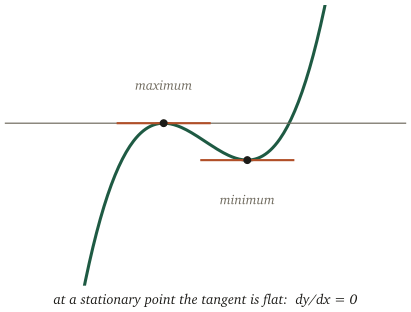
- at a turning point (a flat tangent), .
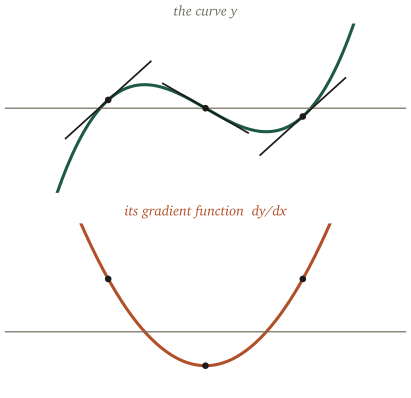
This is the picture to keep in your head: the derivative is just the original curve’s slope, plotted as its own graph.
2. Differentiation from first principles
Before the shortcut, here’s where the derivative comes from. Take two points on the curve a small distance apart and find the gradient of the chord joining them; then shrink to zero.
Key result
The fraction is the gradient of the chord from to . As the chord swings round until it becomes the tangent, and its gradient becomes the derivative.
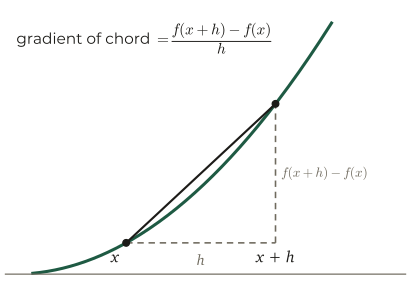
On y = x², the chord from x = 1 to x = 1 + h has gradient (f(1+h) − f(1))/h. Shrink h and watch the chord swing onto the tangent — its gradient heading for 2.
the dashed line is the tangent at x = 1 (gradient 2) — the chord approaches it
Worked example 12.1 · Differentiating x² from first principles
Use first principles to differentiate .
-
Form the chord gradient with :
-
Expand and simplify the top:
-
Let :
3. The power rule
Doing that for every function would be exhausting — happily, a single rule handles all powers of .
Key result
Multiply by the power, then knock one off the power. For a sum, differentiate each term separately; a constant multiple stays, and a lone constant goes to (its graph is flat).
Worked example 12.2 · Differentiating a polynomial
Differentiate .
Apply the rule term by term:
Worked example 12.3 · Negative and fractional powers
Differentiate .
-
Rewrite in index form first:
-
Apply the power rule to each:
-
(Optional) write back in surd/fraction form:
Common mistake
You must rewrite roots and fractions as powers before differentiating. is , and is — you can’t differentiate them while they’re still dressed as a root or a fraction.
4. Interpreting derivatives
Once you have , substitute a value of to get the gradient at that point — and differentiate again for the second derivative.
Key result
- evaluated at is the gradient of the curve at .
- The second derivative (or ) is found by differentiating a second time. It measures how the gradient itself is changing.
Worked example 12.4 · Gradient at a point, and the second derivative
For , find the gradient at and the second derivative.
-
Differentiate:
-
The gradient at :
-
Differentiate again for the second derivative:
Common mistake
A gradient is a number at a chosen point; the derivative is a function. “Find the gradient at ” means differentiate first, then substitute — never substitute into before differentiating.
Practice
Twelve questions in three tiers. Try each one properly before opening the solution — the solutions show full method, not just answers.
Warm-up
Differentiate with respect to :
Show solution
(a) .
(b) .
(c) A constant has zero gradient: .
Differentiate .
Show solution
Term by term:
Find the gradient of at the point where .
Show solution
Differentiate, then substitute:
Given , find .
Show solution
Standard
Differentiate .
Show solution
Rewrite as , then apply the power rule:
Differentiate .
Show solution
Rewrite as :
A curve has equation . Find the values of at which the gradient is zero.
Show solution
-
Differentiate:
-
Set equal to zero and solve:
So the gradient is zero at and .
Differentiate .
Show solution
Expand first — the power rule needs separate powers of :
Use differentiation from first principles to find the derivative of .
Show solution
-
Form the chord gradient with :
-
Expand the top: .
-
Divide by and let :
So .
Exam style
The curve has equation , for .
- Show that can be written as . [2]
- Hence find . [3]
Show solution
(a) Divide each term by :
(b) Apply the power rule:
The curve passes through the point .
- Find the gradient of the curve at . [3]
- Find the value of , other than at , where the curve has the same gradient as at . [2]
Show solution
(a) . At : .
(b) Set the gradient equal to :
The only solution is (a repeated root), so there is no other point with gradient — the curve has that gradient only at .
For the curve :
- Find and . [3]
- Find the -values where . [2]
- Evaluate at each of those -values. [1]
Show solution
(a)
(b) Solve :
(c) At : . At : .
(The negative value flags a maximum at , the positive a minimum at — a Chapter 13 idea.)