Year 1 Pure · Chapter 5
Coordinate Geometry of Circles
Specification: Edexcel Pure 3 — Coordinate geometry · AQA section C
In this chapter
Key facts — this chapter
- A circle with centre and radius has equation .
- To read off the centre and radius of , complete the square.
- Substituting a line into a circle gives a quadratic — its discriminant counts the intersections: two, one (a tangent) or none.
- A tangent is perpendicular to the radius at the point of contact.
- The perpendicular bisector of any chord passes through the centre.
- The angle in a semicircle is a right angle: if is a diameter and lies on the circle, then .
Circles turn everything you know about straight lines — gradients, perpendicularity, midpoints, distance — into one connected topic. Almost every circle question is secretly a straight-line question wearing a disguise.
1. The equation of a circle
Key result
A circle with centre and radius has equation
Why it works
A circle is the set of points at a fixed distance from the centre. For any point on the circle, the distance to comes from Pythagoras: . Squaring both sides gives the equation — so the circle equation is the distance formula, fixed at distance .
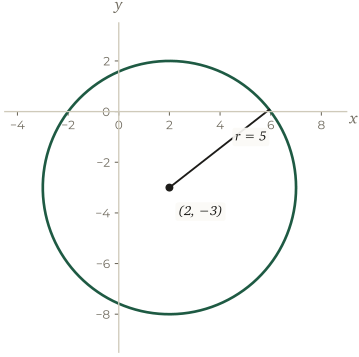
Get a feel for how the equation responds to the circle — drag the centre around, stretch the radius, and watch both forms of the equation update.
Drag the dot to move the centre · drag the square to change the radius
Questions rarely hand you the tidy version, though. More often the equation arrives expanded, looking like (the second form above), and your first job is to tidy it back up: complete the square in and separately, and the centre and radius fall out.
Worked example 5.1 · From expanded form to centre and radius
Find the centre and radius of the circle with equation .
-
Group the -terms and -terms, moving the constant across:
-
Complete the square in each bracket:
-
Substitute back and tidy up:
So the centre is and the radius is .
Common mistake
Two classic slips. The centre takes the opposite signs to the brackets: means centre , not . And the right-hand side is , not — if the equation ends , the radius is .
2. Lines meeting circles
How many times does a line cross a circle? Twice, once, or not at all — and one method answers every version of the question. Substitute the line into the circle’s equation and you’re left with a quadratic, and quadratics you already know how to handle.
Worked example 5.2 · Intersection of a line and a circle
Find the points where the line meets the circle .
-
Substitute into the circle:
-
Notice , so the second bracket is :
-
Solve: , so , giving or .
-
Substitute back into the line (always the easier equation) to find : gives ; gives .
The line meets the circle at and .
Counting intersections with the discriminant
Substituting a line into a circle gives a quadratic , and the discriminant counts the meeting points:
- — the line crosses the circle twice
- — the line touches the circle once: it is a tangent
- — the line misses the circle
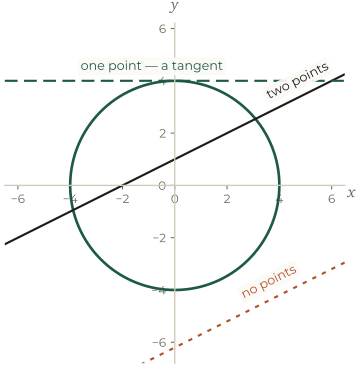
This is the standard route for “show that the line is a tangent” and “find the values of for which the line meets the circle” questions: substitute, then work with the discriminant rather than solving fully.
3. Tangents and normals
A tangent skims past a circle, touching it at exactly one point. You might expect finding its equation to need calculus — happily, circles hand you a shortcut for free.
Key result
A tangent to a circle is perpendicular to the radius at the point of contact. So at a point on the circle:
The normal at is the line along the radius — it passes through and the centre.
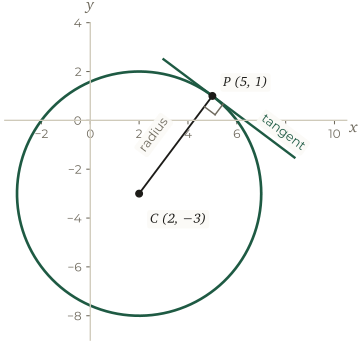
This single fact does almost all the work in tangent questions: you never need calculus to find the tangent to a circle.
Worked example 5.3 · Finding a tangent to a circle
Find the equation of the tangent to the circle at the point .
-
Check lies on the circle: ✓
-
Find the gradient of the radius from the centre to :
-
The tangent is perpendicular to the radius, so take the negative reciprocal:
-
Build the line through with gradient using :
Multiplying through by 4 and tidying: .
Common mistake
Don’t differentiate, and don’t use the gradient of the radius itself — the tangent’s gradient is the negative reciprocal of the radius gradient. Step 1 is worth the five seconds: if the given point isn’t actually on the circle, the question means something different (and your method must change).
4. Chords
A chord is a straight line joining two points on a circle, cutting across the inside. One fact about chords does nearly all the heavy lifting in exam questions:
Key result
The perpendicular bisector of any chord passes through the centre of the circle. Equivalently: the perpendicular dropped from the centre to a chord cuts it exactly in half.
Why it works
The centre is equidistant from every point on the circle — in particular from both ends of the chord. The set of all points equidistant from two points is the perpendicular bisector of the segment joining them, so the centre must sit on it.
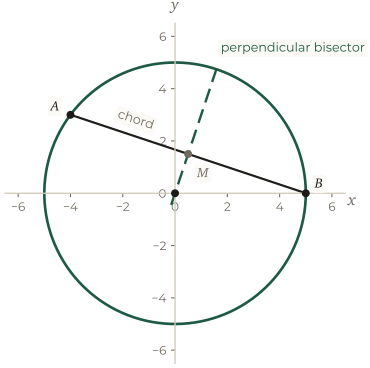
This is the key to “find the centre” questions: given a chord, build its perpendicular bisector and you have a line the centre is guaranteed to lie on. Two chords give two lines — and the centre is where they cross.
Worked example 5.4 · A chord's perpendicular bisector
The points and lie on a circle. Show that the centre of the circle lies on the line .
-
The centre lies on the perpendicular bisector of the chord , so find that line. Midpoint of :
-
Gradient of :
so the perpendicular bisector has gradient .
-
The bisector is the line through with gradient 3:
The centre lies on the perpendicular bisector of , which is . ∎
5. Constructing circles from points
So far we’ve started from the circle’s equation. Exam questions love running things the other way around: here are some points — now find the circle. Two set-ups cover nearly every version you’ll meet.
From the ends of a diameter
If and are the ends of a diameter, the centre is the midpoint of and the radius is half the distance .
Angle in a semicircle
If is a diameter of a circle and is any other point on the circle, then . The converse also holds: if , then lies on the circle with diameter — a favourite “show that” step in exam questions.
Worked example 5.5 · Circle from a diameter
The points and are the ends of a diameter of a circle. Find the equation of the circle.
-
The centre is the midpoint of :
-
The radius is the distance from the centre to either end:
So the circle is .
From two points and a radius
Given two points on a circle of known radius, the centre lies on the perpendicular bisector of the two points (it’s equidistant from them) and at distance from each. There are generally two circles that fit.
Worked example 5.6 · Two points and a radius — two answers
A circle of radius passes through and . Find the two possible equations of the circle.
-
The centre lies on the perpendicular bisector of . Midpoint ; gradient of is , so the bisector has gradient :
-
Write the centre as and set its distance from equal to :
-
Expand and simplify:
-
Factorise: , so or , giving centres and .
The two circles are
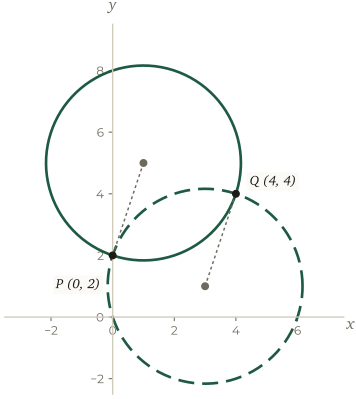
Common mistake
If your working for this type of question produces only one centre, check it — a repeated root happens only when is a diameter. Two distinct answers is the normal situation, and exam questions usually want both.
Practice
Twelve questions in three tiers. Try each one properly before opening the solution — the solutions show full method, not just answers.
Warm-up
Write down the centre and radius of the circle with equation .
Show solution
The equation matches with , , .
Centre , radius . Remember the signs flip: .
Find the equation of the circle with centre and radius .
Show solution
Substitute into , with :
Find the centre and radius of the circle with equation .
Show solution
-
Group and move the constant: .
-
Complete the square: .
-
Tidy: .
Centre , radius .
Determine whether the point lies inside, on, or outside the circle .
Show solution
Compare the squared distance from the point to the centre with :
The point is further from the centre than the radius, so lies outside the circle. (No square roots needed — compare squared distances.)
Standard
Find the coordinates of the points where the line meets the circle .
Show solution
-
Substitute the line into the circle:
-
Expand and simplify:
-
Factorise: , so or .
-
Use the line for the -values: gives ; gives .
The points of intersection are and .
The circle has equation .
- Show that the point lies on .
- Find the equation of the tangent to at .
Show solution
(a) Substitute : ✓ So lies on .
(b)
-
Complete the square to find the centre: , so the centre is .
-
Gradient of the radius from to :
-
Tangent gradient = negative reciprocal: .
-
Line through with gradient :
The line is a tangent to the circle . Find the possible values of .
Show solution
-
Substitute the line into the circle:
-
A tangent touches exactly once, so the discriminant is zero:
-
Simplify:
So or — one tangent on each side of the circle.
The line cuts the circle at the points and .
- Find the coordinates of and , and the length of the chord .
- Verify that the perpendicular from the centre to bisects the chord.
Show solution
(a)
-
Substitute : , so .
-
, giving or .
So and , and is vertical with length .
(b) The chord is vertical, so the perpendicular from the centre is horizontal: the line . It meets at , which is exactly the midpoint of and . ✓
A circle of radius passes through the points and . Find the two possible equations of the circle.
Show solution
-
The centre lies on the perpendicular bisector of . Midpoint ; gradient of is , so the bisector has gradient :
-
Write the centre as and set its squared distance from equal to :
-
Expand:
-
Divide by 5 and factorise: , so or , giving centres and .
The two circles are
Exam style
The points and are the ends of a diameter of the circle .
- Find the equation of . [3]
- Show that the point lies on . [1]
- Write down the size of the angle , giving a reason. [1]
Show solution
(a)
-
Centre = midpoint of = .
-
= squared distance from to : .
-
Equation: .
(b) Substitute : ✓ So lies on .
(c) — the angle in a semicircle is a right angle, since is a diameter and lies on the circle.
The line is a tangent to the circle . Find the two possible values of .
Show solution
-
Substitute into the circle:
-
Expand and collect as a quadratic in :
-
Tangency means the discriminant is zero:
-
Expand:
-
Factorise: , so or .
(Sense check: is the -axis, which sits exactly below the centre — a tangent, as expected.)
The circle has equation , and the point lies on .
- Find the equation of the tangent to at , giving your answer in the form . [4]
- The tangent meets the -axis at and the -axis at . Find the area of the triangle , where is the origin. [3]
Show solution
(a)
-
Check is on : ✓
-
Gradient of the radius from the centre to :
-
Tangent gradient = negative reciprocal: .
-
Line through : , so .
(b)
-
On the -axis, : , so .
-
On the -axis, : , so .
-
The triangle has legs along the axes: