Year 1 Pure · Chapter 7
Binomial Expansion
Specification: Edexcel Pure 4 — Sequences and series · AQA section D
In this chapter
Key facts — this chapter
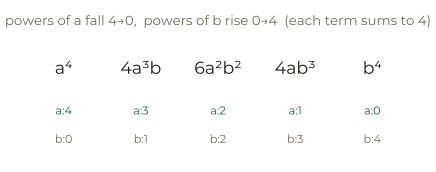
- expands into terms; the powers of fall from to while the powers of rise from to .
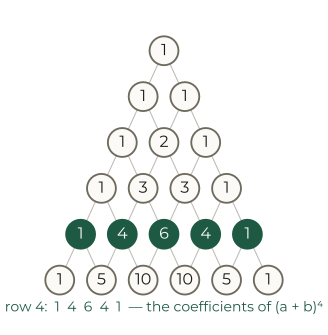
- The coefficients are row of Pascal’s triangle, where each entry is the sum of the two above it.
- Formally, the coefficient of the term in is , often written .
- Binomial theorem: .
- For the terms are simply
- Putting a small number in for gives a fast, accurate estimate of a power — the more terms, the closer.
Multiplying out is easy; by hand is misery. The binomial expansion is the shortcut — a pattern that hands you every coefficient without multiplying a single bracket.
1. Pascal’s triangle
Expand for and the coefficients line up into a famous triangle.
Key result
Each row of Pascal’s triangle gives the coefficients of . Every entry is the sum of the two directly above it, with s down each edge:
Alongside the coefficients, the powers follow their own tidy rule: counts down, counts up, and every term’s powers add to .
Worked example 7.1 · Expanding with Pascal's triangle
Expand .
-
Row 4 of the triangle is .
-
Pair each coefficient with falling powers of and rising powers of :
Worked example 7.2 · A binomial with a coefficient inside
Expand .
-
Row 3 is . Here and :
-
Work out each coefficient:
Common mistake
When a term like or sits inside the bracket, the power hits all of it: the second term of is , not . Raise the whole thing, coefficient and all.
2. The binomial coefficient
Pascal’s triangle is perfect for small , but writing out twelve rows to expand is no fun. The formula jumps straight to any coefficient.
Key result
The coefficient of the term containing in is
where . It counts the ways of choosing which of the brackets contribute a .
Why it works
Expanding means multiplying brackets and collecting like terms. A term with comes from choosing out of exactly of the brackets (and from the rest) — and the number of ways to make that choice is . That count is the coefficient.
Step n up and down. Watch Pascal's row grow (each entry the sum of the two above), and see it become the coefficients of (a + b)ⁿ below.
Worked example 7.3 · A single term via the formula
Find the coefficient of in the expansion of .
-
For the term in has coefficient :
So the coefficient of is .
3. The binomial theorem
Putting it together gives the general formula — and for it’s especially clean.
Key result
In the common case , :
Worked example 7.4 · First terms of an expansion
Find the first four terms, in ascending powers of , of .
-
Use with the "" being and . The coefficients are .
-
Attach the powers of :
-
Simplify each — remember the power hits the as well:
Common mistake
is , not — square the whole of . Forgetting to raise the inner coefficient is the classic binomial error, and it quietly wrecks every term after the first.
4. Estimating with the binomial expansion
A neat payoff: choosing a small value of turns an expansion into a quick, surprisingly accurate numerical estimate.
The idea
To estimate a power like , write the base as with small, expand , and keep the first few terms. Because each term carries a higher power of a small number, the later terms are tiny — so a handful of terms is plenty.
Worked example 7.5 · Estimating a power
Use the first three terms of the expansion of to estimate .
-
The first three terms of are
-
Here , so substitute :
The true value is , so three terms already give four-figure accuracy — the next term, in , contributes only about .
Practice
Twelve questions in three tiers. Try each one properly before opening the solution — the solutions show full method, not just answers.
Warm-up
Write down row 5 of Pascal’s triangle, and hence the coefficients of .
Show solution
Each entry is the sum of the two above it. Row 5 is
These are exactly the coefficients of .
Expand and use it to expand .
Show solution
Row 3 is , so .
With , :
Evaluate:
Show solution
(a) .
(b) (one way to choose nothing).
(c) (one way to choose everything).
Write down the number of terms in the expansion of , and the powers of and in its third term.
Show solution
has terms.
Counting from the first term , the third term is the one in : it contains (the powers always sum to ).
Standard
Expand completely.
Show solution
Row 4 is , with , :
Find the coefficient of in the expansion of .
Show solution
The coefficient of is :
Find the first three terms, in ascending powers of , of .
Show solution
Coefficients , attached to powers of :
(Note .)
Find the coefficient of in the expansion of .
Show solution
The term in takes from of the brackets and from the other :
So the coefficient of is .
Use the first three terms of the expansion of to estimate .
Show solution
First three terms: .
Substitute :
(The true value is )
Exam style
- Find the first four terms, in ascending powers of , of . [3]
- Hence estimate . [2]
Show solution
(a) Coefficients , attached to powers of :
(b) , so substitute :
(The true value is )
In the expansion of , the coefficient of is . Given that , find the value of .
Show solution
The coefficient of is :
Set equal to :
The first three terms of , in ascending powers of , are . Find the values of and .
Show solution
-
The -term gives .
-
The -term gives .
-
From (1), . Substitute into (2):
-
Solve: .
-
Then .
So and .