Year 1 Mechanics · Chapter 4
Variable Acceleration
Specification: Edexcel Paper 3 §7.4 — Calculus in kinematics · AQA section Q4
In this chapter
Key facts — this chapter
- When the acceleration changes with time, the suvat equations do not apply. Use calculus instead.
- Differentiate to go down: and .
- Integrate to go up: and . Find each constant from a known value, such as “starts from rest” or “starts at ”.
- means the body is momentarily at rest. If changes sign there, the body turns round, and its displacement is at a maximum or minimum.
- is the displacement between two times. For the distance, split the integral wherever and add the sizes of the pieces.
In Chapter 2 the acceleration was constant: a straight – graph, and five equations to go with it. Real motion is rarely that tidy. A sprinter’s acceleration fades, and a car speeds up and brakes. When displacement, velocity or acceleration is given as a function of time, the tools are the two halves of calculus from Pure: differentiation (Chapter 12) and integration (Chapter 14).
1. Differentiating: from displacement to velocity to acceleration
Velocity is the rate of change of displacement, and acceleration is the rate of change of velocity. “Rate of change” means derivative.
Key result
These are the gradients of the – and – graphs from Chapter 2, now for curves as well as straight lines. (Some books write for displacement.)
Worked example 4.1 · Velocity and acceleration from displacement
A particle moves along a straight line. Its displacement from a fixed point at time seconds is metres, for . Find the times when it is at rest, its displacement at those times, and its acceleration at those times.
Differentiate twice:
At rest means , so or . Then:
- at : m and ;
- at : m and .
In context
The particle stops 4 m from after 1 s and turns back. It stops again after 3 s, exactly at , and heads out once more.
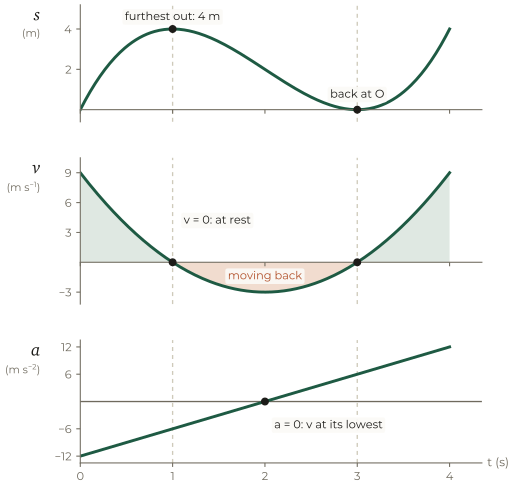
Read the three graphs from top to bottom and each one is the gradient of the one above it. That is differentiation, drawn.
2. Turning round: distance and displacement
Key result
- where the body is momentarily at rest. If changes sign there, the body turns round, and has a maximum or minimum. This is the stationary-point idea from Chapter 13 of Pure.
- The greatest speed on an interval happens either where or at an end of the interval.
- Displacement is where the body is. Distance is how far it has travelled, and every turn-round adds to it.
Worked example 4.2 · Distance travelled
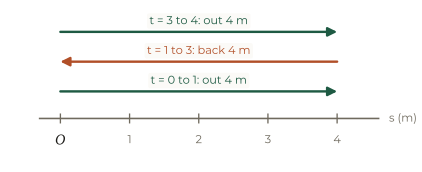
For the particle in Example 4.1, find its displacement from when , and the total distance it travels in the first 4 seconds.
m.
The particle turns round at and , so follow it stage by stage using , , , :
In context
After 4 s the particle is 4 m from , but it has travelled 12 m to get there.
Common mistake
Never find the distance by working out at the end time alone. Always check whether somewhere inside the interval. If it is, the body turned round there, and you must work in stages.
Move through time with the slider (or press play). The particle runs along its track while s, v and a are traced below it on one time axis. Watch where v crosses zero: the particle turns round.
3. Integrating: from acceleration back to displacement
Going the other way means integrating, and every integration brings a constant. The question always tells you enough to find it: “starts from rest” gives at , and “starts at ” gives at .
Key result
Add a constant each time and find it from the initial conditions. For the change in displacement between two times, use a definite integral:
It is the signed area under the – graph, just as in Chapter 2.
Worked example 4.3 · From acceleration to position
A particle starts from rest at . Its acceleration at time seconds is . Find its velocity and displacement at time , its greatest velocity, and the time at which it returns to , with its speed then.
At rest when , so and .
At when , so .
Greatest velocity: where , i.e. , giving .
Back at : gives . There, .
In context
The particle returns to after 9 s, moving at back the way it came. The minus sign is the direction.
Where suvat comes from
Integrate a constant acceleration , starting with velocity at :
The suvat equations are just the constant-acceleration case of this chapter. That is also why they fail when varies.
Common mistake
Don’t use suvat when depends on . The give-away in a question is any expression in , such as or . If you see one, reach for calculus.
Practice
Twelve questions in three tiers. Try each one properly before opening the solution. The solutions show the full method, not just answers. In every question a particle moves along a straight line, with in seconds, displacements in metres and velocities in .
Warm-up
The displacement of a particle from is . Find its velocity and acceleration when .
Show solution
, so .
, so .
A particle has velocity . Find its acceleration when , and its displacement between and .
Show solution
, so .
m. (The velocity is never negative on this interval, so this is also the distance.)
A particle has acceleration . When its velocity is . Find an expression for its velocity, and the velocity when .
Show solution
. At , , so .
, and .
A particle has velocity for . Find when it is at rest, and its acceleration at that moment.
Show solution
(as ).
, so .
Standard
A particle moves so that its displacement from is , for .
- Find the times at which the particle is at rest.
- Find its displacement from at each of those times.
- Find the total distance travelled in the first 5 seconds.
Show solution
(a) , so and .
(b) m and m.
(c) and . It goes out 20 m, back 4 m, then out 4 m:
A particle starts from rest at with acceleration .
- Find expressions for its velocity and displacement at time .
- Find its greatest velocity.
- Find the time at which it returns to .
Show solution
(a) , with at , so . Then , with at , so .
(b) The greatest velocity is where : , so .
(c) gives s.
A particle has velocity . Find its displacement and the distance it travels between and .
Show solution
, so the particle turns round at . Split the integral there.
Displacement m. Distance m.
In context
The particle goes m out and comes straight back, ending where it started after travelling m.
A particle moves with constant acceleration . At it is at with velocity . Use integration to show that and .
Show solution
. When , , so and .
. When , , so and .
Exam style
A particle leaves at and moves with velocity .
- Find the acceleration of when .
- Find the values of at which is at rest.
- Find the distance travels between those two times.
- Find the total distance travels in the first 6 seconds.
Show solution
(a) , so .
(b) , so and .
(c) (since at ). and .
does not turn round between these times, so the distance is m.
(d) . The stages are out , back , then out :
A car starts from rest. For its velocity is . After it travels at a constant speed.
- Show that the acceleration is zero when , and find the speed then.
- Find the distance travelled in the first 10 s.
- Find the total distance travelled in the first 15 s.
Show solution
(a) , which is 0 when . Then .
(b) m.
(c) For the next 5 s it travels at , a further 100 m, so the total is 200 m.
In context
The car speeds up smoothly to over 100 m, then cruises. By it has covered 200 m.
A particle passes at with velocity . Its acceleration is .
- Find its velocity at time .
- Find the time at which it comes to instantaneous rest.
- Find its greatest speed before that time.
- Find its greatest displacement from .
Show solution
(a) , with , so .
(b) , so .
(c) On , , and is greatest where : , giving .
(d) . The particle moves away from until and turns back after that, so the greatest displacement is m (3 s.f.).
Two particles and leave at the same time and move along the same straight line. Their displacements from at time are and .
- Find the time at which they meet again, and how far from they are then.
- Find their speeds when they meet.
- Show that the gap between them before they meet is greatest when their velocities are equal, and find that time.
Show solution
(a) , so . They meet m from .
(b) and .
(c) The gap is for . It is greatest where . But , so this happens exactly when the velocities are equal:
In context
pulls ahead at first. The gap stops growing at s, when has caught up to ‘s speed. From then on is faster, and it closes the gap by .