Year 1 Mechanics · Chapter 1
Modelling in Mechanics
Specification: Edexcel Paper 3 §6.1 — Quantities and units in mechanics · AQA section P
In this chapter
Key facts — this chapter
- A mathematical model is a simplified version of a real situation. You make assumptions, solve, compare with reality, and refine if you need to.
- The SI base units are the metre (m), the kilogram (kg) and the second (s). Every other unit is derived from them: velocity , acceleration , force .
- Weight is a force: with . Mass (kg) is not weight (N).
- Particle: all the mass sits at one point, so size, shape and rotation are ignored. Light: mass ignored. Inextensible: doesn’t stretch. Smooth: no friction. Rigid: doesn’t bend. Uniform: mass spread evenly.
- A scalar has size only (distance, speed, mass, time). A vector has size and direction (displacement, velocity, acceleration, force).
- For a velocity , the speed is , and its direction comes from .
Mechanics is the mathematics of things that move and the forces that move them. Real objects are messy: a football spins, deforms and drags air around it. Before any equation can say something useful, you have to decide what to ignore. That decision is called modelling, and this chapter is about making it well.
1. Mathematical models
A model keeps the features of a situation that matter most and deliberately throws away the rest. The throwing away is done by stating assumptions. A good model is simple enough to solve and accurate enough to be useful. No model is perfect.
Key result
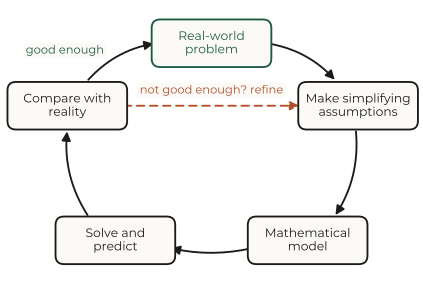
The modelling cycle
- Start from the real-world problem.
- Make simplifying assumptions.
- Write the mathematical model (a diagram and equations).
- Solve it and make a prediction.
- Compare the prediction with reality. If it’s good enough, use it. If not, refine the assumptions and go round again.
Exam questions test the last step as much as the others. Expect to be asked to criticise a model: say which assumption is least realistic and how it affects the answer. Then refine it: say what you would change.
2. Modelling assumptions
Mechanics has its own vocabulary of assumptions. Each word means something precise, and each one lets you leave something out of the maths.
| Word | What it means | What it lets you ignore |
|---|---|---|
| Particle | the object’s mass is concentrated at a single point | size, shape and rotation; air resistance too, usually |
| Light (string, rod, pulley) | its mass is negligible | the weight of the string; tension is the same all the way along it |
| Inextensible (string) | it does not stretch | changes in length; objects joined by it move with the same speed and acceleration |
| Smooth (surface, pulley) | there is no friction | friction forces |
| Rough (surface) | there is friction | nothing: friction must be included |
| Rigid (rod, body) | it does not bend or deform | changes of shape |
| Uniform (rod, body) | its mass is evenly spread | uneven mass: the weight acts at the centre |
| Bead | a particle threaded on a wire or string | its size, and the wire’s thickness |
| Wire | a rigid, thin, light path an object moves along | its thickness |
| Peg | a fixed support a string passes over | its size; if smooth, friction too |
Modelling assumption
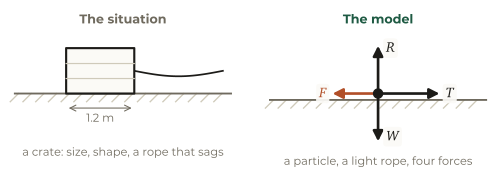
Treating the crate as a particle means ignoring its size, so it can’t tip or rotate, and every force acts at one point. Treating the rope as light means the rope has no weight, doesn’t sag, and pulls equally hard all along its length.
A crate is dragged across a floor by a rope. Switch each modelling assumption on and watch what it removes from the diagram, and from the maths.
Common mistake
An assumption is not a fact, so don’t write “the crate is a particle”. Write “model the crate as a particle”. When you’re asked to criticise a model, name one specific way the assumption fails for this object. “It isn’t realistic” earns nothing.
Worked example 1.1 · Stating and criticising assumptions
A child on a sledge is pulled across snow by a rope. The sledge and child are modelled as a particle, the rope as light and inextensible, and the snow as smooth. Explain what each assumption means here, and say which is the least realistic.
Particle: the child and sledge are treated as a single point, so their size, the way the weight is spread, and any rotation or tipping are ignored.
Light, inextensible rope: the rope’s weight is ignored, so the tension is the same all along it. It doesn’t stretch, so the sledge moves exactly as the end of the rope does.
Smooth snow: there is no friction between the sledge and the snow.
The least realistic is “smooth”. Snow does resist a sledge, and ignoring friction means the model will predict a larger acceleration than the real sledge has.
In context
Refine the model by treating the snow as rough and including a friction force.
3. Quantities and units
Every quantity in mechanics is a number with a unit. The SI system builds every unit from three base units.
Key result
| Quantity | SI unit | Built from |
|---|---|---|
| length, displacement | metre, | base unit |
| mass | kilogram, | base unit |
| time | second, | base unit |
| speed, velocity | length ÷ time | |
| acceleration | velocity ÷ time | |
| force, weight | newton, | (mass × acceleration) |
Exam papers write units as rather than m/s. The negative index means “per”, exactly as in Chapter 1 of Pure: .
To convert, multiply by a fraction equal to 1, so the unwanted unit cancels.
Worked example 1.2 · Converting units
(a) Convert to . (b) The density of a material is . Write this in .
(a) There are m in a km and s in an hour:
(b) and :
Quick check: units as algebra
Units obey the index laws, so you can check a formula by checking its units. In , the term has units , and has units . Both match , so the formula is at least consistent. A formula whose terms have different units must be wrong.
Mass and weight
Mass measures how much matter there is (kg). Weight is the force of gravity on that mass (N), and it acts vertically downwards.
Key result
Use unless a question says otherwise. An answer that uses should be given to 2 or 3 significant figures, because is only known to 2.
A 5 kg mass has weight . A 750 g mass has weight . Convert grams to kilograms first.
Common mistake
“Weighs 5 kg” is fine in a shop but wrong in mechanics: 5 kg is a mass, and its weight is 49 N. And is an acceleration, not a force. The force is .
4. The forces you’ll meet
A force diagram shows every force acting on one object, drawn as arrows from that object. Each type of force has its own letter by convention, and knowing the types is most of the work of drawing one.
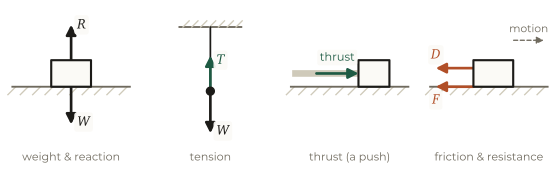
- Weight (or ): acts vertically downwards, from the centre of mass.
- Normal reaction : a surface pushes back on an object resting on it. It acts at right angles to the surface.
- Tension : a taut string or rope pulls on each object it’s attached to.
- Thrust (compression): a rod pushes on the objects at its ends.
- Friction : acts along a rough surface, opposing motion or any tendency to move.
- Air resistance (or ): opposes motion through the air.
Chapter 3 of this course turns force diagrams into equations with Newton’s laws. For now, the skill is to spot every force and to draw each one in the right direction.
5. Scalars, vectors and velocity
A scalar has size only. A vector has size and direction. Several mechanics words come in pairs, one of each:
| Scalar (size only) | Vector (size and direction) |
|---|---|
| distance | displacement |
| speed | velocity |
| mass | weight (a force) |
| time | acceleration |
A runner who completes one 400 m lap has run a distance of 400 m, but their displacement is zero: they finish where they started.
Vectors in mechanics use the , notation from Chapter 15 of Pure. usually points east (or right) and north (or up).
Key result
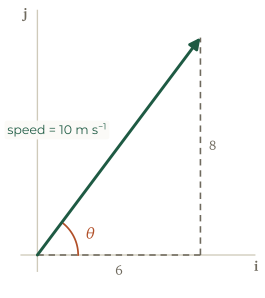
For a velocity :
where is the angle makes with . A body moving with constant velocity from position is at after time .
Worked example 1.3 · Speed and direction
A particle moves with velocity . Find its speed, and the angle its direction of motion makes with .
The speed is the magnitude of the velocity:
Sketch it: 5 right, 12 down. The angle below satisfies
In context
The particle moves at , in a direction below the direction.
Worked example 1.4 · Bearings and position
A boat leaves a harbour with constant velocity , where points east and north. Find (a) its speed, (b) its bearing, and (c) its position vector after 4 hours if it started at km from .
(a) .
(b) A bearing is measured clockwise from north, so use the angle between the velocity and . It is east for every north:
(c) .
Average velocity
If a body moves from to in time , its average velocity is and its average speed is . For a straight journey from to in 4 s, the displacement is . That gives an average velocity of and an average speed of . On a curved or out-and-back journey, the two can be very different, as the 400 m lap shows.
Practice
Twelve questions in three tiers. Try each one properly before opening the solution. The solutions show the full method, not just answers. Take throughout.
Warm-up
Convert:
- to
- to
- to
Show solution
(a) .
(b) .
(c) In one hour the body goes m km, so the speed is .
- Find the weight of a mass.
- Find the weight of a mass.
- A box has weight . Find its mass.
Show solution
(a) .
(b) Convert to kilograms first: .
(c) .
A particle hangs at rest on the end of a string. The string is modelled as light and inextensible. Explain what each of these words means, and what each one allows you to ignore.
Show solution
Light: the string’s mass is negligible. You can ignore its weight, so the tension is the same all the way along it.
Inextensible: the string does not stretch. You can ignore any change in its length, so anything attached to it moves exactly as its end does.
A particle moves with velocity . Find its speed, and the angle between its direction of motion and the vector .
Show solution
Speed .
Sketch it: 5 left, 12 up. The acute angle with is , so the angle with is .
Standard
An athlete runs exactly one lap of a track in , finishing where she started.
- State the distance she ran and her displacement.
- Find her average speed and her average velocity.
- Use your answers to explain the difference between a scalar and a vector.
Show solution
(a) Distance m. Displacement m, because she ends where she began.
(b) Average speed . Average velocity .
(c) Distance and speed are scalars. They measure how much, whatever the direction, so every metre counts. Displacement and velocity are vectors. They account for direction, so running back to the start undoes the outward journey.
A particle starts at the point with position vector m and moves with constant velocity .
- Find the position vector of after 6 seconds.
- Find the distance of from the origin at that time.
Show solution
(a) m.
(b) m (3 s.f.).
A crate is dragged across a warehouse floor by a rope. In a first model, the crate is a particle, the rope is light, and the floor is smooth.
- Draw a force diagram for the crate in this model, naming each force.
- State which assumption is least realistic, and the effect it has on the acceleration the model predicts.
- Suggest how the model could be refined.
Show solution
(a) Three forces act at a single point: the weight vertically down, the normal reaction vertically up, and the tension along the rope. There is no friction arrow, because the floor is smooth.
(b) “Smooth” is least realistic. A crate on a warehouse floor meets significant friction. With the resistance to motion left out, the model predicts a larger acceleration than the crate really has.
(c) Model the floor as rough, and include a friction force opposing the motion.
In context
With friction included, the model’s predicted acceleration drops towards what is actually observed.
Using :
- Momentum is mass × velocity. Find its SI units.
- Work done is force × distance. Write its units in terms of kg, m and s.
- Show that every term in has the same units, where and are velocities, an acceleration and a displacement.
Show solution
(a) .
(b) .
(c) and have units . The term has units (the 2 is a pure number). All three terms match. ∎
Exam style
In this question points due east and due north. A boat leaves a harbour and moves with constant velocity .
- Find the speed of the boat.
- Find the bearing on which the boat moves.
- Find how far the boat is from after 2 hours 30 minutes.
Show solution
(a) .
(b) The bearing is measured clockwise from north. The boat goes 4 east for every 3 north, so the angle from north satisfies , giving . The bearing is (to the nearest degree).
(c) After hours, km, so the distance is km.
(Or: the speed is constant at along a straight line, so the distance is km.)
At time , particle is at m and moves with constant velocity . At the same moment, particle is at m and moves with constant velocity .
- Write the position vectors of and at time seconds.
- Show that and collide, and find the time and the position of the collision.
Show solution
(a) and .
(b) They collide if both components are equal at the same time.
: .
: .
Both components give , so the particles are at the same point at the same time.
In context
They collide after 4 seconds, at the point with position vector m.
A stone is dropped from rest from the top of a cliff m high. A student models the stone as a particle falling freely under gravity, which gives a time to reach the sea of , where is the height fallen.
- Find the time the model predicts.
- The stone actually takes s. Comment on the model, naming the assumption most likely to be responsible.
- Another student uses . Find their prediction, and explain why changing is not a sensible way to improve the model.
Show solution
(a) s (3 s.f.).
(b) The model predicts a shorter time than was observed, so it underestimates the time by about 0.4 s. The most likely cause is ignoring air resistance: treating the stone as a particle falling freely leaves out the drag that slows it down. A refined model would include a resistance force.
(c) s. This moves the prediction the wrong way, further from 3.4 s. More importantly, is a measured physical constant, not a number to tune. The mismatch comes from a missing force, so that is what the refinement should add.
A particle moves with constant velocity. At it is at the point with position vector m. At s it is at , with position vector m.
- Find the velocity of .
- Find the speed of .
- Find the angle between the direction of motion and the vector .
- Find the time at which is due east of the origin (i.e. its -component is zero), and its position then.
Show solution
(a) .
(b) .
(c) The velocity points 3 right and 1.6 down, so the angle below is .
(d) . Set the -component to zero: s. Then the -component is .
In context
is due east of the origin after 2.5 s, at m, i.e. 4.5 m east of .