Year 1 Mechanics · Chapter 2
Constant Acceleration
Specification: Edexcel Paper 3 §7.1–7.3, 8.3 — Kinematics · AQA section Q, R3
In this chapter
Key facts — this chapter
- Displacement , velocity and acceleration are vectors: along a line, their sign gives the direction. Distance and speed are their sizes.
- On a displacement–time graph, the gradient is the velocity.
- On a velocity–time graph, the gradient is the acceleration and the area under it is the displacement.
- The suvat equations, for constant acceleration only: , , , , .
- Each suvat equation leaves out one of the five letters. Choose the one that leaves out the letter you neither know nor want.
- Free fall: downwards. Choose a positive direction and keep every sign consistent with it.
This chapter is about motion in a straight line: a car pulling away from traffic lights, a train between stations, a ball thrown into the air. When the acceleration is constant, five short equations describe the whole motion. Every one of them comes from a single picture, the velocity–time graph.
1. The language of motion
Along a straight line, choose one direction to be positive. Then every vector quantity is just a number with a sign.
Key result
| Quantity | Symbol | Unit | Its size is… |
|---|---|---|---|
| displacement from a fixed point | distance | ||
| velocity: rate of change of displacement | speed | ||
| acceleration: rate of change of velocity |
A velocity of means a speed of in the negative direction. A deceleration of is an acceleration of : the velocity is falling. Be careful with “slowing down”, though. Slowing down happens when and have opposite signs.
2. Displacement–time graphs
Key result
On a displacement–time (–) graph, the gradient is the velocity. A horizontal line means the body is at rest. A negative gradient means it is moving back towards the start.
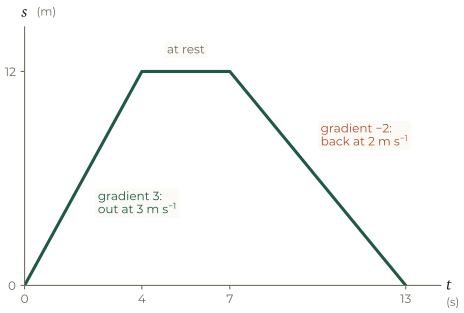
The walker in the graph covers 24 m in total, but ends with displacement 0. The average speed is . The average velocity is 0.
3. Velocity–time graphs
The velocity–time graph carries more information, and it is the one you’ll use most.
Key result
On a velocity–time (–) graph:
- the gradient is the acceleration;
- the area between the graph and the -axis is the displacement. Area below the axis counts as negative displacement.
Why the area is the displacement
Over a short time , a body moving at velocity travels about . That is the area of a thin strip under the graph. Add up all the strips and you have the total displacement, which is exactly the area under the curve. This is the idea behind integration from Chapter 14 of Pure, and in Chapter 4 you’ll write it as .
Drag the points (or use the buttons) to set the velocity every 5 seconds. Each straight piece is a stage of constant acceleration: its gradient is the acceleration, and the shaded area under it is the displacement.
Worked example 2.1 · A journey in three stages
A car starts from rest and accelerates uniformly to in 8 s. It travels at for seconds, then decelerates uniformly to rest in 5 s. The whole journey covers 500 m. Find , the acceleration and the deceleration.
Sketch the – graph: a trapezium. Its area is the distance.
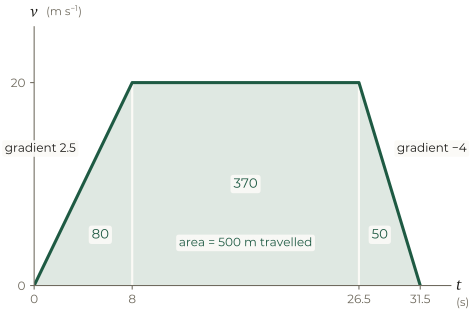
The gradients give the acceleration, , and the deceleration, .
In context
The car travels at constant speed for 18.5 s. It accelerates at and decelerates at .
4. The suvat equations
When the acceleration is constant, the – graph is a straight line. Five quantities describe the motion over a time interval:
- , the displacement;
- , the initial velocity;
- , the final velocity;
- , the acceleration;
- , the time.
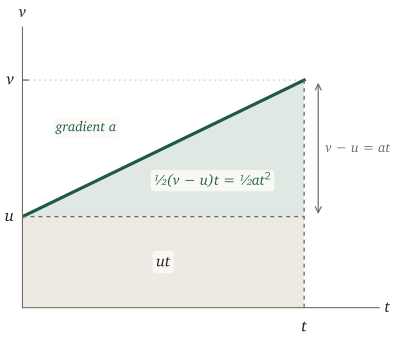
Deriving suvat from the graph
Gradient. The line rises by over time , so :
Area. The region under the line is a trapezium with parallel sides and :
Eliminate.
- Substitute into the area formula: . This is also the rectangle plus the triangle .
- Substitute instead: .
- Substitute : , which rearranges to .
Each equation leaves out exactly one of the five letters:
| Equation | Leaves out |
|---|---|
The routine: write down all five letters, fill in the three you know, mark the one you want, and pick the equation that doesn’t need the fifth.
Worked example 2.2 · Choosing the right equation
A car decelerates uniformly from to over a distance of 84 m. Find the deceleration and the time taken.
, , , , not needed yet. The equation without is :
Now : gives , so .
In context
The car decelerates at and takes 4 s. The negative sign in is the deceleration, so don’t state “a deceleration of ”.
Worked example 2.3 · A quadratic in t
A cyclist passes a lamp post at and accelerates uniformly at . How long does she take to cover the next 30 m?
, , , , not needed. So use :
The negative root means nothing here, because the cyclist only moves forward in time from the lamp post. So s (3 s.f.).
On your calculator
A polynomial or equation solver will give both roots. In an exam, still show the quadratic and the formula: the method marks are for the working.
Common mistake
suvat only works when the acceleration is constant. For a journey in stages, like the car in Example 2.1, apply the equations to one stage at a time. Remember that the final velocity of one stage is the initial velocity of the next.
5. Vertical motion under gravity
Close to the Earth’s surface, and with air resistance ignored, every falling object has the same constant acceleration: downwards. So suvat applies to anything thrown straight up or dropped.
Modelling assumption
The object is modelled as a particle moving freely under gravity. Air resistance is ignored, and is taken to be constant.
Key result
Choose up as positive (or down, but stick to your choice). Then , and a point below the starting point has negative . At the highest point . A body thrown up returns to its starting level with the same speed it was thrown at.
Worked example 2.4 · Thrown straight up
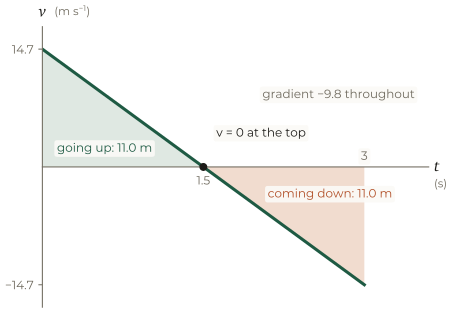
A ball is thrown vertically upwards at from ground level. Find (a) its greatest height, (b) the time it takes to reach it, and (c) the total time it is in the air.
Take up as positive: , .
(a) At the top . Without : , so m (3 s.f.).
(b) : , so s.
(c) It lands when : , so s. That’s twice the time to the top, as the symmetry of the graph promises.
Worked example 2.5 · Landing below the start
A stone is thrown vertically upwards at from the top of a tower 29.4 m high. How long does it take to reach the ground, and how fast is it moving then?
Up is positive, so the ground is at . With , :
so s. Then , so the speed is .
In context
The stone reaches the ground after 3 s, moving at .
Common mistake
The most common error is a sign slip: using for a point below the start, or with up taken as positive. Write “up is positive” at the start of every vertical-motion answer and check each sign against it.
Practice
Twelve questions in three tiers. Try each one properly before opening the solution. The solutions show the full method, not just answers. Take throughout.
Warm-up
A car accelerates uniformly from to in 8 s. Find its acceleration and the distance it travels in that time.
Show solution
.
m.
A particle moving at decelerates uniformly and comes to rest in 6 s. Find the deceleration and the distance travelled while stopping.
Show solution
, so : a deceleration of .
m.
A cyclist starts from rest and accelerates uniformly to in 4 s. She rides at for 10 s, then decelerates uniformly to rest in 6 s.
- Sketch the velocity–time graph.
- Find the total distance travelled and her average speed.
Show solution
(a) A trapezium: a line rising from to , flat to , then falling to .
(b) The distance is the area: m.
Average speed .
A stone is dropped from rest off a bridge and hits the water 2.5 s later. Find the height of the bridge above the water and the speed at which the stone hits it.
Show solution
Take down as positive: , , .
, so the height is 30.6 m (3 s.f.).
.
Standard
A car passes a point at and accelerates uniformly at until it passes , 84 m further on. Find its speed at and the time it takes to get from to .
Show solution
, , . Without : , so .
Then : , so s.
A ball is thrown vertically upwards at from ground level. Find:
- the greatest height it reaches;
- the time it takes to reach that height;
- the total time it is in the air.
Show solution
Up is positive: , .
(a) At the top : , so m.
(b) , so s.
(c) : s.
A particle passes a point with velocity and moves with constant acceleration .
- Find the times at which its displacement from is 16 m, and explain why there are two.
- Find its greatest displacement from .
Show solution
(a) , so or .
The particle passes the 16 m point on its way out (), carries on until it stops, then comes back through the same point ().
(b) It is furthest away when : . Then m.
A train starts from rest and accelerates uniformly to a speed in 40 s. It travels at that speed for 3 minutes, then decelerates uniformly to rest in 60 s. The total distance is 5.75 km.
- Sketch the velocity–time graph.
- Find .
- Find the acceleration and the deceleration.
Show solution
(a) A trapezium: up to over the first 40 s, level for 180 s, then down to 0 over 60 s (280 s in all).
(b) Work in metres and seconds. The area is
(c) Acceleration . Deceleration (3 s.f.).
Exam style
A car is travelling along a straight road at a constant . As it passes a point , a motorbike sets off from rest at in the same direction, accelerating uniformly at .
- Find the time taken for to catch up with , and the distance from at which it does.
- Find the speed of as it catches .
- Find the greatest distance between them before catches up.
Show solution
(a) After seconds, and .
They are level when , i.e. , so s (the root is the start). Distance m.
(b) .
(c) The gap is . It grows while is faster and shrinks once is faster, so it is greatest when their speeds are equal: . Then m.
In context
catches after 16 s, 320 m from , moving at . Before that, the greatest gap is 80 m, 8 s after the start.
A stone is thrown vertically upwards at from the edge of a cliff, 21 m above the sea.
- Find the time it takes to reach the sea.
- Find the speed with which it hits the sea.
- Find the length of time for which the stone is at least 5 m above the point of projection.
Show solution
Up is positive, so the sea is at . , .
(a) .
(The other root is negative.)
(b) , so the speed is (3 s.f.).
(c) , so
The stone is above 5 m between these two times, for s (3 s.f.).
A particle moves along a straight line. At it passes with velocity , and it has a constant acceleration of .
- Find the velocity of when .
- Find the displacement of from when .
- Find the total distance travels in the first 5 seconds.
Show solution
(a) : is now moving back towards .
(b) m.
(c) turns round when : , where m. So it goes 9 m out, then comes back from 9 m to 5 m, another 4 m. The total distance is m.
On the – graph, that’s a triangle of area 9 above the axis and one of area 4 below it: displacement , distance .
- Use a velocity–time graph to show that a body with initial velocity and constant acceleration has displacement after time .
- Hence show that the distance travelled in the th second of motion is .
- A particle moving with constant acceleration travels 13 m in the 4th second and 17 m in the 6th second. Find its initial velocity and its acceleration.
Show solution
(a) The graph is a straight line from to . The area under it is the rectangle plus a triangle with base and height :
(b) The th second runs from to :
(c) and . Subtracting, , so and .
In context
The particle starts at and accelerates at .