Year 2 Statistics · Chapter 2
Conditional Probability
Specification: Edexcel Paper 3 §3.1–3.3 — Probability · AQA section M1–M3
In this chapter
Key facts — this chapter
- is the probability of given that has happened: .
- Knowing shrinks the sample space to : count, or add up probabilities, inside only.
- Multiplication rule: . On a tree diagram, the second-stage branches are conditional probabilities.
- and are usually different. To reverse a tree, divide: .
- and are independent exactly when : knowing doesn’t change the chance of . Then .
- A probability model rests on assumptions, such as fixed probabilities and independence. Say whether they are realistic, and what happens if they fail.
Information changes chances. The probability that a student cycles to school depends on which year they are in; a positive medical test changes the chance that someone has the disease. Conditional probability is the probability of one event once you know that another has happened, and it is the idea behind every tree diagram you have drawn.
Set notation
- : and both happen.
- : or or both happen.
- : does not happen.
- , from Year 1.
1. Conditional probability
is read “the probability of given ”. Once you know that has happened, every outcome outside is ruled out: the sample space shrinks to alone, and you ask what fraction of it lies in .
Worked example 2.1 · From a two-way table
The table shows how 200 sixth-form students travel to school. A student is chosen at random. Find the probability that the student cycles, the probability that the student cycles given that they are in Year 12, and the probability that the student is in Year 13 given that they cycle.
| Cycles | Does not cycle | Total | |
|---|---|---|---|
| Year 12 | 27 | 63 | 90 |
| Year 13 | 22 | 88 | 110 |
| Total | 49 | 151 | 200 |
-
.
-
Given Year 12, only the 90 students in that row count, and 27 of them cycle: .
-
Given that the student cycles, only the 49 cyclists count, and 22 of them are in Year 13: (3 s.f.).
Dividing counts is the same as dividing probabilities, since each count is a probability multiplied by 200. That gives the general rule.
Conditional probability
100 people, each either in A or not, and in B or not. Choose what you are told about the person chosen: everyone it rules out fades away, and the conditional probability is read from the people who are left.
Worked example 2.2 · From a Venn diagram
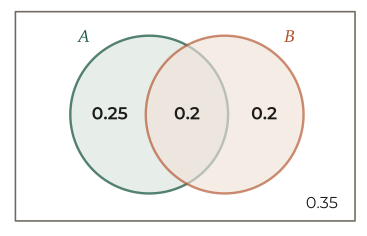
, and . Find , , and .
-
. The Venn diagram follows: in only, in only and outside both.
-
and .
-
is the region outside both circles, and , so
Common mistake
and are different questions with different answers. In Example 2.1, 30% of Year 12 students cycle, but only 55% of cyclists are in Year 12. The event after the bar is the one you already know about: it sets the denominator.
2. Tree diagrams
The multiplication rule
On a tree diagram, each second-stage branch is a conditional probability: the probability of the second event given the branch you are already on.
Trees are drawn in the order things happen, but questions often ask the other way round: given what you can see (a test result), how likely is what you can’t (the disease)? Find the two probabilities from the tree, then divide.
Worked example 2.3 · A positive test
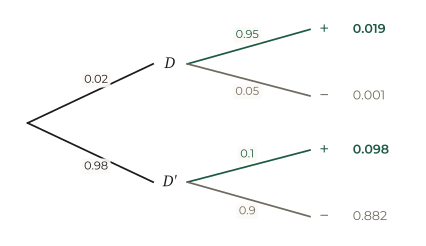
A disease affects 2% of a population. A test for it is positive for 95% of people who have the disease, and also, wrongly, for 10% of people who do not. A person chosen at random tests positive. Find the probability that they have the disease.
-
Let be “has the disease” and “tests positive”. The two paths that end in a positive test give
-
So , and
In context
Only about 16% of people who test positive have the disease. The disease is rare, so the few true positives are outnumbered by false positives from the much larger healthy group.
Common mistake
The test is “95% accurate” for people with the disease, but that is , not . Confusing the two is a classic error, in courtrooms and clinics as well as exams.
3. Independence
Two events are independent when knowing that one has happened tells you nothing about the other. Conditional probability says exactly what that means.
Independence
and are independent exactly when
and then also and . Any one of these shows independence. If and are independent, so are and .
Worked example 2.4 · Testing for independence
Using the table in Example 2.1, determine whether cycling to school is independent of being in Year 12.
, but . These are different, so the events are not independent.
In context
Knowing that a student is in Year 12 raises the chance that they cycle, from 24.5% to 30%.
Worked example 2.5 · Using independence
and are independent events with and . Find and .
-
Independence gives , so
and .
-
is independent of , so also of : .
4. Modelling with probability
Every probability model rests on assumptions: that outcomes are equally likely, that probabilities stay fixed, that events are independent. A good answer names the assumption, says whether it is realistic in context, and says what would change if it failed.
Worked example 2.6 · Criticising a model
An analyst models a tennis player’s first serves: each lands in with probability , independently of every other serve. Give two criticisms of the model and the likely effect of each.
-
The probability is unlikely to be fixed. It will fall as the player tires, and vary with the score and the conditions. A single value of hides this, so the model will be least accurate late in long matches.
-
Serves are unlikely to be independent. A player who has just served well may gain confidence, and one who has missed may play safe. Successes and failures would then come in longer runs than the model predicts.
Practice
Twelve questions in three tiers. Try each one properly before opening the solution. The solutions show the full method, not just answers. Give answers as exact fractions or decimals, or to 3 significant figures where they aren’t exact.
Warm-up
80 adults were asked whether they prefer tea or coffee.
| Tea | Coffee | Total | |
|---|---|---|---|
| Under 40 | 12 | 28 | 40 |
| 40 or over | 26 | 14 | 40 |
| Total | 38 | 42 | 80 |
One adult is chosen at random. Find (a) , (b) , (c) .
Show solution
(a) . (b) . (c) .
, and . Find and .
Show solution
and .
A bag holds 4 red and 6 blue counters. Two are taken without replacement. Find the probability that the second is red given that the first is red, and the probability that both are red.
Show solution
After a red is taken, 3 of the 9 left are red: .
.
, and . Are and independent?
Show solution
, so yes: and are independent.
Standard
Of 60 students, 30 study Maths (), 25 Physics () and 20 Chemistry (). 12 study both Maths and Physics, 8 Maths and Chemistry, 7 Physics and Chemistry, and 4 study all three.
- Draw a Venn diagram showing the number in each region. [3]
- A student is chosen at random. Find and . [2]
- Find the probability that the student studies none of the three. [1]
Show solution
(a) Start from the centre, 4, then the pairs without it:
- Maths and Physics only: ; Maths and Chemistry only: ; Physics and Chemistry only: .
- Maths only: ; Physics only: ; Chemistry only: .
- Outside all three: .
(b) , and .
(c) .
Machine makes 60% of a factory’s components and machine the rest. 3% of ‘s components are faulty, and 5% of ‘s. A component chosen at random is faulty. Find the probability that it was made by machine .
Show solution
So and .
and are independent, with and . Find , and .
Show solution
, so .
is independent of too, so .
(or ).
, and . Find , and .
Show solution
.
, and .
A weather model assumes that it rains on any day with probability , independently of every other day. It predicts that the chance of a week without rain is . Criticise two assumptions of the model and say how each might affect the prediction.
Show solution
Independence: weather comes in spells, so a dry day makes another dry day more likely. Dry weeks are then more common than the model predicts, so is probably too low.
A fixed probability: the chance of rain varies with the season, so one value of all year will overestimate dry weeks in wet months and underestimate them in dry ones.
Exam style
For events and , and , and the probability that neither happens is .
- Find and draw a Venn diagram. [3]
- Find and . [3]
- Determine whether and are independent. [1]
Show solution
(a) , so . The regions are ( only), (both), ( only) and (neither).
(b) . and , so .
(c) but , so they are not independent.
A student’s bus is late on 15% of days. When the bus is late, the student is late for school with probability ; when it isn’t, with probability .
- Find the probability that the student is late on a given day. [3]
- Given that the student is late, find the probability that the bus was late. [3]
- Assuming days are independent, find the probability that the student is late on exactly one of two days. [2]
Show solution
(a) .
(b) .
(c) Late on the first day only, or the second only: (3 s.f.).
Events , and have , and . and are mutually exclusive, and are independent, and .
- Find . [1]
- Draw a Venn diagram showing the probability in each region. [4]
- Find and . [3]
Show solution
(a) Independent, so .
(b) and don’t overlap, so no region is in all three. The regions are only , , only , , only , and outside all three .
(c) , and .