Year 2 Pure · Chapter 1
Proof
Specification: Edexcel Pure 1.1 — Proof · AQA section A1
In this chapter
Key facts — this chapter
- A proof is a chain of correct steps from facts you know to the statement, and it must cover every case. Checking examples is not a proof.
- Deduction: write the numbers algebraically ( for even, for odd) and argue from the definitions.
- Exhaustion: split into a finite set of cases that covers everything, and prove each one.
- Counter-example: a single case where a statement fails disproves it.
- Contradiction: assume the statement is false, reason correctly, and reach something impossible. The assumption must be wrong, so the statement is true.
- The two classics: is irrational, and there are infinitely many primes.
In Year 1, proof turned up inside “show that” questions: expand, simplify, and arrive at what you were told. Year 2 adds one new method, proof by contradiction. It proves things that no amount of checking could ever settle, like the fact that the primes never run out.
1. What counts as a proof
A proof has to work for every case the statement covers, and there are usually infinitely many. So instead of numbers, you use letters that could stand for any of them.
Writing numbers algebraically
For an integer :
- an even number is , and an odd number is ;
- consecutive integers are , , , …;
- a multiple of is ;
- a rational number is , where and are integers and . You can always take the fraction in its lowest terms, so and have no common factor.
Proofs also use a little notation, which exam questions expect you to read and write:
| Symbol | Meaning |
|---|---|
| implies: if the left is true, so is the right | |
| if and only if: each side implies the other | |
| is a member of, as in | |
| , , , | the natural numbers , the integers, the rational numbers, the real numbers |
Common mistake
Two odd numbers are and , not twice. Using the same letter makes them the same number, so your proof only covers one odd number added to itself.
2. Proof by deduction
Start from what you know, write it algebraically, and let the algebra show the result. The last line should make the property visible: a factor of outside a bracket, or a square that can’t be negative.
Worked example 1.1 · Consecutive odd numbers
Prove that the difference between the squares of two consecutive odd numbers is always a multiple of .
-
Two consecutive odd numbers are and , for an integer .
-
Expand both squares:
-
Subtract: the difference is , and is an integer, so the difference is a multiple of .
Worked example 1.2 · An inequality
Prove that for all real values of .
-
Complete the square:
-
A square is never negative, so for every real .
-
So , which is what we wanted.
3. Exhaustion and counter-examples
Proof by exhaustion splits the statement into cases that between them cover everything, then proves each one. For integers, even and odd is the usual split. For remainders on division by , the cases are , and .
Worked example 1.3 · Square numbers
Prove that every square number is either a multiple of or one more than a multiple of .
Every integer is even or odd, so there are two cases.
-
even, :
which is a multiple of .
-
odd, :
which is one more than a multiple of .
The two cases cover every integer, so the statement is true.
A counter-example works the other way. A statement about every case is false as soon as one case fails, and that one case is all the disproof needs.
Worked example 1.4 · Forty successes, then a failure
Disprove the statement: ” is prime for every positive integer .”
Take :
is not prime, so the statement is false.
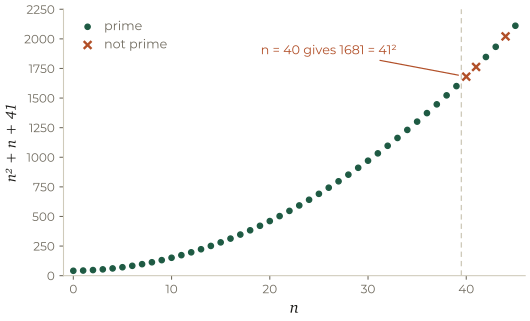
Why it works
Checking cases can build confidence, but it can’t prove anything about infinitely many numbers. The polynomial gives primes for the first forty values of , so a checker would stop long before it fails. Only an argument that covers every at once counts as a proof.
4. Proof by contradiction
Some statements can’t be reached by deduction: ” is irrational” says what a number is not. For those, you argue backwards.
Proof by contradiction
- Assume the statement is false: assume its opposite.
- Reason correctly from that assumption.
- Reach a contradiction: something that can’t be true, such as a clash with the assumption itself or with a known fact.
- Conclude that the assumption was false, so the statement is true.
Why it works
Correct reasoning never leads from a true starting point to a false conclusion. So if careful steps end somewhere impossible, the starting point must have been false. The starting point was “the statement is false”, so the statement is true.
The first step is to write down the opposite exactly:
| Statement | Assume instead |
|---|---|
| is irrational | , with integers , that have no common factor |
| There are infinitely many primes | There are finitely many primes |
| If is even, then is even | is even and is odd |
| There are no integers with property P | There is an integer with property P |
Worked example 1.5 · Even squares come from even numbers
Prove that for any integer , if is even then is even.
-
Assume the opposite: is even and is odd.
-
is odd, so for some integer , and
-
That makes odd, which contradicts being even.
-
So the assumption is false: if is even, is even.
Worked example 1.6 · The square root of 2 is irrational
Prove by contradiction that is irrational.
-
Assume is rational: , where and are integers with no common factor and .
-
Square both sides and rearrange:
So is even, and by Example 1.5, is even.
-
Write . Then
So is even, and is even too.
-
Now and are both even, so they share the factor . That contradicts “no common factor”, so is irrational.
Common mistake
Don’t stop at the contradiction. Say what it contradicts and what that proves: “This contradicts and having no common factor, so is irrational.” Mark schemes award a mark for that closing sentence.
Worked example 1.7 · There are infinitely many primes
Prove by contradiction that there are infinitely many prime numbers.
-
Assume there are finitely many primes, and list them all: .
-
Multiply them together and add :
-
, so has at least one prime factor. Every prime is on the list, so that factor is one of .
-
But dividing by any leaves remainder , so no prime on the list divides .
-
That’s a contradiction, so the list can’t be complete. There are infinitely many primes.
Common mistake
The proof does not say that itself is prime. Often it isn’t: . What the proof needs is a prime factor that is missing from the list, and and are both missing.
Pretend the primes you pick are all the primes there are. Multiply them, add 1, and factorise the result: every prime factor it has is one your list is missing.
Divide N by each prime on the list
The prime factors of N
Practice
Twelve questions in three tiers. Try each one properly before opening the solution — the solutions show full method, not just answers.
Warm-up
Prove that the sum of any two odd numbers is even.
Show solution
Let the two odd numbers be and , where and are integers. Then
is an integer, so the sum is even.
Find a counter-example to each statement.
- For all real , . [1]
- If is prime, then is prime. [2]
Show solution
(a) Take : , which is less than .
(b) Try the primes in order. give , which are all prime, but gives
which is not prime.
Write down the assumption you would start from to prove each statement by contradiction.
- is irrational.
- There is no largest even number.
- If is odd, then is odd.
Show solution
(a) Assume , where and are integers with no common factor and .
(b) Assume there is a largest even number, .
(c) Assume is odd and is even.
Prove by exhaustion that no square number ends in the digit .
Show solution
Write , where is the last digit of . Then
so ends in the same digit as . Check all ten possible last digits: , , , , , , , , and .
So ends in or . None of these is , so no square number ends in .
Standard
Prove that is odd for every integer .
Show solution
is an integer, so this is one more than an even number: it is odd.
Prove that for all positive real numbers and ,
Show solution
and are positive, so and are real. A square is never negative, so
Expanding, , so . Divide by :
Prove that for any integer , if is a multiple of then is a multiple of .
Show solution
Assume the opposite: is a multiple of and is not. Then leaves remainder or on division by , so there are two cases.
:
:
In both cases is one more than a multiple of , so it is not a multiple of . This contradicts the assumption, so if is a multiple of , then is a multiple of .
Prove by contradiction that there are no positive integers and such that .
Show solution
Assume there are positive integers and with . Factorise:
and are at least , so . Then
lies strictly between and , so it is not an integer. But is a difference of integers, so it is an integer. This contradiction shows there are no such positive integers.
Prove by contradiction that if is rational and is irrational, then is irrational.
Show solution
Assume is rational. Write and , where , , and are integers and . Then
and are integers, and , so is rational. This contradicts being irrational, so is irrational.
Exam style
Prove by contradiction that is irrational. You may use the result of Question 7.
Show solution
Assume is rational: , where and are integers with no common factor and . Square and rearrange:
So is a multiple of , and by Question 7 so is . Write :
So is a multiple of , and so is . Then and share the factor , which contradicts their having no common factor. So is irrational.
Prove by contradiction that is irrational.
Show solution
Assume is rational. It is positive, because , so we can write with and positive integers. Then
, so is even. But is a product of odd numbers, so it is odd. An even number can’t equal an odd number, so this is a contradiction, and is irrational.
- Show that is prime. [2]
- It is given that . A student says this shows that the proof that there are infinitely many primes is wrong. Explain why the student is mistaken. [2]
- Prove that for any list of primes , the number is not divisible by any prime in the list. [2]
Show solution
(a) . If were not prime, it would have a prime factor no bigger than , which is less than . So it is enough to check . Each of leaves remainder , and . None divides , so is prime.
(b) The proof never claims that is prime. It shows that the number has a prime factor missing from the list. Here the prime factors are and , and neither is or , which is exactly what the proof says.
(c) is a multiple of each , so leaves remainder on division by . Every prime is at least , so a remainder of is not , and does not divide the number.