Year 1 Statistics · Chapter 5
Probability
Specification: Edexcel Paper 3 §3.1 — Probability · AQA section M
In this chapter
Key facts — this chapter
- For equally likely outcomes, , where is the sample space.
- , and .
- Mutually exclusive events cannot both happen: , so .
- Independent events don’t affect each other’s chances: .
- On a tree diagram, multiply along a path and add the paths that fit.
- Without replacement, the second set of branches changes: one fewer item, and one fewer of whatever was taken.
Probability puts a number on uncertainty. Almost every question in this chapter is answered by one of two pictures — a Venn diagram or a tree diagram — so the skill is choosing the right one and reading it carefully.
1. Sample spaces
The sample space is the set of all possible outcomes. When every outcome is equally likely,
Key result
For two dice there are equally likely outcomes. Six of them give a total of 7, so . Listing the sample space, or drawing it as a grid, is often the quickest route.
Common mistake
Outcomes are only equally likely if the question says so, or the context makes it clear (a fair die, a well-shuffled pack). “The total of two dice” has 11 possible values, but they are certainly not equally likely.
2. Venn diagrams
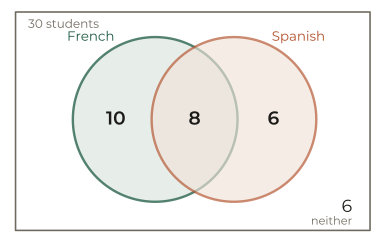
A Venn diagram splits the sample space into regions, and every region can hold a count or a probability. The rectangle around it holds everything.
Key result
The subtraction matters: adding and counts the overlap twice.
Worked example 5.1 · Reading a Venn diagram
In a class of 30 students, 18 study French, 14 study Spanish and 8 study both. A student is chosen at random. Find the probability that they study (a) both languages, (b) at least one of them, (c) neither, (d) French but not Spanish.
Fill the overlap first: 8 study both, so study only French and study only Spanish. That accounts for 24, leaving 6 who study neither.
(a) .
(b) .
(c) , which is , as it must be.
(d) .
3. Mutually exclusive and independent
These two words sound similar and mean completely different things.
Key result
Mutually exclusive: and cannot both happen.
Independent: whether happens does not change the chance of .
Why they're opposites, not partners
If two events are mutually exclusive and both have positive probability, then knowing happened tells you definitely did not. That’s the strongest possible influence, so mutually exclusive events with non-zero probabilities can never be independent.
Worked example 5.2 · Testing for independence
A fair six-sided die is rolled. is the event “the score is even” and is “the score is a multiple of 3”. Determine whether and are mutually exclusive, and whether they are independent.
and , so .
They are not mutually exclusive, since : a 6 is in both.
, so they are independent.
In context
Knowing the score is even does not change the chance that it is a multiple of 3, and vice versa.
Twenty students, two clubs. Set how many belong to each and how many belong to both, and the diagram reports whether the two events are mutually exclusive and whether they are independent.
Common mistake
To show two events are independent you must compare with and state the conclusion. Saying “they don’t affect each other” is not a proof, and neither is a diagram on its own.
4. Tree diagrams
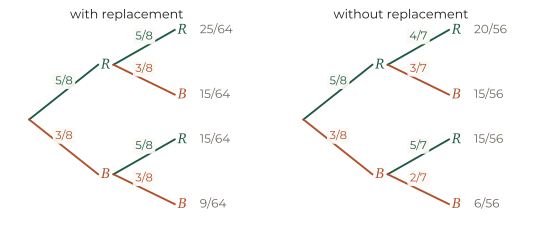
A tree diagram handles two or more stages. Each branch carries the probability of that step.
Key result
- Multiply along a path to get the probability of that whole sequence.
- Add the probabilities of every path that fits the description.
- The branches from any one point add to 1, and so do all the final path probabilities.
Worked example 5.3 · With and without replacement
A bag holds 5 red and 3 blue counters. Two are taken at random. Find the probability of one of each colour (a) with replacement, (b) without replacement.
(a) With replacement, each draw is , , and the two draws are independent. Two paths give one of each:
(b) Without replacement, only 7 counters remain for the second draw:
In context
Removing the first counter makes a second of the same colour slightly less likely, so a mixed pair becomes a little more likely: against .
On your calculator
Leave answers as fractions where you can: they’re exact, and they keep the branch arithmetic simple. Your calculator’s fraction mode will add and multiply them directly.
Common mistake
The classic slip is “at least one”. Don’t add up every path separately when the complement is quicker:
Practice
Twelve questions in three tiers. Try each one properly before opening the solution. Leave answers as exact fractions or decimals unless a question says otherwise.
Warm-up
and are mutually exclusive events with and . Find
- ;
- ;
- .
Show solution
(a) Mutually exclusive, so .
(b) .
(c) : they cannot both happen.
and are independent, with and . Find
- ;
- the probability that at least one of them happens.
Show solution
(a) .
(b) .
(Or use the complement: .)
Of 40 people at a club, 22 play tennis, 18 play badminton and 9 play both.
- Draw a Venn diagram to show this.
- Find the probability that a person chosen at random plays neither sport.
Show solution
(a) The overlap holds 9. Tennis only: . Badminton only: . That accounts for 31, so play neither.
(b) .
Explain the difference between mutually exclusive events and independent events, and give an example of each using a single roll of a fair die.
Show solution
Mutually exclusive events cannot both happen, so . For example, “the score is 2” and “the score is odd”.
Independent events do not affect each other’s probability, so . For example, “the score is even” and “the score is a multiple of 3”: .
Standard
Two fair six-sided dice are rolled and the scores are added.
- Find the probability that the total is 7.
- Find the probability that at least one die shows a 5.
- Find the probability that the total is more than 9.
Show solution
There are 36 equally likely outcomes.
(a) Six give a total of 7: (1,6), (2,5), (3,4), (4,3), (5,2), (6,1). .
(b) Use the complement. Neither die shows a 5 in outcomes, so .
(c) Totals over 9 are 10, 11, 12: three, two and one outcome, giving 6 in all, so .
A machine produces components, and each one independently has probability 0.7 of passing a test. Two components are tested.
- Draw a tree diagram.
- Find the probability that both pass.
- Find the probability that exactly one passes.
Show solution
(a) Two stages, each with branches pass (0.7) and fail (0.3).
(b) .
(c) Two paths: .
(Check: .)
For two events, , and .
- Determine whether and are independent.
- Find and .
Show solution
(a) , so and are independent.
(b) , and .
In a survey of 120 people, 54 own a bike, 72 own a car and 30 own both.
- Find the probability that a person chosen at random owns a bike or a car (or both).
- Determine whether “owns a bike” and “owns a car” are independent.
Show solution
(a) .
(b) and , so . But , so the two events are not independent.
Exam style
A bag contains 6 white and 4 green balls. Two balls are taken at random without replacement.
- Draw a tree diagram for the two draws.
- Find the probability that both are white.
- Find the probability that the two balls are different colours.
- Show that your three path probabilities add to 1.
Show solution
(a) First draw: white , green . If white was taken, the second branches are and ; if green, they are and .
(b) .
(c) .
(d) Both green: . Then
For two events, , and .
- Find .
- Determine whether and are mutually exclusive, and whether they are independent.
- Find the probability that exactly one of the two events happens.
Show solution
(a) .
(b) Not mutually exclusive, since . Not independent either, since .
(c) Exactly one means the union minus the overlap:
Two students attempt a puzzle independently. Ana solves it with probability and Ben with probability .
- Find the probability that at least one of them solves it.
- Find the probability that exactly one of them solves it.
Show solution
(a) Use the complement: neither solves it with probability , so
(b) .
A production line has three machines working independently. Each machine works on any given day with probability 0.95. The line can only run if all three work.
- Find the probability that the line runs on a given day.
- Find the probability that at least one machine fails.
- The manager says that because each machine is 95% reliable, the line must be 95% reliable. Explain why this is wrong.
Show solution
(a) , so about 0.857.
(b) , about 0.143.
(c) The line needs all three to work, and the chances multiply: , which is less than 0.95. Each extra machine is another chance to fail, so the line is less reliable than any single machine.
In context
The line stops on about 14% of days — roughly one day a week — even though each machine is 95% reliable.